Thursday Oct 22, 2026
Thursday Oct 22, 2026
Monday, 6 April 2026 05:29 - - {{hitsCtrl.values.hits}}
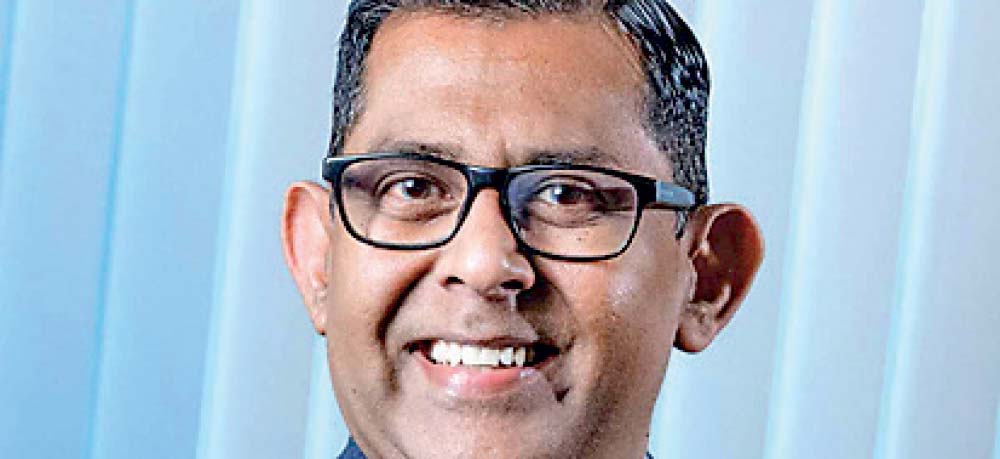
Damith Pallewatte

Chathuranga Abeysinghe
Hatton National Bank PLC (HNB) Managing Director/CEO Damith Pallewatte pushed back against criticism of high lending rates to micro, small and medium enterprise (MSMEs), arguing that current pricing reflects funding costs rather than excessive spreads during a panel exchange with Industry and Entrepreneurship Development Deputy Minister Chathuranga Abeysinghe.
The Deputy Minister questioned why banks were charging around 11% on SME loans backed by collateral and proper financial documentation when inflation remains near 2%, suggesting a wide margin between funding costs and lending rates.
“You say banks lend if there is collateral, financial records, and other documentation in order. So why do banks lend at 11% interest to SMEs when inflation is around 2% – that’s nearly a 10% spread?” Abeysinghe asked during a panel discussion at the recently held AmCham Sri Lanka CEO Forum.
Responding, Pallewatte rejected the premise. “The statement is unfounded. We lend to SMEs at 11% but we source deposits at 8-9%. Funding is expensive. If we can attract deposits at 2-3%, banks can lend at 5%,” he said.
He reiterated that collateral-backed lending reflects risk management rather than pricing advantage, noting that banks are lending depositor funds and must ensure recoverability. “Collateral is a second way out. The first is cash flow,” he said, explaining that security provides comfort against default where repayment capacity is uncertain.
Pallewatte also pointed to the absence of low-cost, long-term funding lines that previously supported concessional SME lending.
“25 to 30 years ago, banks had access to development funding, which allowed on-lending at lower rates. Those channels have largely dried up,” he said, adding that efforts are underway to restore such funding to support priority sectors.
Data from the Central Bank of Sri Lanka (CBSL) show the Average Weighted SME Lending Rate stood at 11.64% in February, against an Average Weighted Fixed Deposit Rate of 8.37%. New SME lending averaged 11.31%, while new fixed deposits were priced at 6.66%.
The Average Weighted Prime Lending Rate stood at 9.35% in the last week of March, indicating that SME borrowers continue to face a pricing premium relative to top-tier corporates.
Separately, Abeysinghe last week criticised the banking sector for withholding State-funded concessional credit to MSMEs.
He said the Government’s Rs. 95 billion MSME financing push is facing bottlenecks at the bank branch level. “Some bank branches prioritise increasing their own branch profits,” he said, adding that borrowers are often redirected towards higher-interest internal loan products or told that quotas are exhausted.
According to data posted by the Deputy Minister on social media, under the broader MSME supportive initiatives for 2026, a total of Rs. 95.686 billion has been allocated across multiple loan schemes, but only Rs. 17.492 billion has been disbursed as at 10 March 2026.
State banks have disbursed only Rs. 2.18 billion, with utilisation rates ranging from 11-18%. In contrast, several private banks have reached or exceeded their allocated limits. Commercial Bank has disbursed Rs. 1.027 billion against a Rs. 1 billion allocation (103%), HNB Rs. 1.024 billion (102%), and National Development Bank Rs. 400.286 million (100%). Other banks show mixed progress, with utilisation rates ranging from 20-96% (https://www.ft.lk/top-story/Deputy-Minister-accuses-banks-of-self-interest/26-790415).



