Thursday Sep 17, 2026
Thursday Sep 17, 2026
Thursday, 17 September 2026 05:11 - - {{hitsCtrl.values.hits}}
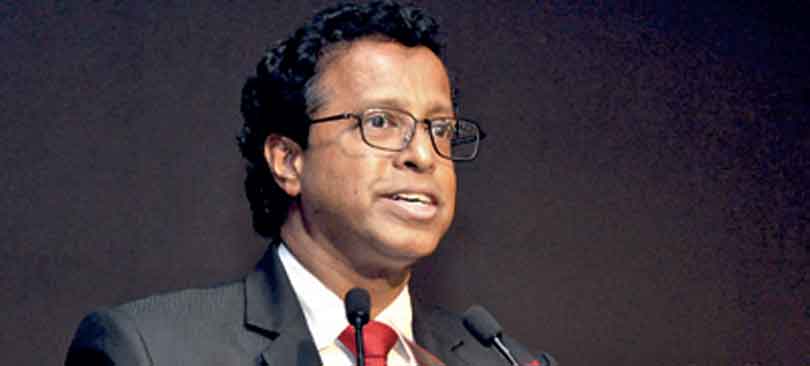
Prime Minister’s Secretary Pradeep Saputhanthri – Pic by Lasantha Kumara
By Nisthar Cassim
In a clarion call to step up good governance in the private sector, Secretary to Prime Minister Pradeep Saputhanthri this week stressed that strong institutions need leaders who understand that authority carries responsibility.
Speaking at the Sri Lanka Institute of Directors’ (SLID) 25th anniversary celebrations at the Cinnamon Grand on Monday, he also shared several useful insights to the importance of good governance, leadership, and corporate success.
He said that advancing the practice of corporate governance matters today more than ever. “Sri Lanka is undertaking important economic and structural reforms as we rebuild from the most difficult economic crisis in our recent history,” he said, adding “At the same time, artificial intelligence (AI) and other technologies are changing businesses, institutions, and the way decisions are made.”
“This is changing the environment in which leaders exercise judgement. Decisions are increasingly informed and influenced by data, algorithms, and AI. For directors, technology can no longer be left entirely to technical specialists."
It has become a question of governance, accountability, and institutional responsibility,” Saputhanthri emphasised at the SLID’s 25th anniversary celebrations chaired by Chairman Dinesh Weerakkody, past Chairpersons, and private sector leaders.
He recalled that historian and author Yuval Noah Harari has made a distinction which is particularly relevant to those who lead institutions. That is “As intelligence becomes increasingly abundant, wisdom becomes even more important.”
The Secretary to the Premier said that technology can provide information and generate answers, but it cannot decide what matters to us, which risks are worth taking, or what kind of institutions we want to build. Those remain matters of human judgement.
“What if that is where leadership and governance meet?” inquired Saputhanthri from the audience at the SLID forum.
“Strong institutions need more than capable individuals. They need accountability, Integrity, transparency, and rule of law. They need leaders who understand that authority carries responsibility,” he emphasised.
He pointed out that the Government’s efforts to strengthen integrity and governance are part of a wider national endeavour.
Noting that the quality of a country’s institutions is not shaped by the Government alone, Saputhanthri stressed that it is also shaped in boardrooms, businesses, and professional institutions.
“In an age when information itself is becoming increasingly difficult to verify, trust will depend even more on the values and conduct of our institutions. This gives directors and boards a responsibility, and that extends well beyond compliance,” he stressed. “It means understanding change, anticipating risks, and preparing institutions for challenges that may not yet be fully visible.”
Noting that good governance and performance are not competing objectives over time, he said that one sustains the other.
In that context, the Secretary to the Premier congratulated the SLID and its past Chairpersons for 25 years of developing directors, strengthening boards, and helping advance the practice of corporate governance in Sri Lanka.
“This contribution has been particularly valuable through director education, leadership development, and professional forums,” he said adding, “As the SLID begins its next chapter, I hope it will continue its good work.”
Saputhanthri also observed that times ahead will bring significant challenges as well as create new opportunities if enterprise is aligned with integrity, innovation with responsibility, and ambition with sound governance. This way, he emphasised that strong institutions can be built which are not totally successful but worthy of the trust placed.
“Ultimately, leadership is measured not only by the results we achieve, but also by the strength of institutions we leave behind for those who come after us,” he stressed.




