Friday Oct 16, 2026
Friday Oct 16, 2026
Tuesday, 10 February 2026 05:35 - - {{hitsCtrl.values.hits}}
|
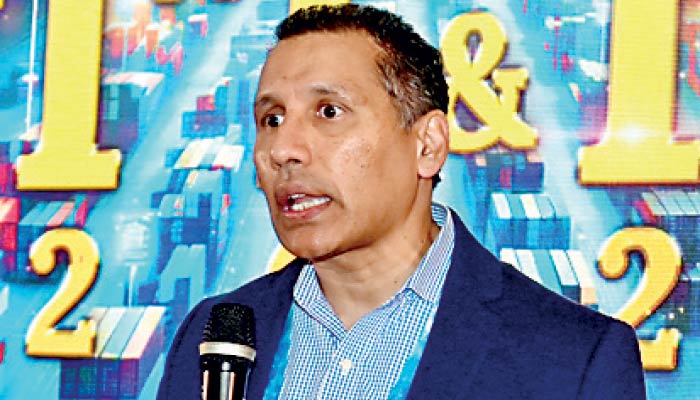
Ramana Jampala – Pic by Lasantha Kumara
|
Avlino CEO Ramana Jampala yesterday said operational efficiency, not capacity expansion, must be the starting point for modernising ports and terminals, warning that large capital investments without fixing underlying inefficiencies risk delivering suboptimal returns.
Delivering the keynote at the inaugural session of the Terminal Technology and Trade Engagement 2026 held under the Colombo Plan Maritime Advisory Program (MAP), Jampala stressed that policymaking and technology implementation must go hand in hand if ports are to remain competitive in an increasingly complex global trade environment.
“Growth is important, expansion is important. However, preceding expansion, there must be an emphasis on efficiency. If you don’t have efficiency in your personal operations, the incremental investment dollars you require to get incremental revenue will not be optimal,” he said.
Jampala cautioned against reflexively pursuing capital expenditure as a solution to congestion and delays, arguing instead that ports should first ask whether they are extracting maximum productivity from existing infrastructure, equipment, and yard capacity.
“Strive not for capex; strive for operational efficiencies,” he told the audience of policymakers, port officials, and industry stakeholders.
The Avlino CEO urged senior management in Sri Lanka’s port and maritime sector to move beyond static, rules-based systems and embrace intent-driven operations. “Earlier, predefined rules defined your business Key Performance Indicators (KPIs). Now, management should define the KPIs and the system should dynamically adapt to deliver them,” he said.
He opined that if this shift is embraced, Sri Lanka’s ports could “leapfrog three to five years” in operational maturity, aligning themselves with the most advanced terminals globally.
To illustrate the point, Jampala shared Avlino’s experience working with the Virginia Port Authority in the US, specifically at the Virginia International Terminal (VIT), one of the busiest terminals on the US East Coast. At the time, the terminal faced persistent truck queues, with 50 to 100 trucks lining up outside the gate each day.
“The solution being considered internally was to add three more lanes to the gate. That would have cost somewhere around $ 30 to $ 50 million,” he recalled.
Instead, Avlino examined the root cause of the delays and found that the problem lay not at the gate, but in how containers were stacked in the yard. Containers were being handled an average of 2.3 times before being loaded onto outbound trucks, resulting in trucks spending more than 7.5 minutes inside the terminal. “The problem had nothing to do with capex. It had everything to do with how containers were being stacked,” Jampala said.
Using machine learning and optimisation, Avlino introduced a system that predicted how long each container was likely to remain in the yard and reorganised stacking accordingly. The result was a dramatic reduction in unnecessary rehandling.
“We didn’t reduce touches from 2.3 to 2.1 times. We reduced it by 45%. Containers are now touched only 1.4 times, and truck-out time dropped from 7.5 minutes to about 4 minutes. Today, satellite images show no more than three trucks waiting outside the gate,” he said, noting that efficiency gains alone can unlock capacity that would otherwise require heavy investment.
Jampala asserted that this lesson is directly relevant to ports in the region, including Sri Lanka, particularly as terminals face pressure to grow volumes while managing costs.
He highlighted industry benchmarking reports such as the Drewry container terminal productivity rankings, expressing hope that Sri Lankan terminals could break into the global top tier in the coming years. “If we can create the right mindset – how to understand where inefficiency originates in container terminal operations – that can be the yard, the waterside, or the gate – then with the same infrastructure, we can deliver higher productivity,” he said.
Beyond efficiency, Jampala outlined what he described as a “paradigm shift” under way in terminal operations, driven by the need to balance three often-conflicting objectives: maximising throughput, maintaining profitability, and reducing turnaround times for vessels and trucks.
“Everyone wants maximum throughput. But to get maximum throughput, you tend to overutilise your equipment, and the greater the utilisation, the lower your profitability. And if you try to balance those two, turnaround time suffers,” he said.
He explained that most terminals today rely on predefined rules and configuration parameters within terminal operating systems, adjusted manually by planners in response to disruptions such as delayed vessels or equipment breakdowns. Although effective in the short term, this approach often leads to what he called “local optimisation at the expense of global efficiency.”
“You may turn a vessel around faster by dumping 600 or 800 containers into the nearest block. You solve one problem, but you create another that haunts you for the next three to five days,” he said.
The alternative, Jampala argued, lies in real-time or “runtime” optimisation, where Artificial Intelligence (AI)-driven systems continuously predict future yard conditions and dynamically adjust decisions as containers are discharged.
“The moment a container comes off the vessel, the system can predict how long it will stay in the yard, what the yard will look like three or four days from now, and where that container should be stacked to minimise future rehandling,” he explained.
This, he said, allows terminal operators to make deliberate trade-offs between throughput, equipment utilisation, and turnaround times, based on business priorities set by management. “The COO should be able to say, ‘Next week, I want higher throughput at this utilisation and this turnaround time,’ and have the operating logic change dynamically to deliver that outcome.”
Jampala emphasised that such systems do not require heavy investment in hardware, large in-house data science teams, or disruptive process overhauls. “These systems don’t replace your system of record, they partner with it to bring certainty in real time under uncertain conditions,” he added. – (CdeS)