Tuesday Oct 13, 2026
Tuesday Oct 13, 2026
Tuesday, 24 March 2026 02:25 - - {{hitsCtrl.values.hits}}
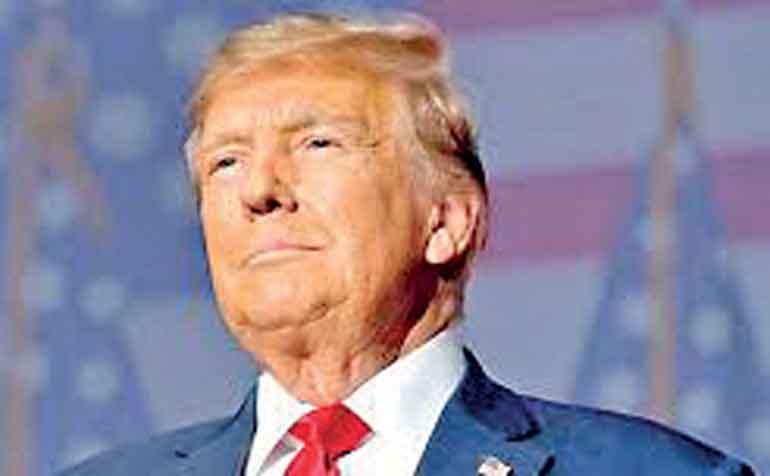
US President Donald Trump
US President Donald Trump yesterday said that he has ordered the US military to postpone strikes against Iranian power plants and energy infrastructure for five days after holding “good and productive conversations” with Tehran.
Oil prices fell by more than 13% after the announcement. Brent crude futures had fallen about $ 17, or 15%, to a session low of $ 96 a barrel by 11:08 GMT, while US West Texas Intermediate had fallen $ 13, or about 13.5%, to a session low of $ 85.28. This comes after oil prices had spiked above $ 100 per barrel as Iran’s attacks on vessels had de facto closed the Strait of Hormuz.
According to BBC, Trump said the US and Iran have held talks on the “complete and total resolution of hostilities” in the Middle East.
He said that, as a result of the talks, he has postponed threatened strikes on Iranian power plants for five days – oil and gas prices fell immediately.
However, Iranian Parliament Speaker Mohammad Bagher Ghalibaf denied talks have taken place with the US and said “fake news” is being used to “manipulate” the oil markets.
Trump later said the US side was represented by Steve Witkoff and Jared Kushner. He said if the postponement of strikes goes well, “we’re going to end up with settling this – otherwise, we’ll just keep bombing our little hearts out.”
On Saturday night, Trump had given Iran a 48-hour deadline to reopen the Strait of Hormuz, or, he said, the US would “obliterate” Iranian power plants.
Trump’s latest message is perhaps his most conciliatory since the war began, but it leaves significant unanswered questions. Earlier, UK Prime Minister Keir Starmer and Trump agreed that reopening the Strait of Hormuz is “essential to resume global shipping” during a call late on Sunday, according to Downing Street.
Box
Head:
Iranian media say no direct or indirect contact with Trump, claim he “backed down”
Iran’s Fars news agency, quoting an unnamed Iranian source, said there has been no direct contact with US President Donald Trump, “not through an intermediary.”
The source claimed Trump “backed down” after being warned that Iran would target power plants across the Gulf and in Israel.
The report added that Trump had said talks with Iran were under way, despite the source denying any such communication.
The claims could not be independently verified, and there has been no immediate comment from Iranian officials.
World in energy crisis worse than 1970s’ oil shocks combined, IEA Head says
The world is facing a worse energy crisis than the twin oil shocks of the 1970s and the fallout of the Ukraine war combined, Head of the International Energy Agency (IEA) Dr. Fatih Birol has warned.
Speaking at a media event in Australia yesterday, Dr. Birol said the energy crunch prompted by the US-Israel war on Iran exceeded the 1973 and 1979 oil shocks and gas shortages stemming from Russia’s 2022 invasion of Ukraine put together.
“This crisis, as things stand, is now two oil crises and one gas crash put all together,” Dr. Birol said in remarks to the National Press Club of Australia in Canberra.
He said the effective closure of the Strait of Hormuz and attacks on energy facilities had reduced global oil supplies by about 11 million barrels per day (bpd), more than double the combined shortfalls of the 1970s’ crises.
He said liquefied natural gas (LNG) supplies had been reduced by about 140 billion cubic metres (bcm), compared with a shortfall of 75 bcm in the aftermath of Ukraine’s invasion by Russia.
At least 40 energy facilities across nine countries have also been severely damaged in the conflict, the IEA Chief said.
“The global economy is facing a major, major threat today, and I very much hope that this issue will be resolved as soon as possible,” Dr. Birol said.
He also expressed concern that the scale of the crisis had previously not been fully understood, explaining his decision to speak publicly about the situation last week for the first time.
On Friday, the Paris-based intergovernmental organisation, which earlier this month announced plans to coordinate the release of 400 million barrels of oil from emergency stockpiles, proposed a series of measures governments could take to reduce energy consumption. The proposed measures include facilitating more remote working and carpooling, and lowering speed limits on motorways.
“I thought the depth of the problem was not well appreciated by the decision-makers around the world,” Dr. Birol said.
The IEA Chief said he was in consultation with different countries about releasing more strategic oil reserves if needed, but the “single most important solution” to the crisis was to unblock the Strait, which usually carries about one-fifth of global oil and LNG supplies.
Oil prices have surged more than 50% since the start of the war, which began with US-Israeli strikes on 28 February, amid Iran’s effective blockade of the critical waterway.



