Saturday Nov 07, 2026
Saturday Nov 07, 2026
Friday, 6 November 2026 00:36 - - {{hitsCtrl.values.hits}}
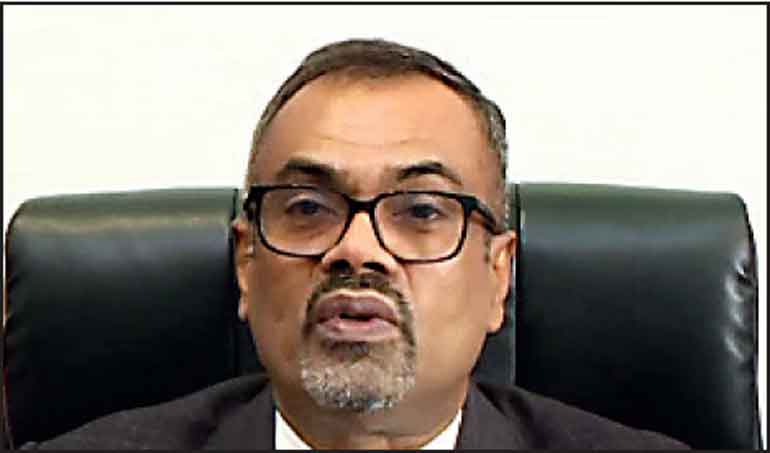
Finance Deputy Minister
Dr. Anil Jayantha Fernando
The Government has not added to the public’s tax burden and has instead moved to correct flaws in an unfair tax structure, Deputy Finance Minister Dr. Anil Jayantha Fernando said, rejecting claims by Opposition groups circulating on social media over eight recent measures.
In a statement on Wednesday, Dr. Fernando said tax revenue is the primary source of funding for education, healthcare, development activity and infrastructure, and that the Government had spent two years improving collection efficiency, tax administration and public compliance. The tax base has since widened, allowing the Government to collect more revenue in 2025 than budgeted, he said.
He described the recent claims as misleading and said they amounted to a ‘distortion of facts’.
On the 6% increase in excise duty applied in January 2025, Dr. Fernando said the change was not a new tax but an adjustment under the existing indexation mechanism, which revises rates on selected goods by adding 4 percentage points to the previous year’s average inflation rate. Based on 2024 inflation, the formula produced a 6% revision. A 14% increase was applied under the same mechanism in 2024, during the administration of Ranil Wickremesinghe.
The Government has since declined to apply the 2026 revision, exercising flexibility built into the formula, citing the economic shock caused by Cyclone Ditwah.
Dr. Fernando said revisions to customs duty on electric vehicles formed part of a restructuring of the existing tariff regime rather than an additional levy, aimed at correcting shortcomings in the structure and curbing revenue losses.
The 50% surcharge on customs duty for private vehicle imports followed pressure on the foreign exchange market and higher dollar demand arising from the conflict in the Middle East. Rather than restricting imports across the board, the Government opted for the surcharge as a short-term measure to manage outflows. He said the objective was to protect reserves and prevent shortages of essential goods, not to raise revenue.
On withholding tax, the rate deducted at source from interest income rose to 10% from 5%. Dr. Fernando said the previous arrangement had penalised people outside the income tax net, few of whom pursued refunds. Such individuals can now obtain exemption by submitting a declaration or affidavit confirming their tax-exempt status, while the 10% deducted from those liable to income tax is credited against their final assessment.
He said the corporate tax rate on alcohol and tobacco companies rose to 45% from 40% because the sectors carry a greater capacity to generate profit, describing them as ‘sin industries’ in international usage.
On service exports, Dr. Fernando said exporters of services had been shielded by exemptions and interpretations under the former tax laws, leaving an imbalance against goods exporters and domestic service providers. Service exporters have been brought into the tax net at 15% for companies, against the 30% rate proposed by the previous Government, with individuals capped at 15% instead of rates of up to 36%.
He said VAT on services supplied through digital platforms, such as ride-hailing and food delivery applications, was intended to equalise treatment with operators delivering the same services conventionally.
The 20.5% rate on financial services consolidates VAT at 18% and the Social Security Contribution Levy (SSCL) at 2.5%, both previously calculated on the same base but administered under separate documentation and procedures.
Dr. Fernando said rate changes alone were an insufficient gauge of the overall burden.
“Changes in tax rates alone should not be used as the basis for determining whether the overall tax burden has increased.”
“Attention must also be paid to fairness in the tax system, adherence to policy principles, the proper utilisation of tax revenue, and measures to prevent waste, fraud and corruption.”
He said supply of fuel, fertiliser and medicines had continued without interruption through the Middle East conflict, crediting the Government’s economic management.
The Minister’s defence rests on a revenue base that has widened quickly but is still collected weakly. Revenue has doubled to 15.4% of GDP since 2021, from 7.3%, yet VAT non-filing rose to 19.1% among non-large taxpayers and 4% among large ones between 2025 and the first quarter of 2026, while income tax non-filing reached 52.7% for corporate income tax and 67.8% for individual income tax in 2025. Tax defaults reached about Rs. 2.1 trillion at 31 December, 2025, with about Rs. 1.6 trillion under dispute.
The International Monetary Fund (IMF) has said the next phase turns on compliance rather than rates. In a diagnostic published by the Ministry of Finance, Planning and Economic Development on 30 October, 2026, its Fiscal Affairs Department said risk-based methods were not yet embedded in daily operations and that penalties available in law were applied inconsistently.
“In Sri Lanka’s case, the Medium Term Revenue Strategy (MTRS) should be seen less as a vehicle for short-term tightening and more as a platform for locking in recent gains,” the report said. It put the yield from lifting revenue administration capability to 0.55 from 0.39 on its Operational Strength Index at about 1.9 percentage points of GDP over five years, an illustrative figure, and warned that the maintenance contract for the Inland Revenue Department’s core filing and payment platform expires on 31 January, 2027 (see: https://www.ft.lk/front-page/With-gains-exhausted-Govt-must-overhaul-tax-administration-IMF/44-799541).
Investors read the fiscal position more generously. Capital Alliance Holdings PLC (CAL) Group CEO Kanishke Mannakkara told a media briefing this week that the fiscal responsibility framework must continue through the upcoming Budget and called the widening of the tax net ‘very laudable efforts’.
“The primary headwinds for Sri Lanka right now are external and geopolitical rather than structural domestic issues. Once tensions in the Middle East subside, I expect Sri Lanka and neighbouring regional markets to regain upward momentum,” Singapore-based Asia Frontier Capital Fund Manager Ruchir Desai said (see: https://www.ft.lk/front-page/SL-fundamentals-strong-for-frontier-revival--Budget-must-focus-on-fiscal-reforms-momentum/44-799571).



