Thursday Oct 15, 2026
Thursday Oct 15, 2026
Monday, 6 April 2026 05:33 - - {{hitsCtrl.values.hits}}
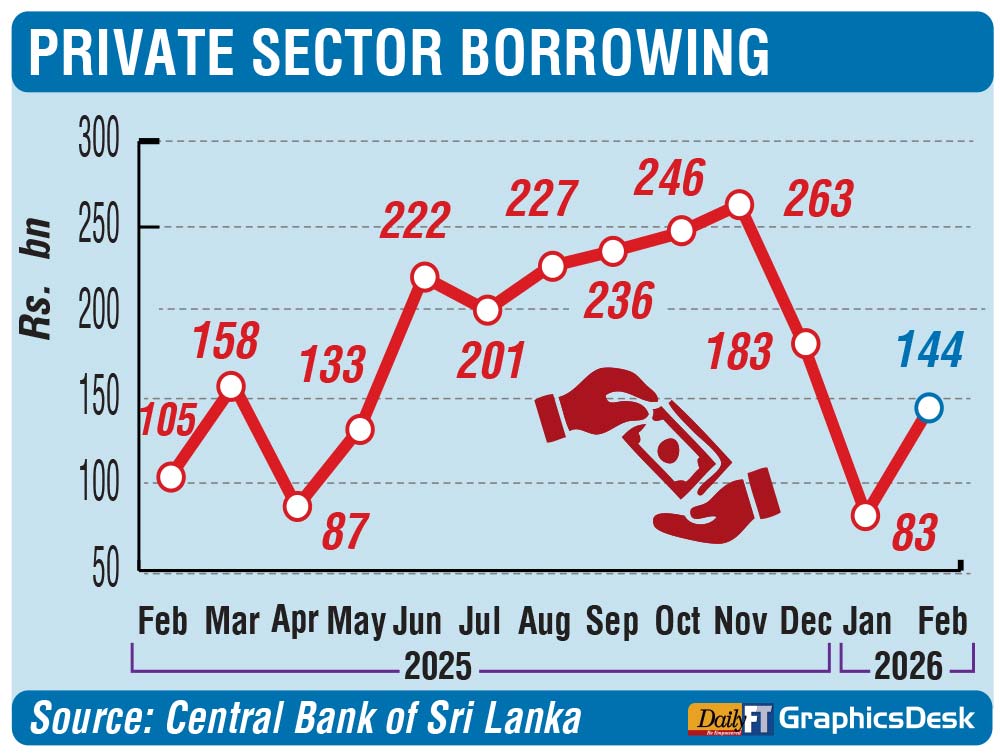 Private sector credit showed a sharp rebound in February, with fresh borrowings rising 74.7% month-on-month to Rs. 144.3 billion from a nine-month low in January, even as overall lending momentum remained below late-2025 peaks amid lingering post-Cyclone Ditwah disruptions and before the outbreak of the Middle East war.
New private sector borrowing from Sri Lanka’s banking sector slowed sharply to Rs. 82.6 billion in January, the lowest level in 11 months, extending the credit slowdown that emerged in the aftermath of Cyclone Ditwah. However, the new borrowing in February is the fourth lowest monthly figure over the past 12 months.
According to latest Central Bank of Sri Lanka (CBSL) data, new borrowings from domestic commercial banks reached Rs. 142.6 billion, recovering from the nine-month low of Rs. 108 billion in January.
Private sector borrowing from domestic commercial banks had peaked at Rs. 263 billion in November 2025, before declining to Rs. 183 billion in December 2025 and Rs. 108 billion in January, marking the third lowest monthly level in the past year. Only April 2025 (Rs. 87 billion) and February 2025 (Rs. 105 billion) recorded lower levels of new lending during the period.
Despite the slowdown in fresh borrowing, the total outstanding private sector debt stock rose 26.4% year-on-year (YoY) to Rs. 10.44 trillion by end-February.
Borrowings from domestic banks increased 28.9% YoY to Rs. 9.88 trillion. In contrast, outstanding debt from overseas banking units declined 5.5% YoY to Rs. 557.7 billion.
Meanwhile, net credit to the Government declined marginally by 1.5% YoY to Rs. 8.14 trillion, with CBSL exposure rising 2.1% to Rs. 1.75 trillion, while borrowings from domestic banks fell 2.4% to Rs. 6.3 trillion.
Bank lending to public corporations picked up in February, with new loans amounting to Rs. 14.40 billion during the month. However, the total outstanding debt from domestic banks fell 26.6% YoY to Rs. 437.2 billion as of end-February.
CBSL officials at the 25 March monetary policy briefing downplayed any concerns on the Middle East war’s impact on lending rates and credit growth.
CBSL Economic Research Director Dr. Lasitha Pathberiya has said interest rates are expected to ease, with private sector credit continuing to grow.
“Market interest rates followed a broad-based downward adjustment in spite of a short-lived uptick in November and December 2025, and [the] reduction in interest rates will continue in the months ahead,” Dr. Pathberiya said, presenting the case for holding rates at the Monetary Policy Review No. 2 of 2026 media briefing last week.
He said momentum in private sector credit was also expected to continue.
“In January, the YoY growth of private sector credit dispersed by licenced commercial banks stood at 26.3%, and in 2025, the expansion of private sector credit was at around Rs. 2 trillion compared to around Rs. 800 million in 2024,” he noted.
CBSL Governor Dr. Nandalal Weerasinghe said there were no indicators that small and medium enterprises (SMEs) required any credit relief, with no spike in non-performing loans despite escalating costs from global fuel supply shocks, with the Government introducing quotas and increasing prices by more than 30% since the Mideast war began.




