Tuesday Sep 15, 2026
Tuesday Sep 15, 2026
Wednesday, 11 March 2026 01:59 - - {{hitsCtrl.values.hits}}
By Charumini de Silva
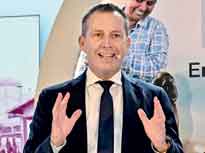 |
| Chairman and Managing Director Bernie Stefan -Pic by Daminda Harsha Perera |
Nestlé Lanka is set to invest Rs. 9 billion over the next four years to expand its manufacturing operations in Sri Lanka, signalling renewed confidence in the country’s domestic market and export potential even amid recent economic challenges.
Speaking at the celebration marking 120 years of Nestlé’s operations in Sri Lanka, Chairman and Managing Director Bernie Stefan said the investment will largely focus on strengthening the company’s manufacturing base in Pannala, with a major emphasis on scaling up export-oriented production lines such as coconut milk powder.
Nestlé’s decision to expand its operations comes at a time when many companies are cautiously navigating Sri Lanka’s economic recovery. However, Stefan said that the company’s long-standing connection with local consumers continues to underpin its confidence in the market.
“We (Sri Lanka) are 23 million people, a big city in India has the same size. But Sri Lanka remains in a strategic position within Nestlé’s South Asian region along with India and Bangladesh. What makes us proud of being here is that Nestlé brands are part of Sri Lankan lives every single day,” he told the Daily FT.
Although Sri Lanka is a relatively small market, Stefan said steady long-term growth remains achievable. “Do I believe that this market will double in a few years? No. But if we can achieve sustainable growth every year, even three to five percent, that is already a very exciting opportunity,” he said.
Reflecting on the milestone anniversary, Stefan said the company’s enduring relationship with Sri Lanka remains central to its future plans. “Over 90% of Nestlé products sold in the country are manufactured locally, which reflects our long-term integration into the Sri Lankan economy. 120 years is just a number. What truly matters is that Nestlé brands have been part of Sri Lankan lives for generations and we are committed to continuing that journey,” he added.
Stefan noted that Nestlé products are consumed extensively across the island. “Every minute, about 5,000 of our products are consumed; whether it is Milo, Nestomalt, Nespray, or Nescafé,” he said.
He explained planned investment will primarily be directed toward upgrading the company’s factory operations and expanding export-oriented production lines. “We’ve always been here to invest in this country, and we see huge potential, both in the domestic market to grow with Sri Lankan consumers, but also as an export hub,” Stefan said.
He outlined that coconut milk powder has become a fast-growing global product category, driven by rising demand for plant-based ingredients and dairy alternatives. “When you look on a global level, coconut milk is becoming an extremely hip and trendy product, especially in the West and in China,” he said.
He also said Nestlé Lanka is already the country’s leading exporter of coconut milk powder, with the product becoming a globally recognised brand originating from Sri Lanka. The company traces the innovation back nearly four decades to a Swiss factory manager who adapted milk powder technology to coconut milk.
He pointed out that the sector has also seen steady volume growth over the years. “When you look at volume growth, we have seen consistently high single-digit to low double-digit growth,” he said.
Despite restructuring trends seen in some industries ahead of global headwinds, Stefan assured that Nestlé Lanka does not plan to reduce its workforce. “We are not right-sizing. There is no need to do that,” Stefan said, adding that the company currently employs around 800 staff directly, while thousands more livelihoods depend on its wider supply chain, including distributors, farmers and service providers.
Nestlé Lanka works with over 7,000 dairy farmers supplying fresh milk and purchases around 130 million coconuts annually, supporting thousands of rural households and SMEs. “In 2025, Rs. 3.5 billion worth of fresh milk was procured,” he said.
Stefan emphasised that helping young people enter the workforce remains a key priority for the company. Through its Nestlé Needs Youth initiative, the company partners with universities and career programs to provide mentorship, internships and employment opportunities for students. “We reach around 10,000 students through university partnerships and mentoring programs,” he said.
Stefan added that many professionals who started their careers at Nestlé have gone on to succeed in other industries. “I’m always a little sad to see someone leave, but also very proud when they say, ‘I started my career at Nestlé,’” he said.
Alongside investment and employment initiatives, Nestlé Lanka is also strengthening its sustainability efforts across its value chain. Stafan announced that Nestlé Lanka also aims to become 100% plastic neutral in 2026. “For every ton of plastic we sell, we will collect one ton,” Stefan said.
The company has committed to achieving net-zero carbon emissions globally by 2050 and is implementing several initiatives locally to reduce its environmental footprint.
These include using biomass boilers and renewable electricity at its Pannala manufacturing facility and shifting some logistics operations to rail to reduce transport emissions.
Nestlé Lanka’s community engagement also extends to agricultural development programs. Through the Nestlé Coconut Development Plan, implemented in collaboration with the Coconut Cultivation Board, the company supports farmers with hybrid plantlets, fertiliser and training in regenerative agricultural practices. He said over e He 5,000 coconut growers have benefited from the program since its launch. The company has also worked with schools and environmental authorities to promote waste management awareness among young people.




