Thursday Oct 22, 2026
Thursday Oct 22, 2026
Friday, 4 September 2026 06:31 - - {{hitsCtrl.values.hits}}
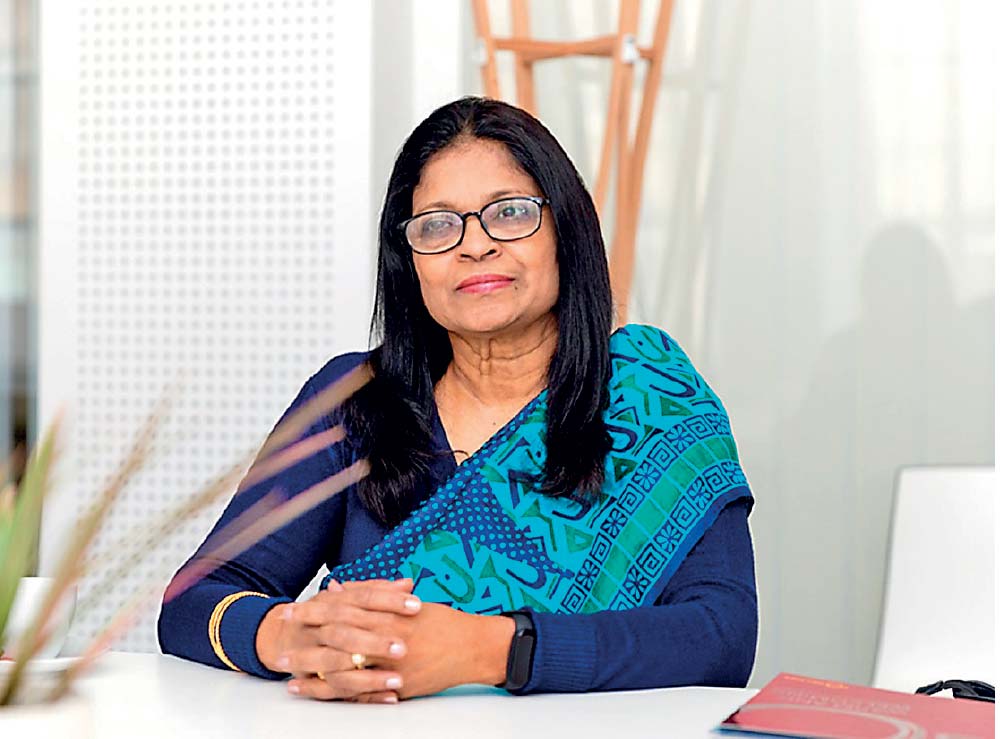
Chairperson Grace Asirwatham
The National Commission on Women (NCW) is preparing policy reforms aimed at liberating women from unpaid domestic and care responsibilities, so they can participate more fully in the economy and in politics, NCW Chairperson Grace Asirwatham told the Committee on Public Finance (CoPF).
Briefing the Committee, which was chaired by MP Ravi Karunanayake in the absence of CoPF Chairman Dr. Harsha de Silva, former Ambassador Asirwatham said the Commission’s mandate went beyond litigation and included a draft policy on unpaid work performed by women.
Asked by Karunanayake what this meant in practice, whether it implied a husband would have to pay his wife for cooking, Asirwatham said the focus was on reforms that would allow women to step out of unpaid domestic roles altogether.
“When a woman becomes pregnant, she is the one who stays home to look after the children, or the elderly, it is treated as her responsibility alone. Why can’t that be shared? Even maternity leave should be shared by the men in the household,” she said. Educated women, she added, should be freed to enter the workforce and contribute to economic development and decision-making, whether through shared care responsibilities at home or paid help.
“We have to decide for ourselves. We don’t want anyone to decide for us, that is the ultimate empowerment,” she said.
The Commission has submitted reform proposals to a Parliamentary Select Committee to facilitate greater entry of women into politics, along with submissions on Provincial Council reform, the Muslim Marriage and Divorce Act, and health policy.
Asirwatham said the NCW, established under the Women Empowerment Act, No. 37 of 2024 and constituted in September last year, had a broad mandate to empower women of Sri Lanka.
Only around one in three women of working age in Sri Lanka are active in the labour force, with the participation rate having stagnated between 30% and 36% for decades. A large share of employed women are engaged in informal, low-paying or vulnerable sectors, including agriculture, and micro, small and medium enterprises (MSMEs), while also remaining under-represented in leadership roles, occupying less than 30% of senior and middle management positions, while political representation continues to remain critically low, according to a World Bank study.
The NSW appeared before the CoPF chiefly to seek approval of a resolution on commissioners’ remuneration. Asked when the public could approach the commission directly, she said those mechanisms were still being developed, with a website, dedicated phone line and regional point-persons yet to be established.
On the limits of its role, she said: “We do not do the firefighting. If someone is hurt, it is the duty of the Women’s Affairs Ministry to coordinate and manage. We deal with complaints.”
The Commission plans to recruit around 20 staff, including Directors of Finance, Legal and Administration, and is receiving technical assistance from the United Nations and the Human Rights Commission to set up its investigation and mediation mechanisms. Its 2027 budget has been submitted through the Women and Child Affairs Ministry, under which the Commission is gazetted, with a larger operational budget expected in 2028 as regional offices are established.




