Tuesday Sep 15, 2026
Tuesday Sep 15, 2026
Friday, 12 June 2026 00:00 - - {{hitsCtrl.values.hits}}
 In recent years, the global energy industry has focused its exploration activity in the eastern hemisphere on the giant hydrocarbon provinces of the Middle East, the deepwater basins of West Africa, and, more recently, the emerging gas plays of East Africa.
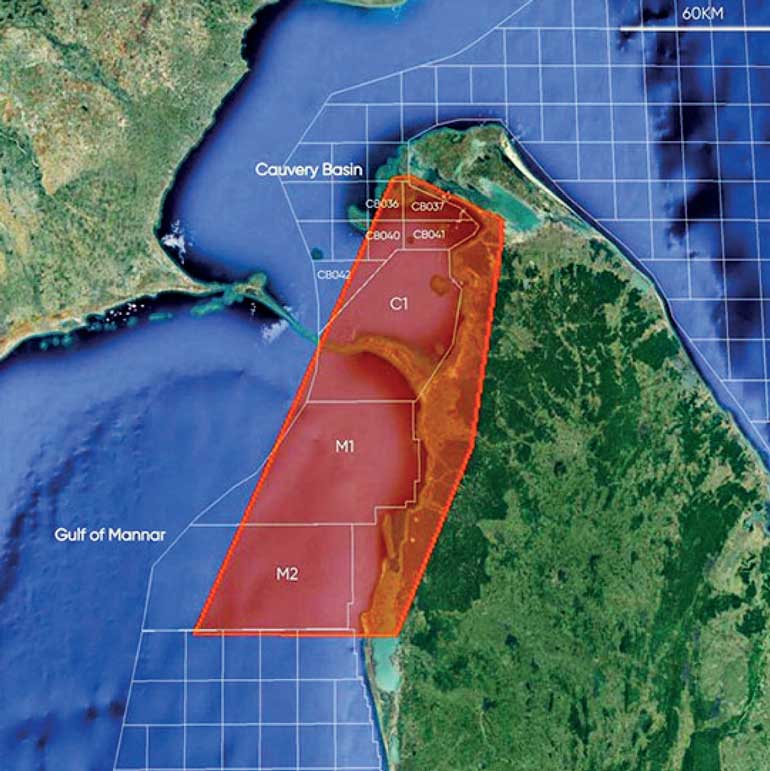
Yet, a largely overlooked opportunity exists in the heart of the Indian Ocean, adjacent to South Asia’s booming economies and at the crossroads of some of the world’s most important shipping lanes. Sri Lanka’s Mannar Basin, an offshore sedimentary basin with proven gas discoveries renewed Government focus and regulatory momentum, may represent one of the region’s most compelling energy opportunities.
At a time when energy security, regional supply diversification, and strategic infrastructure have returned to the forefront of investment decision-making, sitting alongside the drive for the energy transition, the Mannar Basin deserves renewed attention from international energy companies, investors and policymakers.
Proven basin waiting to be unlocked
Unlike many frontier areas seeking exploration capital, in Sri Lanka, there is a confirmed petroleum system to support the investment case, minimising the usual geological risk in untested waters.
The Mannar Basin, located offshore between Sri Lanka and India’s southeastern coastline, has been the subject of geological interest for nearly half a century; serious offshore exploration began in 2008 when Cairn Lanka, a subsidiary of Cairn India, was awarded exploration rights over Block M2. The breakthrough came in 2011 when Cairn drilled a series of exploration wells and made Sri Lanka’s first offshore hydrocarbon discoveries at the Dorado and Barracuda prospects.
These discoveries confirmed the existence of an active petroleum system and established the Mannar Basin as containing commercial quantities of hydrocarbons. More importantly, they validated decades of geological work and demonstrated that the basin possesses the critical ingredients for a functioning petroleum system, justifying further exploration.
Yet despite the significance of the discoveries, neither development nor further exploration followed. Global energy prices weakened, deepwater development economics became more challenging, and Sri Lanka lacked the domestic gas infrastructure required to support commercialisation. The basin entered a prolonged period of relative inactivity, despite the proven discoveries and continued interest of a select few who understood the greater potential.
Why Mannar Basin matters today
The global energy landscape has changed significantly since those discoveries were made.
Energy security has become a strategic priority for governments worldwide. Natural gas continues to play a vital role in power generation, industrial development and economic growth, particularly across Asia where energy demand continues to expand. The international community has recognised the role of natural gas in accelerating the energy transition, bridging the gap from more polluting energy sources such as coal or diesel.
For Sri Lanka, domestic gas production could reduce dependence on imported fuels, lower emissions, strengthen energy security, improve the balance of payments and support the development of new industries. Beyond upstream production, gas could underpin future investments in power generation, fertiliser production, petrochemicals, industrial feedstocks and maritime energy services.
The opportunity is therefore far larger than the development of a single gas field. It is the potential foundation for a new energy and industrial ecosystem.
Regulatory reform creates new investment framework
One of the most significant developments in recent years has occurred above ground.
Historically, investors cited regulatory uncertainty as a barrier to long-term upstream investment. Recognising this, Sri Lanka enacted the Petroleum Resources Act No. 21 of 2021, establishing a modern legal framework for petroleum exploration and production and creating the Petroleum Development Authority of Sri Lanka (PDASL) as an independent regulator.
The legislation introduced clearer licensing procedures, enhanced governance structures, stronger environmental oversight and greater transparency in resource management. Subsequent regulations governing joint studies and service providers, coupled with efforts to expand access to technical data and establish competitive licensing processes, have further strengthened the investment environment.
For international investors evaluating frontier opportunities, these developments represent an important shift. Sri Lanka is actively positioning itself to attract experienced operators and capital under a more predictable and internationally aligned regulatory framework.
Existing discoveries only the beginning
While the Dorado and Barracuda discoveries demonstrated the basin’s potential, there are industry experts who see a greater opportunity beyond the discoveries themselves.
The Mannar Basin remains remarkably underexplored by international standards. Only a small number of wells have been drilled across a basin covering a large offshore area. Advances in seismic imaging, basin modelling and geological interpretation now provide tools that were not available during the initial exploration campaigns.
The leading group to have maintained an interest in the basin is Seaway, whose technical leadership first became aware of the opportunity during the Cairn Lanka era and has continued evaluating the basin for more than a decade. The company’s work, led by experienced industry professionals Rob Jones and Rod Murray, has focused on a strategy to commercialise the existing discoveries integrated with broader exploration of the basin.
According to the team’s assessment, additional appraisal of the existing discoveries will be required to improve reservoir understanding and to optimise future development plans. However, they argue that the commercial equation extends beyond simply proving the existing reserves.
“The obvious answer to commercialisation is often presented as cutting development costs,” says Rob Jones. “Our view is different. Maintaining world-class standards of safety and environmental stewardship is non-negotiable. The more effective solution is to find additional gas resources that allow infrastructure costs to be spread across larger volumes, improving project economics for both investors and the host Government.”
This perspective is particularly relevant in Sri Lanka, where the Government participates in petroleum developments and therefore shares in project success without bearing the upfront exploration expenditure undertaken by investors.
Seaway’s evaluation suggests that significant undiscovered potential exists within the basin. Modern geological and geophysical techniques have identified a number of promising prospects and leads that warrant further investigation and may materially increase the basin’s resource base.
“While deepwater drilling is always challenging, the Mannar Basin is uncomplicated with normal pressure, compaction trends and the absence of nasties such as H2S or CO2”, remarked Rod Murray, a globally experienced deepwater project consultant
The Seaway team includes UK petroleum industry professional Fergus Kulasinghe, whose family heritage traces back to Sri Lanka, alongside Sri Lankan business leader Niro Cooke. Together with the company’s technical specialists, they have sought to connect international expertise with local stakeholder engagement and a long-term vision for responsible resource development.
As Fergus Kulasinghe notes, “For many basins, the true potential has only been understood after the initial discoveries were re-evaluated in the context of the wider basin. Mannar may well be one of those stories, and it is critical to recognise the maximum potential from the outset to optimise use of the resources.”
Window of opportunity
No responsible assessment should overlook the challenges. Offshore developments require substantial capital investment, long project timelines and policy consistency. Commercial success will ultimately depend on competitive fiscal terms, infrastructure planning and continued regulatory stability.
However, many of the conditions that previously constrained development have changed. Sri Lanka now has a modern petroleum Act, an independent regulator, improved access to technical data and a renewed commitment to attracting international investment.
For investors seeking opportunities beyond established producing regions, the Mannar Basin offers something increasingly rare in the global energy industry: proven hydrocarbons, strategic geography, improving regulation and substantial unexplored upside.
In a region where energy demand continues to grow rapidly and opportunities for meaningful frontier discoveries are becoming increasingly scarce, Sri Lanka’s offshore gas sector may prove to be not merely an overlooked opportunity, but one of Asia’s most promising energy plays.