Wednesday Sep 16, 2026
Wednesday Sep 16, 2026
Wednesday, 16 September 2026 00:24 - - {{hitsCtrl.values.hits}}
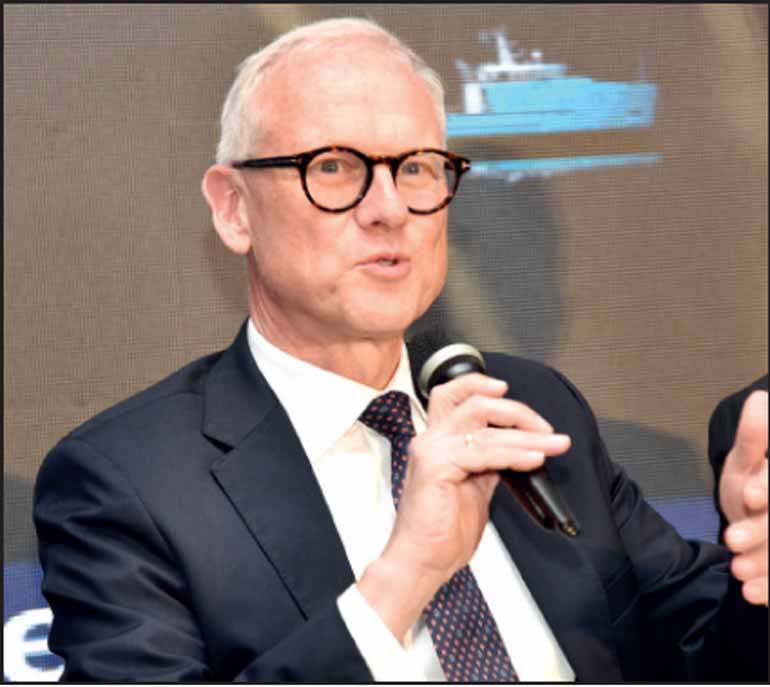
Rene Piil Pedersen
By Charumini de Silva
Sri Lanka should move beyond its traditional role as a transshipment hub and build a broader logistics ecosystem capable of capturing higher-value activities and attracting foreign investment, A.P. Moller-Maersk Singapore Managing Director Rene Piil Pedersen said.
Speaking during a panel discussion at the Colombo International Maritime and Logistics Conference 2026 last week, he said the combination of Colombo’s strategic location and stronger logistics capabilities could allow Sri Lanka to participate in far more of the global supply chain.
Pedersen, whose responsibilities span Maersk’s shipping, terminal and landside logistics operations, said the company’s role was fundamentally to enable trade with the benefits extending beyond simply moving containers through a port.
“The real transformation happens when you combine a hub with strong logistics capability. That combination creates an ecosystem far bigger than the sum of its parts, and it’s also what attracts FDI,” he said.
He pointed to Singapore, Vietnam and Malaysia as examples of markets, where the combination of port infrastructure and logistics services had created opportunities well beyond conventional transshipment.
For Sri Lanka, he said, the opportunity was to capture a larger portion of the value generated around international trade.
“Sri Lanka has the opportunity to capture a much larger share of the value chain; not just in distribution, but in value-added services,” Pedersen said.
He cited Singapore’s free-trade-zone model, where products such as Scotch whisky can be imported, stored and subsequently labelled according to the requirements of different destination markets.
“Such activities generate economic value without the country having to manufacture the underlying product. With Sri Lanka located alongside one of the world’s major shipping routes, similar opportunities existed to develop logistics and value-added services around the Port of Colombo,” he explained.
Pedersen said the immediate challenge for Sri Lanka is to translate its geographical advantage into a comprehensive maritime and logistics proposition.
“Seize the day. Sri Lanka has the opportunity to make this happen. Your geographic position and your standing as an important hub for the region and globally,” he said, noting that the FMC’s representation at the conference is a clear testament to it.




