Friday Nov 20, 2026
Friday Nov 20, 2026
Friday, 20 November 2026 00:24 - - {{hitsCtrl.values.hits}}
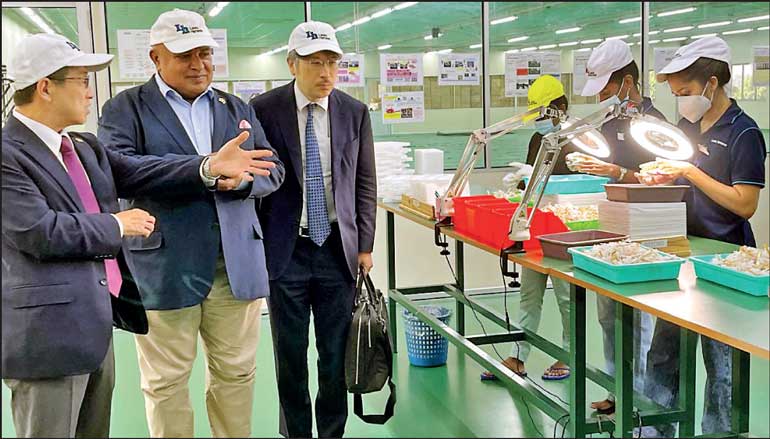
Lanka Harness Ltd., Executive President Dr. Rohan Pallewatta (centre) explaining the manufacturing process to Japanese Ambassador Akio Isomata (left) during his visit to the factory in Biyagama yesterday
Text and pix by Charumini
de Silva
Japan is keen to explore the proposed Japan-India-Sri Lanka economic corridor as a platform for export-oriented industrial development and regional supply chain integration, with Japanese Ambassador Akio Isomata identifying Sri Lanka’s high-value manufacturing capabilities as an important proposition.
Following a visit to Lanka Harness Ltd., at the Biyagama Export Processing Zone (EPZ) yesterday, Ambassador Isomata said he was pleased to witness company’s precision manufacturing capabilities and quality standards first-hand. He described the experience as “impressive”.
The proposed economic corridor, driven by Japan’s Ministry of Economy, Trade and Industry (METI) and the Japan External Trade Organisation (JETRO), is focused on strengthening export-oriented industrial and trade opportunities across the three countries.
Lanka Harness, which manufactures automotive electronic wire harness and critical safety components, including impact sensors for airbags and seatbelts, has established itself as a high-value export manufacturer supplying major global automotive companies. The company exports to 17 countries, including Japan, Indian China, Romania, while generating an annual revenue of over $ 80 million and providing direct and indirect employment to around 1,000 Sri Lankans.
Executive President Dr. Rohan Pallewatte said Sri Lanka has the potential to develop a $ 5 billion automotive components export industry, provided the country could offer investors policy consistency, competitive operating costs and targeted incentives to support export manufacturing.
“Attracting next wave of investment would depend on a predictable policy environment, competitive energy costs and incentives to expand manufacturing capacities,” he added.
He stressed that the proposed economic corridor could create significant opportunities for Japanese investors seeking access to India’s vast automotive supply chains, particularly under the Indo-Lanka Free Trade Agreement (FTA).
“As the Indo-Lanka FTA qualifying products with at least 35% domestic value addition, can access preferential market entry, providing an attractive proposition for manufacturers locating production in Sri Lanka, to serve the Indian market,” he said, adding that Sri Lanka’s FTA’s with both India and Pakistan as a strategic advantage, opening access to markets representing around one-fifth of the world’s population.
Dr. Pallewatte also noted had he recently visited around 50 companies in Japan to promote Sri Lank as a manufacturing destination, noting that the country could serve as a strategic production and supply-chain hub for investors seeking access to regional markets.
He said the company had already demonstrated that Sri Lankan manufacturing talent could meet some of the world’s most demanding automotive quality requirements, maintaining a defect tolerance of just one part per million.
“What is unique is about what we do at Lanka Harness is the quality standards. The defect rate allowed is one part per million and that is the highest standard in the world,” he said, adding that sustaining such standards over decades required rigours processes and highly committed workforce.
He credited the company’s success to locally recruited employees, many drawn from villages surrounding its factories and said the workforce had consistently showcased their capability to meet demanding Japanese manufacturing standards.
Having started with an initial investment of $ 8 million in 2002, backed by a Japanese investor, Itho Yoshiyaki, despite the country’s challenging investment climate at the time, Dr. Pallewatte said Lanka Harness Ltd., has since expanded its international customer base and manufacturing capabilities.
He said the company had recently completed a new factory with available production capacity, positioning it to accommodate additional orders from Japanese manufacturers considering Sri Lanka as an export base, including companies planning to establish operations in India.
Dr. Pallewatte also noted had he recently visited around 50 companies in Japan to promote Sri Lank as a manufacturing destination, noting that the country could serve as a strategic production and supply-chain hub for investors seeking access to regional markets.



