Thursday Oct 15, 2026
Thursday Oct 15, 2026
Monday, 9 February 2026 04:47 - - {{hitsCtrl.values.hits}}
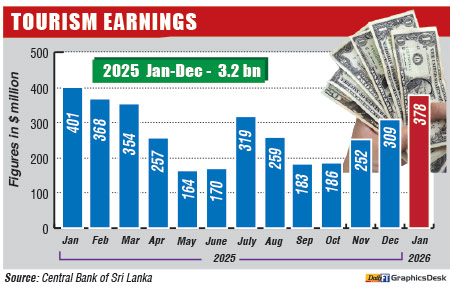 Sri Lanka’s foreign exchange earnings from tourism edged lower in January despite recording its highest-ever monthly increase in visitor arrivals, highlighting persistent pressure on per-capita spending even as the sector seeks to regain its pre-crisis footing.
Tourism revenue fell 6% year-on-year (YoY) to $ 378.5 million in January 2026, according to the Central Bank of Sri Lanka (CBSL). However, January experienced a 23% increase compared with December 2025, reflecting the winter holiday season.
The decline came despite a 10% increase in tourist arrivals to 277,327 during the month.
Although arrivals continue to recover, the latest data suggest that restoring higher-value tourism will be critical if the sector is to deliver stronger foreign exchange inflows.
Without a rebound in per-visitor spending, analysts warn that headline growth in arrivals alone may be insufficient to materially strengthen Sri Lanka’s external position.
Some analysts attribute the softer revenue performance to a downward revision in estimated daily tourist spending, which has weighed on headline earnings since August last year.
The revised estimate reduced average daily expenditure per visitor from $ 172 to $ 148, following a fresh survey conducted by the Sri Lanka Tourism Development Authority (SLTDA).
January marked the fifth decline in monthly tourism revenue over the past seven months. Earnings had weakened in July and August 2025 before recording a modest recovery in the subsequent two months, but have since remained under pressure. The trend underscores the growing gap between headline arrival numbers and actual foreign exchange generation.
Tourism accounts for nearly 3% of Sri Lanka’s economy and is a critical source of foreign currency, particularly as imports and the merchandise trade deficit gradually expand alongside the broader economic recovery.
In 2025, earnings from the sector stood at $ 3.22 billion, a marginal 1.6% increase from $ 3.17 billion a year earlier, despite a much stronger rise in arrivals.
Visitor numbers climbed 15.1% in 2025 to 2.36 million, up from 2.05 million in the previous year, reflecting improving connectivity and a gradual restoration of traveller confidence.
The Government has set an ambitious target of attracting a minimum of 3 million tourists in 2026, betting on higher volumes to lift overall receipts.
At its peak in 2018, tourism contributed close to 5% of Sri Lanka’s economy. The sector has since endured a series of shocks, beginning with the Easter Sunday terror attacks in 2019, followed by the COVID-19 pandemic and the country’s unprecedented economic crisis in 2022.




