Sunday Sep 13, 2026
Sunday Sep 13, 2026
Friday, 9 January 2026 00:23 - - {{hitsCtrl.values.hits}}
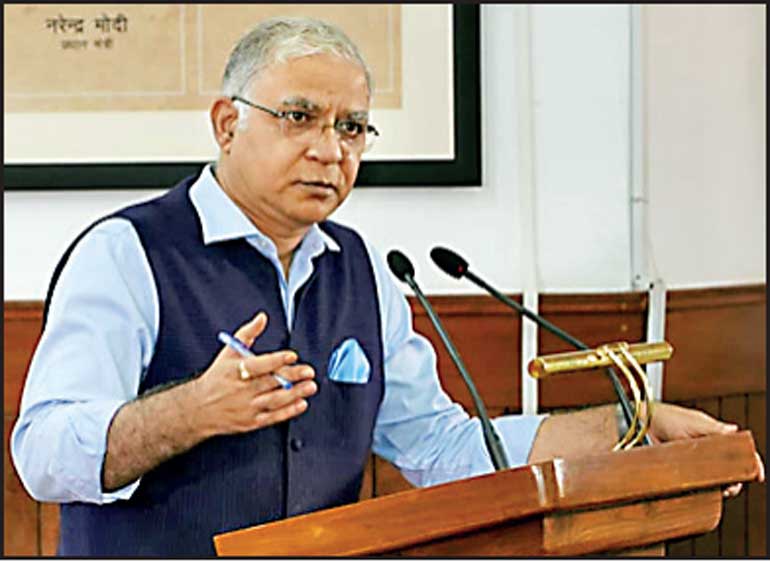
Indian High Commissioner to Sri Lanka Santosh Jha
India aims to move decisively from announcements to execution in its economic engagement with Sri Lanka in 2026, with a sharper focus on investments, connectivity, digital collaboration, and concessional financing, while awaiting Colombo’s formal position on upgrading the bilateral trade framework, Indian High Commissioner to Sri Lanka Santosh Jha said yesterday.
Addressing a press conference in Colombo, Jha underscored that Sri Lanka holds a central place in India’s regional economic strategy, describing the relationship as one of India’s most important partnerships under its Neighbourhood First approach. He said India viewed its engagement with Sri Lanka not as episodic crisis support but as a long-term economic partnership anchored in delivery and scale.
The shift was most visible in India’s $ 450 million post-Cyclone Ditwah assistance package, comprising $ 350 million in concessional lines of credit in Indian Rupees and $ 100 million in grants (in US dollars).
“It is not the announcement of the package that is that important but its implementation and delivery,” Jha said, noting that a joint monitoring and review mechanism was already operational to accelerate execution.
He said grant-funded projects were being prioritised to ensure faster roll-out, including bridge reconstruction, restoration of railway links, water purification facilities, and housing repairs, while negotiations on the concessional credit lines were being concluded in parallel. The objective, he said, was to ensure that financing translated quickly into visible economic and social outcomes.
On energy cooperation, Jha said the India-Sri Lanka power grid interconnection project had crossed a key milestone, with engineering work completed.
“The technical details have been finalised. Now we are working towards the financial modalities of implementation,” he said, adding that while post-disaster recovery had temporarily taken precedence, the commitment on both sides remained strong given the project’s economic upside for Sri Lanka.
He also said discussions were under way on positioning Trincomalee as an energy hub, with initial engagement having taken place and further talks planned. The High Commissioner said the focus at this stage was on commercially viable components, including bunkering, pipeline connectivity, and tank farm development, noting that details on structure and sequencing were still being worked through. He indicated that the initiative was being approached in phases, with emphasis on areas that could strengthen Sri Lanka’s role in regional energy logistics without overextending capital commitments at an early stage.
He clarified that proposals on physical land connectivity remained open but were dependent on Sri Lanka’s readiness to proceed. “Our proposal to the Government of Sri Lanka still is there to conduct a detailed project report process,” Jha said, noting that the initiative had originated from Sri Lanka and that further movement would depend on Colombo’s response.
On trade, Jha said India was awaiting Sri Lanka’s internal decision on whether to update the existing Free Trade Agreement (FTA) or pursue an Economic and Technology Cooperation Agreement (ECTA). “We are waiting for the Government of Sri Lanka to complete its own processes, to come forward and express their intention about moving forward in whichever direction they prefer,” he said.
He stressed that the existing FTA, which has been in force for over 25 years, had delivered measurable benefits to Sri Lanka. “If you look at just the FTA component of the trade which uses the FTA benefits, Sri Lanka has had a surplus for several years,” Jha said, adding that any update would be guided by lessons drawn from later FTAs negotiated by both countries.
Jha said Indian investment remained a cornerstone of Sri Lanka’s economy, though often understated in official statistics. “If we look at the Board of Investment (BOI) figures, approximately 25% of the foreign direct investment (FDI) into Sri Lanka in 2025 was from India,” he said, adding that once investments routed through global subsidiaries were accounted for, “approximately 40-50% of FDI inflows into Sri Lanka are from Indian companies.” He cited the West Container Terminal at the Port of Colombo, CEAT’s $ 171 million investment, and the revival of Colombo Dockyard with support from Mazagon Dock Shipbuilders as examples of sustained commercial engagement.
Beyond traditional infrastructure and trade, the High Commissioner said India was expanding cooperation in technology, artificial intelligence (AI), and digital public infrastructure (DPI). He pointed to progress on Sri Lanka’s digital identity project, which has moved into an advanced tendering stage, as well as deeper engagement between Indian technology firms, venture capital (VC), and Sri Lanka’s startup ecosystem. He said strong intent and operational collaboration, rather than new agreements alone, were driving momentum in these areas.
Reflecting on 2025, Jha described it as a year of consolidation, marked by milestones such as the ground-breaking of the Sampur Solar Power Project, the launch of the Maho–Anuradhapura railway signalling system, and substantive progress on grid connectivity. India also remained Sri Lanka’s largest source market for tourism, accounting for over 20% of arrivals and surpassing pre-pandemic levels.
Concluding, Jha said India viewed its relationship with Sri Lanka as a strategic priority with direct economic stakes for both sides. “Timing, as you would appreciate, is the essence in the post-disaster recovery phase,” he said, adding that India would continue to push for faster delivery and deeper economic and technological integration in the year ahead.




