Sunday Oct 11, 2026
Sunday Oct 11, 2026
Thursday, 23 April 2026 05:52 - - {{hitsCtrl.values.hits}}
Advocata Institute yesterday warned that the recent increase in domestic Liquefied Petroleum Gas (LPG) prices remains insufficient, effectively shifting the cost burden onto lower-income households through indirect cross-subsidies.
The economic policy think tank said the shortfall between the cost of LPG and its retail price is being covered by charging higher prices to industrial users, costs that are then passed on to consumers through higher prices of goods and services.
Advocata said:
“While Advocata Institute welcomes the recent LPG price increase by Litro Gas Lanka, it remains inadequate and indirectly forces Sri Lanka’s vulnerable segments to subsidise wealthier LPG consumers.
“This inequity arises because the retail price remains below cost-reflective levels despite the price revision. In April 2026, Saudi Aramco’s Asia-Pacific benchmark rose sharply, adding approximately Rs. 1,000–1,200 to the landing cost of a standard 12.5kg cylinder. The retail price, however, was increased by only Rs. 775, leaving a shortfall of approximately Rs. 225–425 per cylinder.
“The gap is currently covered through cross-subsidisation, where industrial users are charged higher prices than households. In practice, these costs are often passed on to consumers, as Sri Lanka’s protectionist trade regime allows local companies to do so without losing market share. As a result, households ultimately bear the burden through higher prices on everyday goods.
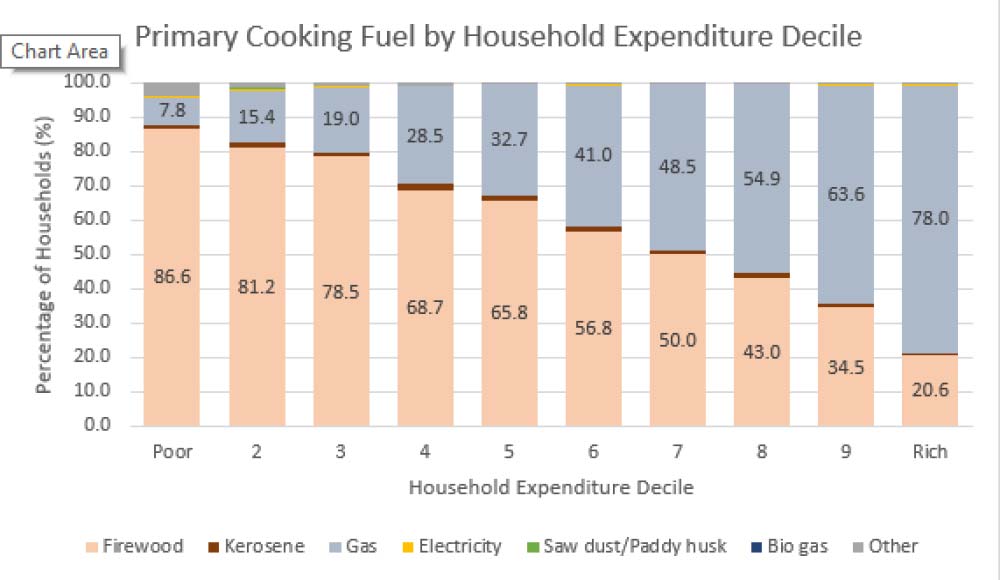
“However, the benefits of this subsidy are concentrated among higher-income households. According to the 2024 Census of Population and Housing, LPG is used for cooking by 42.4% of households nationally, while 55.4% still use firewood. The 2019 Household Income and Expenditure Survey (HIES) further shows that nearly 80% of households in the highest expenditure tier use LPG, compared to less than 8% in the lowest-income tier.
“As such, the subsidy primarily benefits wealthier households, while its costs are indirectly borne by the broader population – including those who do not consume LPG. Beyond this inequity, the cross-subsidisation model creates two economic risks.
“First, artificially low prices can discourage conservation and the transition to alternatives such as firewood and briquettes. This sustains LPG demand and contributes to ongoing pressure on foreign exchange reserves.
“Second, pricing below cost creates an artificial price ceiling. Private sector competitors, unable to match the subsidised prices, risk being driven out of the market. This discourages new entrants and limits investment in the sector.
“Advocata Institute urges the Government to replace this cross-subsidisation model with a fully cost-reflective pricing mechanism. Targeted cash transfers should be utilised to ensure that assistance reaches vulnerable households, while avoiding the inefficiencies of subsidies that disproportionately benefit higher-income groups.”




