Wednesday Sep 30, 2026
Wednesday Sep 30, 2026
Wednesday, 8 July 2026 00:22 - - {{hitsCtrl.values.hits}}
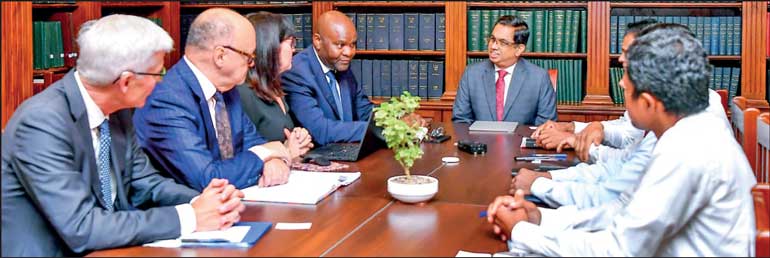
The International Monetary Fund (IMF) has reviewed progress on Sri Lanka’s public revenue reform program with the Revenue Administration Reform and Modernisation Bureau (RARMB), focusing on tax administration, Customs modernisation, digital transformation and measures to broaden the country’s tax base.
While revenue authorities have achieved record collections in 2025, and expected to exceed targets for 2026, the IMF is also focusing on governance improvements.
A special discussion between the RARMB, which operates under the direct supervision of the Presidential Secretariat to modernise Sri Lanka’s public revenue system, and the IMF was held recently at the Presidential Secretariat under the chairmanship of Secretary to the President Dr. Nandika Sanath Kumanayake.
The discussion reviewed the reforms implemented over the past year under Sri Lanka’s Medium-Term Revenue Strategy (MTRS), covering the country’s tax system, customs procedures, excise administration and the overall public revenue framework, the President’s Media Division (PMD) said in a statement yesterday.
The PMD said: The IMF delegation also held separate discussions with senior officials of the Inland Revenue Department, the Finance Ministry, Sri Lanka Customs and the Department of Excise.
The IMF representatives paid particular attention to digital transformation initiatives, accelerating data integration, human resource and leadership development programmes, and sustainable strategies to broaden the tax base. During the discussions, the RARMB was recognised as a “reform hub with a strong governance framework”.
The IMF also agreed to continue providing technical assistance and advisory support for the reform programmes being implemented at Sri Lanka Customs, the Inland Revenue Department and the Department of Excise.
The RARMB, established in early 2025 under the leadership of President Anura Kumara Dissanayake with Cabinet approval, aims to modernise public revenue collection, improve the efficiency of tax administration, implement legal and institutional reforms, and provide integrated management of the Inland Revenue Department, Sri Lanka Customs and the Department of Excise.
As part of the Inland Revenue Department’s reform programme, its branches have been reorganised into Medium Corporate, Metro and Regional Offices under a structured restructuring process. As a result, tax compliance has increased from 40-45% to 70-75%.
In addition, following several decades without major legislative reform, a draft Bill to amend the Customs Ordinance has been prepared and submitted to the Legal Draftsman’s Department. Further measures, including simplifying the tariff structure, introducing paperless processes and improving trade facilitation for exporters, are also scheduled for implementation.
Meanwhile, under the Department of Excise reform program, work is already under way to modernise the Department’s operations through the introduction of a new Excise Management System.
An integrated coordination mechanism has also been established between Sri Lanka Customs and the Inland Revenue Department under the RARMB. The mechanism is intended to facilitate data sharing, integrated risk management, joint audits and verification of importers’ tax compliance through a unified system.
The discussion was attended by an IMF delegation led by Andrew Killer of the IMF’s Fiscal Affairs Department, Revenue Administration Project Manager Cindy Negus, IMF Resident Tax Adviser to the Inland Revenue Department Greg, Canadian Senior Adviser Bob Hamilton, and senior officials of the Revenue Administration Reform and Modernisation Bureau (RARMB).



