Sunday Oct 11, 2026
Sunday Oct 11, 2026
Saturday, 21 March 2026 00:00 - - {{hitsCtrl.values.hits}}
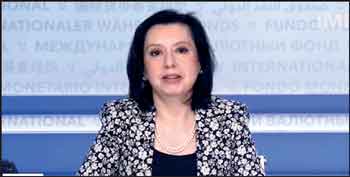 |
| Communications Department Director Julie Kozack |
The International Monetary Fund (IMF) has flagged Sri Lanka’s significant exposure to the Middle East conflict and said it will assess the potential economic impact and how best to support the country during its upcoming mission, as authorities seek to complete a combined Fifth and Sixth Review under the Extended Fund Facility program.
An IMF staff team is scheduled to visit Sri Lanka from 26 March to 9 April to hold discussions with authorities on economic policies, with the external shock from the Middle East crisis expected to weigh on the country’s near-term outlook.
IMF Communications Department Director Julie Kozack said Sri Lanka remains vulnerable through multiple external channels despite improvements in macroeconomic conditions.
“However, Sri Lanka, as noted, is exposed, significantly exposed to the conflict in the Middle East through trade remittances and tourism channels, which weighs, which can weigh or may weigh on its economic outlook with regard to what comes next for Sri Lanka,’ Kozack said.
She said the upcoming discussions will incorporate a detailed assessment of these risks and inform the IMF’s next steps under the program.
“And there the aim will be to complete a combined Fifth and Sixth Review under the program. And obviously, as part of those discussions, the team will be engaging with the authorities to better understand what could be the potential impact of the Middle East conflict on Sri Lanka’s economy. And the team, when they return, will obviously have an updated assessment of Sri Lanka’s economy and how the IMF can best support continue to support Sri Lanka,” Kozack noted.
Sri Lanka’s EFF arrangement, valued at $ 2.9 billion, remains central to its post-crisis stabilisation efforts. The successful completion of the combined reviews is expected to unlock around $ 650–700 million, subject to Board approval.
Kozack also pointed to continued progress under the program despite recent shocks, including Cyclone Ditwah, with growth strengthening and key macroeconomic indicators stabilising. The economy expanded by 5% in 2025, while inflation eased to 1.6% in February. Debt restructuring is nearing completion and gross official reserves have increased significantly.
However, the IMF indicated that evolving geopolitical risks, particularly from the Middle East, could weigh on these gains, with the upcoming review expected to provide a clearer assessment of the outlook and policy priorities.




