Friday Sep 18, 2026
Friday Sep 18, 2026
Friday, 18 September 2026 00:30 - - {{hitsCtrl.values.hits}}
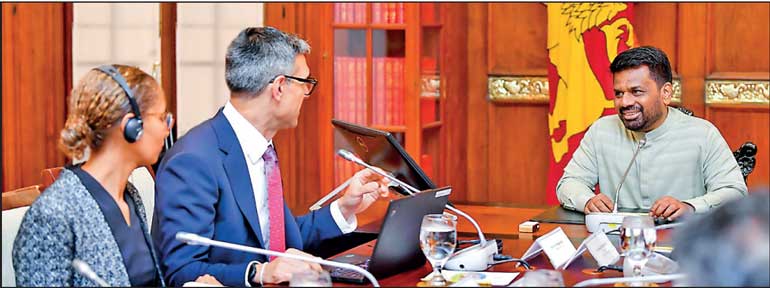
From left: IMF Resident Representative for Sri Lanka Martha Tesfaye Woldemichael and Sri Lanka Mission Chief Evan Papageorgiou with President Anura Kumara Dissanayake
The International Monetary Fund (IMF) reviewed progress on Sri Lanka’s social welfare schemes, an important deliverable under the country’s IMF-supported program, during a meeting between a visiting Fund delegation and President Anura Kumara Dissanayake.
The meeting took place yesterday at the Presidential Secretariat, the Presidential Media Division (PMD) said, but did not share specifics of the discussion on the welfare programs.
The meeting was held with a delegation led by IMF Mission Chief Evan Papageorgiou, who is in Colombo from 10 to 23 September for the Seventh Review of the country’s Extended Fund Facility (EFF) program and the 2026 Article IV Consultation.
Protecting poor and vulnerable groups has been a consistent theme across the EFF program’s reviews. At the arrangement’s approval in March 2023, the Fund welcomed the authorities’ commitment to strengthen social safety nets, including through a minimum spending floor and a new Social Registry.
Subsequent review statements through 2024 and 2025 repeatedly noted that quantitative targets were met each period except the indicative target on social spending, while the combined Fifth and Sixth Reviews concluded in April this year made continued relief measures contingent on restoring cost-recovery electricity and fuel pricing while protecting the vulnerable.
Speaking to the mission yesterday, Dissanayake said recent economic indicators showed Sri Lanka’s economy had entered a path towards stability, and that the Government’s objective was to build on that stability to move the country towards what he termed a “transformative era.” He added that the gains achieved were meant to ease and improve people’s living standards.
Dissanayake told the delegation that the IMF-backed program had provided an important foundation for achieving economic stability, which he said had also helped the country withstand the economic impact of Cyclone Ditwah and the fallout from the conflict in the Middle East. He noted Sri Lanka had recorded economic growth of 4.2% for the second quarter of this year, calling it an important sign that the economy was recovering.
Recalling the Government’s tax revenue collection over the past two years, the President reiterated that safeguarding the economic stability achieved with IMF assistance remained the Government’s objective.
Papageorgiou, for his part, said Sri Lanka had made significant economic progress under Dissanayake’s leadership, commending the country’s fiscal discipline, including higher Government revenue and increased foreign investment. He stressed the importance of sustaining the stability achieved as the country moves towards 2027 and beyond.
The difficulties faced by the public due to higher energy costs stemming from the Middle East conflict were also discussed, the PMD said.
Representing Sri Lanka at the meeting were Central Bank of Sri Lanka (CBSL) Governor Dr. Nandalal Weerasinghe, Finance, Planning and Economic Development Ministry Secretary Dr. Harshana Suriyapperuma, Senior Economic Adviser to the President Duminda Hulangamuwa, and Senior Additional Secretary to the President on Finance and Economic Affairs G.M.R.D. Aponsu.



