Monday Jul 13, 2026
Monday Jul 13, 2026
Thursday, 5 February 2026 05:42 - - {{hitsCtrl.values.hits}}
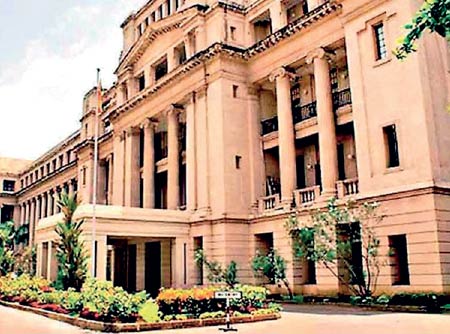 After setting tax collection records in 2025 without administrative reforms, the Finance Ministry this week announced the formal establishment of the Tax Policy Analysis Unit (TPAU) under the Department of Fiscal Policy, marking a significant institutional step towards embedding tax policy formulation within the Government’s fiscal framework.
The Ministry said the operational launch of the Unit was accompanied by a first capacity-building training program conducted by the International Monetary Fund (IMF) from 19 to 30 January, aimed at strengthening technical capacity in tax policy analysis and reform design.
Following the training program, an IMF mission team met with Treasury Secretary Dr. Harshana Suriyapperuma and the Director General of the Department of Fiscal Policy to discuss the operationalisation of the Unit and its role in supporting tax policy reforms, according to the Finance Ministry.
The Ministry said the TPAU has been set up to strengthen analytical capacity in tax policy design, appraisal, and monitoring, at a time when sustaining revenue mobilisation remains central to macroeconomic stability.
“The core functions of the TPAU include revenue analysis; economic and distributional analysis of tax policies; evaluation of tax expenditures; engagement with key stakeholders; and analysis and support on international taxation and regional and international tax cooperation,” the Finance Ministry said.
The Unit is expected to support the design, appraisal, and monitoring of tax policy reforms, an area long weakened by fragmented institutional responsibility and ad hoc decision-making.
The creation of the TPAU comes as Sri Lanka seeks to lock in revenue gains achieved during the post-crisis adjustment phase, amid concerns among investors and economists over policy reversals, weak costing of tax measures, and the erosion of the tax base through exemptions.
The structure and mandate of Sri Lanka’s TPAU broadly mirror international best practice recommended by the IMF for low- and middle-income countries seeking to build durable domestic revenue mobilisation.
In its 2017 Fiscal Affairs Department guidance, the IMF argued that effective tax systems require a dedicated, technically competent tax policy unit within the finance ministry, tasked with revenue forecasting, distributional analysis, tax expenditure evaluation, and coordination with revenue administration.
The IMF has cautioned that, in the absence of such units, governments often rely on temporary commissions, politically driven tax changes, or cherry-picked recommendations that undermine the integrity of the tax system and delay difficult decisions.
For investors, the establishment of the TPAU is viewed as a structural reform that could reduce policy uncertainty and strengthen confidence in fiscal projections, particularly as the Government seeks to balance revenue mobilisation with growth and equity objectives.
Sri Lanka set records for duties and income tax collections in 2025, but governance lapses within tax administration, including the Inland Revenue Department and Sri Lanka Customs, have been flagged in IMF diagnostic assessments.



