Thursday Oct 22, 2026
Thursday Oct 22, 2026
Monday, 8 December 2025 04:46 - - {{hitsCtrl.values.hits}}
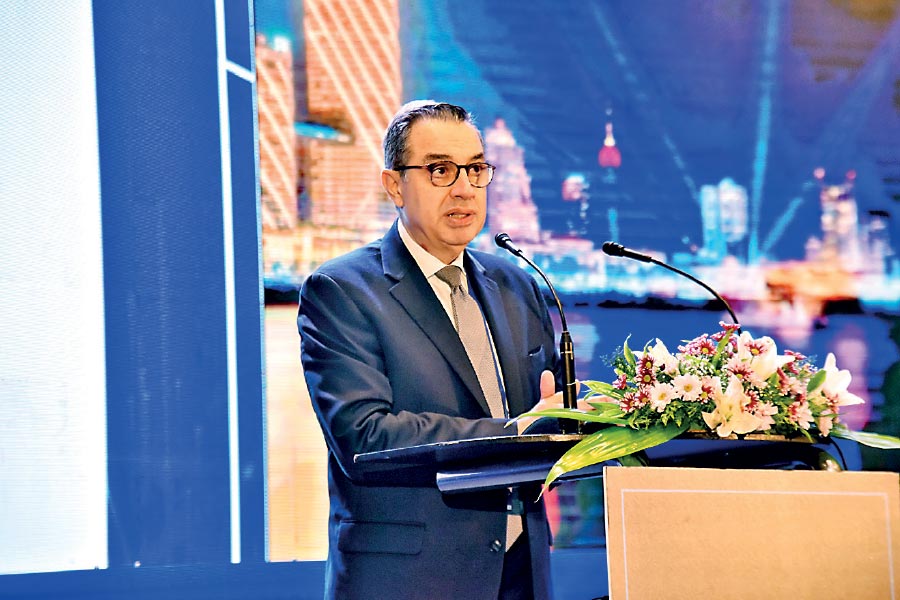
IFC South Asia Regional Director Imad Fakhoury - Pic by Upul Abayasekara
By Charumini de Silva
International Finance Corporation (IFC) South Asia Regional Director Imad Fakhoury has urged Sri Lanka to move beyond economic stabilisation and decisively enter a phase of competitive, private sector-led growth, warning that the Government’s limited fiscal room makes sustained reforms and private capital mobilisation indispensable.
Delivering the keynote at the ‘Investment Point of View’ session of the Sri Lanka Economic Summit organised by The Ceylon Chamber of Commerce, he said the country’s hard-won stability now provides a crucial opening to lift public investment, strengthen competitiveness, and scale islands of excellence in high-value sectors.
“Fiscal consolidation must not be seen as an end in itself, but as the foundation for long-term development, serving to unlock infrastructure expansion, exports, and productivity-driven growth,” he stressed.
He noted that Sri Lanka’s recovery from the crisis is built on measurable gains, including a current account surplus, exceeding International Monetary Fund (IMF) targets for the primary surplus, and a projected decline in the debt-to-GDP ratio to below 95%, ahead of the IMF’s 2032 timeline.
However, he cautioned that maintaining this trajectory is essential for foreign and domestic investor confidence, particularly as the State cannot finance the country’s development priorities alone.
“Progress achieved so far must now be followed by deeper reforms to improve the overall business environment,” he added.
He pointed to the power sector as a critical example, where unbundling of the Ceylon Electricity Board (CEB) under the broader State-owned enterprise (SOE) restructuring agenda signals improved governance and the potential to attract investment into renewable energy. He opined that Sri Lanka will require close to $ 11 billion by 2030 to meet its climate and net-zero commitments, and that predictable power purchase agreements, transparent pricing, and adherence to global environmental and governance standards are essential to draw long-term institutional capital.
He added that the World Bank Group, including the IFC, is supporting these efforts through guarantees, risk-sharing tools, and instruments designed to de-risk both equity and debt investments in the real economy.
Fakhoury underscored the need to level the playing field for both domestic and foreign investors, particularly in areas such as land access and sectoral ownership restrictions.
He called for stronger Micro, Small and Medium Enterprise (MSME) financing, highlighting a gap equivalent to 20% of GDP, and urged swift operationalisation of the new Secured Transactions Act to unlock credit for small businesses, including women-led enterprises.
Additional reforms in competition policy, labour laws, trade facilitation, and public sector governance, he said, are necessary to drive investment, enhance transparency, and reduce the costs of doing business.
Fakhoury said the direction outlined in the 2026 Budget, placing private sector-led growth at the centre, reflects an essential shift. But he noted that consistent policy, minimal reversals, and rapid implementation of the Economic Transformation Act’s key elements, including the public-private partnership (PPP), insolvency and investment protection laws, will determine whether Sri Lanka can scale investment and achieve durable growth.
He identified renewable energy, logistics, export-oriented industries, digital services, specialised manufacturing, agribusiness, and high-value tourism as the sectors with the strongest potential to propel Sri Lanka towards its ambition of 7% annual GDP expansion.
He noted that the Colombo Port’s role as a critical transshipment hub can be further strengthened by focusing on efficient port operations, expanding logistics and supply chain services, and maximising port capacity to attract global investment.
“Sri Lanka must shift decisively from an inward-focused model to an export-driven strategy through new free trade agreements (FTAs), modernised tariff policies, and smoother trade facilitation,” he stressed.
Highlighting that the country already hosts high-performing “islands of excellence” in specialised manufacturing, digital services, and niche agribusinesses, he said these should be scaled through expanded Board of Investment (BOI) and sector-specific zones, improved digital infrastructure, better STEM skills, and strong branding for premium agro-products.
Fakhoury said Sri Lanka possesses all attributes needed to become one of Asia’s premier destinations. To reach the goal of $ 8 billion in annual earnings and 4 million visitors, he called for a destination management framework that elevates high-value segments such as wellness, Meetings, Incentives, Conferences and Exhibitions (MICE), surfing, and nature-based tourism, while improving connectivity and development in the island’s east and north.
“The partnerships and consensus emerging from the two-day summit reflect a shared recognition that Sri Lanka’s future should not be defined merely by resilience, but by competitive excellence,” he said.
He reiterated that the World Bank Group and IFC stand ready to support the private and public sectors as the country seeks to consolidate its recovery, accelerate investment, and position itself as a gateway to regional opportunity.
“Sri Lanka can achieve much more than stabilisation. It can transform,” he said, urging State institutions and businesses to work “shoulder to shoulder” to turn renewed confidence into sustained, job-creating growth.




