Thursday Oct 22, 2026
Thursday Oct 22, 2026
Saturday, 13 December 2025 00:51 - - {{hitsCtrl.values.hits}}
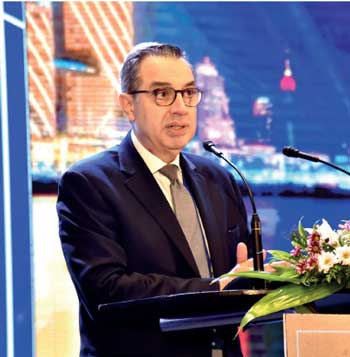 |
| IFC South Asia Regional Director Imad Fakhoury |
By Charumini de Silva
The International Finance Corporation (IFC) says Sri Lanka must reposition itself globally as a sustainable, export-driven, and outward-looking investment destination, while fixing long-standing issues around policy predictability and the business environment to unlock its full potential.
Speaking at the Sri Lanka Economic Summit, IFC’s South Asia Regional Director Imad Fakhoury outlined why the institution continues to maintain a strong and diversified presence in the country despite recent economic shocks.
“Sri Lanka cannot get rich by looking inward,” he implied, calling for a continued push toward competitiveness, investment attraction and export-oriented growth.
IFC says...
He said Sri Lanka must redesign its global investment brand after years of stop-start progress and recurring economic crises.
“Sri Lanka has an incredible paradox. On one hand, it’s a great development success story with strong social indicators, low poverty, and one of the highest per-capita incomes in South Asia. But we also have had a lot of economic crises, the last in 2022,” he observed.
Fakhoury urged policymakers and the private sector to shift the country’s international positioning. “Sri Lanka has to position itself as a green sustainable brand, as an outward-looking brand, as an export-driven brand,” he said.
He opined that this direction, supports the country’s ambition to serve as a major transshipment hub, while creating “islands of excellence” in digital services, agribusiness, specialised manufacturing and diversified tourism.
However, he noted that none of this potential can be realised without policy consistency. “The branding going forward should really pivot and focus on the brands I’ve mentioned, while working hard on policy predictability and continuously improving the doing-business environment,” he added.
He highlighted opportunities to expand high-value tourism niches, unlock new destinations in the north and east, and scale digital-services exports.
The IFC currently has a long-term finance portfolio of around $ 270 million in Sri Lanka and investments across roughly a dozen companies, in addition to a stream of short-term financing, advisory engagements and blended instruments.
“As IFC, we are an international development finance institution, the largest in the world in terms of supporting and investing with the private sector across developing regions,” Fakhoury said.
He noted that from fiscal year 2021 to the end of fiscal year 2026, the IFC’s combined long-term and short-term financing, across funded and unfunded instruments, is expected to reach $ 16 billion globally.
“We’re definitely bullish,” he said, noting that Sri Lanka remains an important part of the IFC’s South Asia strategy.
Fakhoury said IFC sees continued opportunity in strengthening financial inclusion, with a major focus on expanding financing for SMEs, MSMEs, and women-owned or women-led enterprises.
“Sustainability finance and trade finance are critical areas,” he said, adding that capital-market development and innovative financial instruments will remain high priorities in Sri Lanka.
In the real economy, the IFC is eyeing growth in agribusiness, responsible tourism, export-oriented sectors, decarbonisation of manufacturing, and value-added production, including healthcare and pharmaceuticals. “We see promising pipeline opportunities going forward,” he said.
On infrastructure, he described the organisation as “very bullish” on renewable energy, energy efficiency, mobility, ports, and logistics. The IFC is also working with the public arm of the World Bank Group to reform markets and enable private investment.
“Public-private partnerships (PPPs) will be a critical modality given the financing needs and the limitations on fiscal space,” he stressed.
He also said the IFC is additionally expanding work around technology and innovation. “Our work on helping the start-up ecosystem is significant. “We have been investing and identifying opportunities for disruptive technology startups,” he added.




