Tuesday Jul 21, 2026
Tuesday Jul 21, 2026
Tuesday, 21 July 2026 05:35 - - {{hitsCtrl.values.hits}}
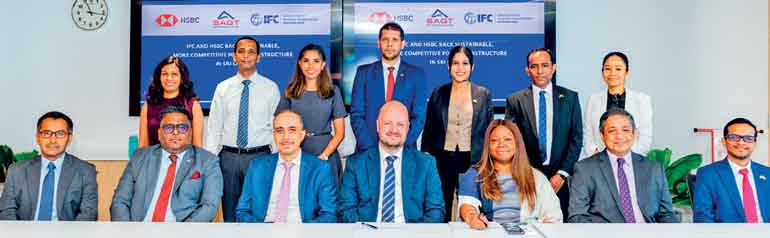
World Bank Group’s International Finance Corporation (IFC) and The Hongkong and Shanghai Banking Corporation (HSBC) are investing up to $ 40 million through financing in South Asia Gateway Terminals Ltd., (SAGT) to modernise and decarbonise operations at Port of Colombo, the cornerstone of Sri Lanka’s maritime trade.
The investment will advance the Port’s competitiveness, resilience, and sustainability, reinforcing its position as South Asia’s leading transshipment hub and deepening Sri Lanka’s connectivity to global markets. A joint statement said the financing package – a sustainability-linked loan of up to $ 20 million from the IFC, including up to $ 8.57 million mobilised through the IFC’s Managed Co-Lending Portfolio Program (MCPP), and a parallel green loan of up to $ 20 million from HSBC – demonstrates how blended private capital can finance critical infrastructure at scale.
The proceeds will fund advanced twin-lift ship-to-shore cranes that will increase productivity, improve operational reliability, and reduce energy use, enabling SAGT to meet growing trade demands with faster, more efficient services to global shipping lines.
The transaction marks the IFC’s first sustainability-linked financing for an infrastructure company in Sri Lanka and a return to the country’s ports sector after two decades.
It builds on a longstanding partnership with SAGT that began in 1999, when the IFC financed Sri Lanka’s first public-private partnership (PPP) container terminal. Since then, SAGT has helped establish Port of Colombo as one of the region’s leading transshipment hubs, setting benchmarks for operational excellence, innovation, and private sector participation in Sri Lanka’s maritime sector.
The investment is expected to raise quay-side productivity by at least 11%, expanding the Port’s capacity to handle both transshipment and domestic container traffic. It will also help lower SAGT’s carbon footprint, create jobs, and open more opportunities for women in a sector where they remain significantly underrepresented.
Sri Lanka sits at the crossroads of some of the world’s busiest shipping routes, with nearly half of global container traffic passing nearby. Port of Colombo is central to this strategic advantage, anchoring the country’s role as a regional logistics hub and underpinning an industry that contributes around 2.5% of GDP.
SAGT CEO Steen Knudsen said: “At SAGT, we are committed to shaping the future of Sri Lanka’s maritime industry through continuous investment in world-class infrastructure that drives productivity, enhances operational excellence, and reinforces Port of Colombo’s position as a leading regional transshipment hub. As the IFC’s first sustainability-linked financing for an infrastructure project in Sri Lanka, this milestone underscores our commitment to pioneering sustainable growth and setting a new benchmark for the industry.”
World Bank Group Country Manager for Sri Lanka and Maldives Gevorg Sargsyan said: “When trade moves, economies follow. As the IFC’s first sustainability-linked financing for infrastructure in the country, this investment demonstrates how innovative financing can modernise essential economic assets, accelerate decarbonisation, and drive long-term, sustainable growth.”
HSBC Sri Lanka Director Banking – Corporate and Institutional Banking Amesh Dissanayake added: “Our international reach and global expertise support us to play a prominent role in financing the transition in the sectors where it matters most. Given its strategic importance to Sri Lanka, HSBC is committed to supporting the maritime and logistics sector as it modernises and transitions to a lower-carbon future. Our parallel green loan of up to $ 20 million will enable SAGT to upgrade critical port equipment, improving productivity and reliability while reducing energy consumption and CO₂ emissions. This is an example of how sustainable finance can deliver practical, measurable outcomes.”
The investment aligns with the World Bank Group’s Country Partnership Framework for Sri Lanka and its programatic approach to ports and logistics, supporting the Government’s ambition to strengthen the country’s position as a regional logistics and transshipment hub and deepen the country’s integration into global trade networks.



