Monday Oct 05, 2026
Monday Oct 05, 2026
Friday, 21 August 2026 00:21 - - {{hitsCtrl.values.hits}}
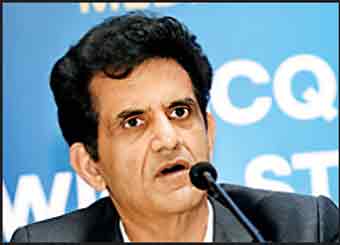 |
| Group CEO Ashish Chandra |
 |
| Executive Director Sabrina Esufally |
By Charumini de Silva
Hemas Holdings is setting its sights on Bangladesh as its next overseas growth market, following its recent entry into Kenya, as the Sri Lankan conglomerate seeks to build a wider emerging-markets footprint in consumer businesses.
Hemas Holdings PLC Group CEO Ashish Chandra said Bangladesh offered a similar investment proposition to Kenya—a large population, sustained economic growth, and rising consumer aspirations—with the group taking a five to 10-year view rather than pursuing short-term returns.
“The logic is similar to what we saw in Kenya. Bangladesh is a large and growing market, and we take a long-term view whenever we enter a country,” he told the Daily FT.
At present, Hemas’ flagship hair care brand Kumarika and personal care product Eva.
Chandra said Bangladesh’s lower per-capita income of around $ 2,500-$ 2,600 was less significant to the investment case than its strong growth trajectory.
“We continue to believe in the long-term potential of Bangladesh. We believe that as incomes rise, consumer spending and demand for personal care products will also increase,” he said.
Beauty and men’s grooming could therefore provide an initial foothold in Bangladesh, with the group positioning itself away from the highly competitive mass market and towards higher-value consumer segments.
The Bangladesh push comes as Hemas deepens its internationalisation strategy following its acquisition of a 75% stake in Kenyan stationery manufacturer Twiga Stationers and Printers for $ 16.2 million.
The Kenya transaction marked a significant step beyond Hemas’ traditional Sri Lankan base, while Bangladesh would extend the group’s emerging-market strategy into South Asia’s second-largest economy.
The group has also earmarked around $ 100 million for new investments, both locally and internationally.
Chandra said the group’s approach was not to treat overseas investments as one-year propositions, but to build businesses capable of developing over five and 10-year horizons.
Hemas Holdings ventured into Bangladesh in 2011, launching its fast-moving consumer goods (FMCG) and personal care business by setting up operations and manufacturing/distribution capabilities in the country.
As per the performance review for the 12 months ended 31 March 2026, it noted that the Value-Added Hair Oil industry in Bangladesh recorded a value growth of 3.9% year-to-date as of December 2025, although volumes declined over the same period.
Home and personal care in Bangladesh delivered revenue growth of 11% YoY in 4Q and 13% for the full year FY26. Earnings recorded an exceptional increase of over 140% YoY in FY26, although 4Q earnings declined YoY due to higher promotional activity during the period, but within budgeted expectations. Margins expanded, driven by an improved sales mix favouring higher-margin products, complemented by effective cost price controls.
Hemas Holdings PLC Executive Director Sabrina Esufally said the sheer scale of Bangladesh’s market was a major attraction, with a population of around 180 million providing a substantial consumer base despite economic and political challenges.
“If you have a young population with aspirations, people continue to spend on products that improve their lives,” she said.
Esufally pointed out that Hemas’ experience navigating Sri Lanka’s own periods of economic and political volatility could give it an advantage in other emerging markets.
“Volatile economies do not necessarily scare us,” she said, noting that the group had continued to generate returns even during difficult economic periods because underlying consumer needs and aspirations remained intact.
For Hemas, the strategy increasingly appears to be less about replicating its Sri Lankan business in individual countries and more about identifying consumer categories where rising incomes, population growth, and changing lifestyles can support sustained demand.



