Wednesday Oct 07, 2026
Wednesday Oct 07, 2026
Wednesday, 7 October 2026 05:32 - - {{hitsCtrl.values.hits}}
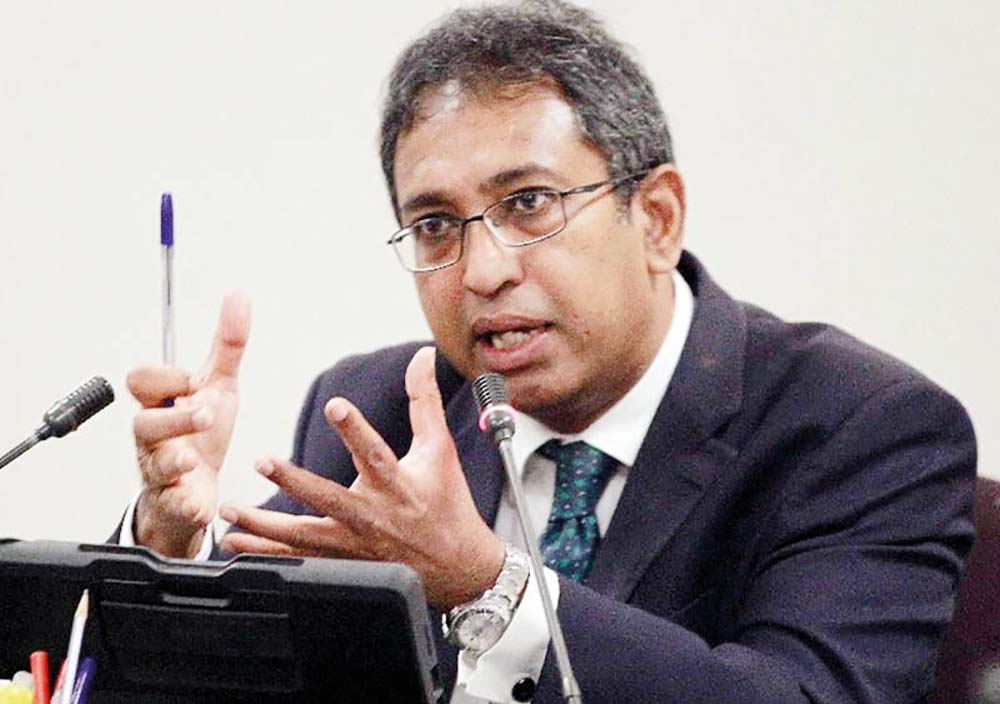
SJB MP Dr. Harsha de Silva
Samagi Jana Balawegaya (SJB) MP Dr. Harsha de Silva yesterday urged the Government to buy back part of Sri Lanka’s Macro-Linked Bonds (MLBs) before markets reprice them, claiming proactive action could save the country $ 300 million to $ 400 million over the next decade.
MLBs, issued under the 2024 sovereign debt restructuring, tie repayments to economic performance, so that bondholders recover more if GDP growth exceeds the IMF baseline. Dr. de Silva told Parliament that because growth has surpassed that forecast, total payments on the instruments would rise from $ 6.2 billion to $ 7.4 billion over the next 10 years if the Public Debt Management Office (PDMO) does nothing.
“If we wait, the market is going to reprice these Bonds, and we will no longer have an incentive to buy them back,” he said. “We have to play the market before the market plays us.”
The legal framework for such an operation already exists, he noted, pointing to the 2018 Liability Management Act he proposed as a Non-Cabinet Minister. The potential saving, he added, was about twice the $ 200 million Asian Development Bank (ADB) loan before the House.
Dr. de Silva conceded the MLB terms were unfavourable, but argued the deal had taken Sri Lanka out of default and into a stable position, and that the task now was to manage the liability efficiently. He faulted the PDMO for being slow to decide how the country would return to international capital markets.
That urgency, he argued, was underscored by a debt reduction story the Government was overstating. Public debt to GDP stood at 98% at end-2025 and was expected to fall to about 93%, a positive he said must be acknowledged. However, most of the reduction occurred between 2022 and 2024, when the ratio fell from 121%, on the back of revenue, spending and restructuring decisions taken before the present Government assumed office.
Nor, he said, was the higher-than-expected primary surplus entirely a product of discipline. Only 76% of capital expenditure was executed in 2025, and just 26% from January to August this year. “Underspending is not the same thing as fiscal reform, and it costs us growth,” he said, adding that the President’s pledge to spend over 4% of GDP on capital investment must actually be implemented.
Revenue gains were similarly flattered by one-off factors. Dr. de Silva said Rs. 900 billion, or 63%, of the Rs. 1.4 trillion revenue increase in 2025 came from pent-up demand for vehicle imports, which was not sustainable beyond this year. Citing Fitch, he said interest payments were expected to absorb about 41% of Government revenue this year, while external repayments would rise after 2028 to about $ 4 billion a year by 2030, leaving the country vulnerable to external shocks.
Against those heavy repayments, he said, new financing remained thin. Excluding the IMF, multilateral lenders disbursed only about $ 177 million in the first half of 2026: the World Bank $ 94 million, ADB $ 52 million, the Asian Infrastructure Investment Bank $ 23 million and others $ 8 million. Bilateral lenders disbursed just $ 24 million, led by Japan at about $ 14 million and India at $ 8 million, while the IMF disbursed about $ 619 million over the same period.
“Six months of near-zero bilateral inflows is not a financing strategy,” he said.
Even where funds were secured, Dr. de Silva questioned the Government’s capacity to use them. He asked how the $ 45 million budgeted this year under the $ 200 million ADB facility would be spent with 10 months already lapsed. He also termed the Finance Ministry’s $ 57.4 million ADB agreement to promote rooftop solar through virtual net metering an ‘oxymoron’, given the Government’s stated position of ending net metering. “One part of the Government can’t say we are stopping rooftop solar while another part obtains ADB funding to promote it,” he said.
Such inconsistencies, he warned, would also weigh on market access, which the recent upgrade to ‘B-‘ did not guarantee. He noted that only Fitch had upgraded Sri Lanka and that a rating of at least ‘BB’ was needed, adding that the upgrade reflected past reforms while further improvement would depend on the Government’s forward policies.
He observed that the Government had acknowledged IMF funding was conditional on the Budget conforming to the program, meaning the Government would remain aligned with the IMF throughout 2027.
Turning finally to reserves, Dr. de Silva said they had recovered but remained well below the IMF’s Assessing Reserve Adequacy (ARA) metric, with net usable reserves lower than publicly stated as they included swaps that could not be drawn on. Central Bank dollar purchases fell from almost $ 600 million in August to $ 65 million in September, he said, stressing that sustained purchases and policy consistency were essential to improving ratings and regaining market access.



