Tuesday Oct 20, 2026
Tuesday Oct 20, 2026
Tuesday, 7 July 2026 04:34 - - {{hitsCtrl.values.hits}}
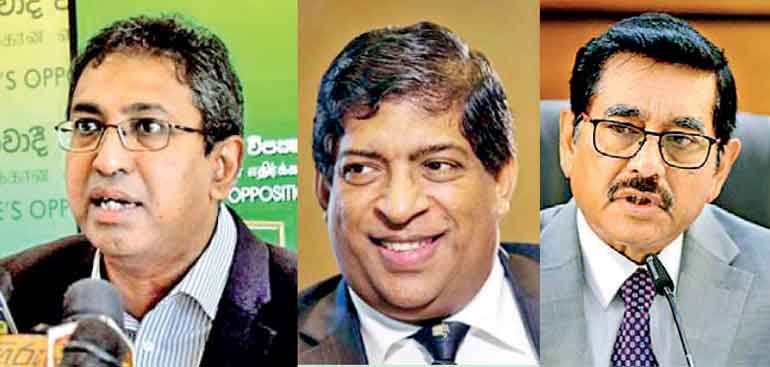
CoPF Chairman MP Dr. Harsha de Silva, UNP MP Ravi Karunanayake, CBSL Governor Dr. Nandalal Weerasinghe
The Parliamentary Committee on Public Finance (CoPF) last week pressed the Central Bank of Sri Lanka (CBSL) over whether the country’s anti-money laundering and counter-terrorism financing framework is becoming more expansive than necessary, with lawmakers questioning whether successive legal amendments risk extending regulatory powers beyond what is required to meet international standards.
The discussion took place as the Committee considered several Bills and regulations aimed at strengthening Sri Lanka’s compliance with the standards of the Financial Action Task Force (FATF), the global body that sets benchmarks for combatting money laundering and terrorist financing.
CBSL and legal officials argued that the reforms are driven not by a desire to widen State powers but by the need to satisfy increasingly demanding international assessments and avoid the economic consequences of renewed grey-listing.
CoPF Chairman Dr. Harsha de Silva questioned whether some of the proposed legislative language went beyond what was strictly necessary to meet FATF obligations, referring to concerns raised by civil society groups, including the potential impact on individual liberties. While acknowledging the importance of strengthening the legal framework, he asked whether sufficient consideration had been given to ensuring that innocent individuals would not be unfairly affected by broad criminal provisions.
CBSL and legal officials responded that the legislation largely reflected obligations arising from international conventions and evolving UN standards, particularly following concerns over foreign terrorist fighters after the 2019 Easter Sunday attacks.
They added that concerns raised by petitioners had already been considered, with committee-stage amendments proposed to other related legislation following observations by the Supreme Court.
CoPF member MP Ravi Karunanayake widened the discussion by questioning whether Sri Lanka had become overly focused on incorporating every international recommendation into domestic law without giving sufficient weight to national priorities.
He argued that Parliament should carefully consider whether the country was legislating beyond what served its own interests, noting that previous debates had already highlighted the risk of “technical defaults” arising from excessive regulatory obligations.
Karunanayake repeatedly asked officials who Sri Lanka was ultimately seeking to satisfy through the expanding legislative framework and whether domestic interests should take precedence over international expectations.
Officials from the Attorney General’s Department and the Financial Intelligence Unit replied that FATF assessments have entered a new phase.
Unlike previous mutual evaluations, which focused largely on whether appropriate laws existed, the current review cycle places greater emphasis on effectiveness, examining the number of investigations, prosecutions, convictions, and asset freezes carried out by authorities.
They said merely having legislation in place would no longer be sufficient to satisfy assessors. Authorities would now be expected to demonstrate that the framework is being actively enforced.
When Karunanayake questioned why Sri Lanka should attach so much importance to FATF compliance, officials stressed that virtually every jurisdiction is expected to implement the organisation’s recommendations and that failure to do so carries significant financial consequences.
They noted that grey-listing increases scrutiny of cross-border financial transactions, raises compliance costs, and affects the country’s international financial reputation. Officials also outlined the latest FATF blacklist and grey list, emphasising that countries now face a more demanding process both to avoid and to exit enhanced monitoring.
CBSL Governor Dr. Nandalal Weerasinghe said the primary objective was to protect Sri Lanka from the economic damage associated with renewed FATF sanctions rather than to satisfy external demands for their own sake.
He said the experience of previous grey-listing episodes demonstrated the significant costs imposed on the economy and financial system, making continued compliance an important national interest.
Dr. de Silva acknowledged the economic importance of avoiding another grey-listing, recalling the extensive effort required for Sri Lanka to secure its removal in the previous review cycle. While indicating the Committee would approve the measures before it, he maintained that Parliament should continue to balance stronger enforcement powers with appropriate safeguards for civil liberties.




