Thursday Oct 15, 2026
Thursday Oct 15, 2026
Tuesday, 28 July 2026 04:34 - - {{hitsCtrl.values.hits}}
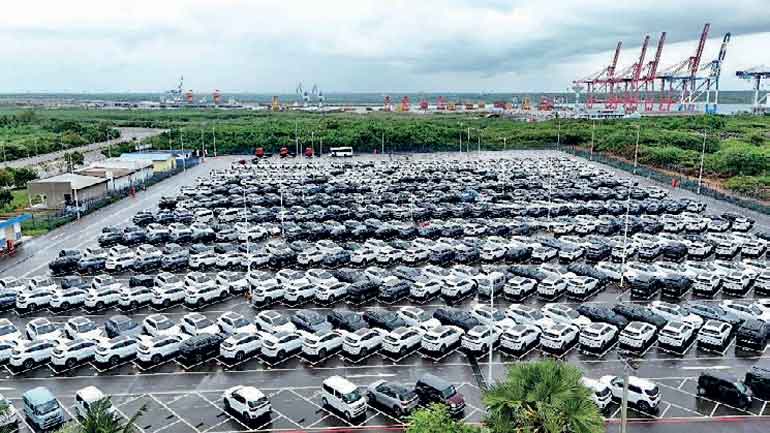
Hambantota International Port Group (HIPG) yesterday defended its vehicle storage policy, saying long-term storage at the Port reflects legacy vehicle import restrictions and clearance delays rather than a reliance on storage charges, as it continues to handle growing roll-on/roll-off (RORO) volumes.
The Port said more than 50,000 vehicles are currently on site, but only 1,278 locally imported vehicles have remained for over three months and 581 for more than a year, with most of the latter imported before Sri Lanka resumed vehicle imports in 2025 or dating back to the period of the import ban.
In a statement, HIPG said: “While all of these vehicles are from the local imports sector, the majority of vehicles lying in the Port for over a year are linked to legacy market conditions created by Sri Lanka’s vehicle import restrictions.
Of the 581 vehicles that have remained at the Port for more than one year, around 400 were imported before Sri Lanka resumed vehicle imports in 2025.
A further 175 vehicles date back to the period before the vehicle import restrictions were introduced in 2020, while 178 vehicles have remained at the Port since before HIPG assumed management of Hambantota Port in December 2017.”
HIPG stressed that the Port’s business is built on the efficient movement of cargo, not on earning revenue from storage charges.
“Ports are designed to facilitate cargo movement, not to serve as long-term vehicle storage yards. Every vehicle that remains in the Port for months or years occupies valuable operational space required to handle new cargo and support the continued growth of Sri Lanka’s automotive logistics sector,” it said.
Unlike many ports in the region, HIPG provides one of the most customer-friendly storage policies available. Import cargo receives 10 days of free storage, with charges commencing only from the 11th day, while transshipment cargo benefits from 21 days of free storage, with charges applicable only from the 22nd day. Before HIPG assumed management of Hambantota Port, customers were provided with only three days of free storage.
The Port explained that delays in cargo clearance often arise due to documentation issues, banking procedures, financing arrangements, and other administrative matters beyond the Port’s control. As a result, vehicles may remain within the Port for extended periods, creating storage accumulation and reducing the operational capacity required to accommodate increasing RORO volumes.
HIPG emphasised that storage charges are an operational management tool designed to encourage timely cargo clearance and efficient utilisation of limited Port space, not a revenue-generating mechanism.
The Port has consistently demonstrated flexibility during exceptional market conditions. During the vehicle import restrictions and subsequent cross-border disruptions, thousands of vehicles remained at the Port for several months. HIPG granted substantial demurrage waivers and concessions regardless of whether customers subsequently re-exported their vehicles or cleared them into Sri Lanka, resulting in a significant financial sacrifice by the Port.
Similarly, during recent disruptions affecting vehicle transshipment through the Gulf region, HIPG introduced a storage cap mechanism to prevent storage charges from increasing beyond reasonable levels relative to vehicle values.
“These initiatives prove our commitment to supporting customers during exceptional circumstances while ensuring the Port continues to operate efficiently. Our objective has always been to generate value through cargo handling and logistics services, not through long-term storage charges,” the statement said.
HIPG noted that all waivers, concessions, and special storage arrangements are considered individually and approved directly by Port management, taking into account prevailing market conditions and customer circumstances.
The Port reiterated its commitment to working closely with Sri Lanka Customs, importers, and all industry stakeholders to resolve outstanding legacy cases while maintaining the efficient cargo flow necessary to support Sri Lanka’s trade and economic growth.




