Friday Sep 18, 2026
Friday Sep 18, 2026
Friday, 18 September 2026 00:26 - - {{hitsCtrl.values.hits}}
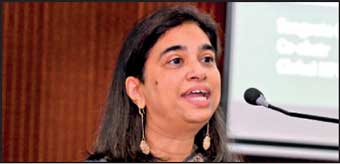 |
| Global NPO Coalition on FATF Co-Chair Sangeeta Goswami |
 |
| Neelan Tiruchelvam Trust Chairperson Ambika Satkunanathan |
Global NPO Coalition on FATF Co-Chair Sangeeta Goswami yesterday said Sri Lanka, like most countries undergoing a Financial Action Task Force (FATF) Mutual Evaluation on anti-money laundering and countering the financing of terrorism (AML/CFT) standards, is prone to over-compliance, adopting restrictions well beyond what the FATF standard actually requires out of desperation of being placed on its grey list.
Goswami said the FATF’s Mutual Evaluation process carries significant consequences for non-compliant countries, including reduced access to correspondent banking relationships and diminished international assistance, making governments “desperate” to avoid an adverse finding. In that desperation, she said, governments often fail to properly understand how the non-profit sector actually operates, resulting in a mix of unintended and, in some cases, intended consequences for civil society.
She said this overreach stems partly from a lag in how governments and financial institutions have adapted to changes in the FATF’s own standards. Recommendation 8, the FATF rule governing non-profit organisations, was revised in 2016 to move away from presuming the entire sector was vulnerable to terrorism financing, replacing a blanket approach with one requiring risk-based, sector-specific assessment. Most non-profits in any given country are now assessed as low risk under the revised standard, she said.
Despite this shift, Goswami said oversight of the non-profit sector globally has continued to be shaped largely through a security and counter-terrorism financing lens over the past 25 years, with laws, regulations, and institutions revised to comply with a framework whose underlying logic has since moved on.
She said banks, too, have been slow to recalibrate: absent clear, differentiated risk signalling from government and central bank supervisors, financial institutions continue to apply blanket caution to non-profit clients rather than the simplified due diligence the revised standard now permits for low-risk cases.
Goswami said the core task facing countries such as Sri Lanka undergoing evaluation this year was to “socialise” the revised, proportionate approach among regulators, banks, and policymakers, rather than continuing to operate under assumptions the FATF itself has since revised.
Delays caused by banks’ blanket caution towards non-profit clients, rather than case-by-case risk assessment, have held up humanitarian transfers with direct human cost, Goswami said at the launch of the Sri Lanka Civil Society FATF Shadow Report.
Providing Sri Lankan context, Neelan Tiruchelvam Trust Chairperson Ambika Satkunanathan said civil society organisations in Sri Lanka have for decades been labelled corrupt or opportunistic by successive governments, through rhetoric she said was aided by Government-aligned media portraying NGOs as foreign agents profiting from crisis.
She said this narrative has intensified since 2023, with the FATF framework increasingly cited to justify laws and practices aimed at controlling civil society groups that scrutinise Government action and corruption.
Satkunanathan pointed to the killing of two children by a grenade thrown into a house last week, in a case of mistaken identity linked to an alleged conflict between groups involved in drug trafficking, saying the incident was being exploited to justify repressive financial-crime measures rather than addressing the actual failure to prosecute organised crime.
She said that failure stemmed from a lack of political will, given the involvement of politicians, officials, and Police in enabling money laundering and drug trafficking, rather than from any deficiency in existing law.
She argued that laws must include safeguards against wrongly penalising innocent persons in pursuit of serious offenders, questioning what would happen if an individual’s bank accounts were frozen without a court order based on mistaken suspicion, leaving them unable to meet basic needs or defend themselves before ever being informed of a hearing. Courts, not Police, should determine guilt or innocence, she said.
Satkunanathan said Sri Lanka’s civil society had historically played a documenting and accountability role during periods of State human rights violations, and had stepped in to deliver support during natural disasters, the COVID-19 pandemic, and the 2022 economic crisis where Government response fell short.
She said many changes to law and practice presented by the Government as necessary for FATF compliance in fact violate FATF standards, a distinction with direct economic consequence: non-compliance or partial compliance findings from the FATF can raise Sri Lanka’s borrowing costs, restrict its relationships with international banks, and subject it to higher compliance costs and increased monitoring, affecting the banking sector and wider economy.
It was for these reasons, she said, that civil society organisations submitted a shadow report to inform the FATF’s Mutual Evaluation of Sri Lanka, in the hope of encouraging measures that genuinely adhere to FATF standards rather than diverge from them.
Goswami, meanwhile, said banks were made gatekeepers under the FATF framework, required to screen customers and transactions for money laundering and terrorism financing risk, with lapses carrying heavy fines and reputational damage. She said compliance functions at some banks now account for as much as a fifth of total staff, reflecting a broader shift of regulatory risk from Government to the private sector.
In the absence of a robust, differentiated risk assessment from Government, Goswami said, banks tend to apply blanket, undifferentiated caution to non-profit clients.
Given non-profit clients are typically less profitable than commercial customers, she said banks often find it easier to introduce friction into transactions or exit non-profit banking relationships altogether, rather than absorb the compliance cost of case-by-case assessment, a pattern she said had delayed humanitarian remittances to the point where funds intended for time-sensitive relief work sometimes arrive too late to be of use.



