Sunday Oct 04, 2026
Sunday Oct 04, 2026
Saturday, 27 June 2026 01:09 - - {{hitsCtrl.values.hits}}
 Tables Fiscal Strategy Statement under Public Financial Management Act
Outlines 2027 fiscal strategy, revenue plans, expenditure priorities and fiscal risk assessment
Minister Dr. Anil Jayantha rejects claims that new VAT measures impose fresh taxes on SMEs
Clarifies digital tax amendments target non-resident service providers to ensure equal treatment
By Charumini de Silva
|
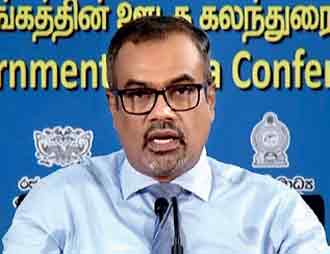
Finance and Planning Deputy Minister Dr. Anil Jayantha Fernando |
The Government yesterday formally presented its Fiscal Strategy Statement to Parliament, setting out the policy framework that will underpin the 2027 Budget while reaffirming its commitment to fiscal consolidation, revenue mobilisation and transparent public financial management as the country continues its economic recovery.
Addressing a media briefing, Finance and Planning Deputy Minister Dr. Anil Jayantha Fernando said the statement was tabled in accordance with the Public Financial Management Act No. 44 of 2024. It is a new statutory requirement that must be presented before 30 June each year, outlining the Government’s fiscal strategy for the following year together with an assessment of risks that could affect public finances.
He described sound public financial management as one of the pillars of sustaining economic stability, stressing that without adequate Government revenue, “the country would really lead to a collapse situation.”
“The statement consists of two key components. The first outlines the Government’s fiscal strategy, including revenue mobilisation measures and expenditure priorities that will form the foundation for next year’s Budget. The second provides a comprehensive assessment of fiscal risks, covering both domestic vulnerabilities and external economic threats, together with the strategy to manage them,” he explained.
Dr. Fernando said the document is intended not only for policymakers but also for the general public, adding that it would be published on the Finance Ministry’s website to enhance transparency and allow citizens to evaluate the Government’s fiscal strategy and governance framework.
The Deputy Minister also countered what he described as widespread misinformation surrounding several tax amendments recently presented in Parliament, particularly changes relating to Value Added Tax (VAT), digital services and financial services taxation.
Rejecting claims that the Government had introduced a new tax burden on small and medium-sized enterprises (SMEs), Dr. Fernando clarified that VAT is ultimately paid by consumers rather than businesses, with enterprises merely acting as collection agents throughout the supply chain.
“The misleading information is that we have imposed a ‘new tax’, especially on SME entrepreneurs. No, it is wrong,” he said.
He insisted that the Government’s objective is to gradually bring businesses involved in manufacturing, wholesale and retail trade into a more comprehensive VAT registration network, enabling firms to claim input tax credits while improving fairness and reducing leakages in the tax system.
However, acknowledging current business conditions, Economic Development Deputy Minister Nishantha Jayaweera said the Government had decided to temporarily postpone the reduction of the compulsory VAT registration threshold from Rs. 60 million to Rs. 36 million, allowing affected businesses additional time to prepare for the new compliance requirements following recent economic disruptions.
He stressed that other tax administration reforms aimed at improving compliance, digitalisation and efficiency would proceed as planned.
Addressing concerns over so-called “digital taxes”, Dr. Fernando dismissed claims that the Government had imposed a tax on software or digital businesses.
Instead, he said the amendment merely extends VAT obligations to non-resident providers of digital services supplied to Sri Lankan consumers through electronic platforms, ensuring equal treatment between overseas providers and resident businesses already subject to VAT.
“What we have done is increase fairness,” he said, noting that detailed implementation guidelines would be issued by the Inland Revenue Department (IRD).
Dr. Fernando also clarified amendments relating to VAT and the Social Security Contribution Levy (SSCL) applicable to financial service providers, explaining that the changes simply consolidate the two applicable tax rates into a combined 20.5% calculation for ease of administration rather than introducing an additional tax burden.
He accused critics of misrepresenting the amendments and creating unnecessary public concern through social media.
“I take the opportunity to tell the general public not to be misled by this wrong information. Always follow proper and authentic information, which is publicly available,” he said.
Reiterating the Government’s broader economic priorities, Dr. Fernando said maintaining fiscal discipline, strengthening revenue administration and adhering to good governance principles remain essential to safeguarding macroeconomic stability and keeping Sri Lanka’s recovery on track.
“We have understood that one of the key factors in stabilising the country and taking the economy towards our objective is the quality of public financial management,” he said.