Tuesday Sep 15, 2026
Tuesday Sep 15, 2026
Monday, 9 March 2026 06:42 - - {{hitsCtrl.values.hits}}
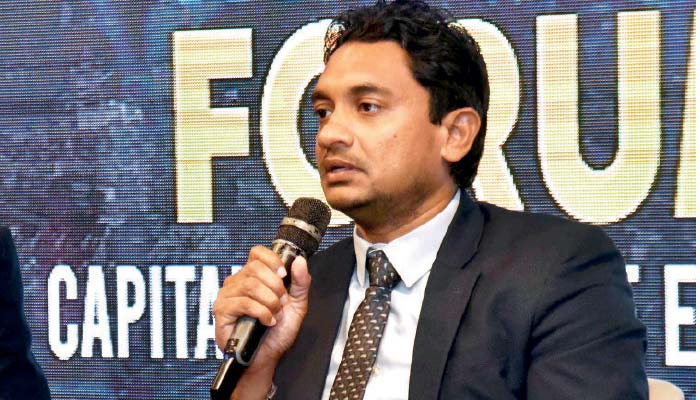
Industry and Entrepreneurship Development Deputy Minister Chathuranga Abeysinghe – Pic by Upul Abayasekara
By Charumini de Silva
The Government will maintain cost-reflective pricing for fuel and electricity despite rising global oil prices triggered by tensions in the Middle East.
Speaking during a panel discussion at the LOLC Securities Forum, Industry and Entrepreneurship Deputy Minister Chathuranga Abeysinghe said that the Government will avoid returning to policies that burden State institutions and public finances.
He acknowledged that global oil price spikes during geopolitical crises are largely unavoidable and will have to be absorbed by the economy in the short term. “This is an inevitable situation. Oil prices generally shoot up when something happens in the Middle East,” he said.
He said the Government will not intervene to artificially lower fuel prices through State institutions such as the Ceylon Petroleum Corporation (CPC), reiterating that energy prices will remain aligned with global costs.
“Everything will be cost-reflective. As a society and as a country, we will have to bear it,” he stressed.
According to Abeysinghe, the price increases could lead to a short-term rise in inflation and affect export competitiveness due to higher shipping and energy costs. However, he said the overall inflation outlook remains manageable.
“We might see a spike in inflation, but since we are still below the target, it may hover around 5-6%,” he said.
The Deputy Minister explained that inflation in Sri Lanka is largely driven by supply-side factors, particularly fuel prices, rather than demand-driven pressures. “The reality we need to understand is that Sri Lankan inflation is mostly supply-side driven, especially by fuel prices,” he said.
Instead of subsidising fuel through State enterprises, he said the Government plans to provide targeted support to vulnerable sectors if necessary.
“We will not allow institutions to give discounts. If certain communities face hardships, the Government will provide direct support to those sectors,” he said, citing possible assistance for industries such as fisheries if costs become unsustainable.
Abeysinghe added that if global conditions worsen significantly, authorities may reconsider expenditure priorities in the Budget.
“We have planned large capital expenditures this year. If necessary, we can reallocate funds to ensure people remain comfortable,” he said, but noted that it would not be necessary as the Government did not change it even in the aftermath of Cyclone Ditwah.
He asserted that the Government’s fiscal discipline will remain unchanged even amid global shocks. “We will not borrow beyond what we have planned and we will not return to policies that disturb the debt market,” he said.
Meanwhile, Lynear Wealth Management Unit Trusts and Head of Equities CEO Asanka Herath also speaking on the panel said maintaining cost-reflective pricing is critical for preserving macroeconomic stability.
“As an investor, the two key variables I watch for are the fiscal deficit and the current account balance,” he said.
He noted that if State enterprises absorb losses due to subsidised fuel pricing, the fiscal deficit would expand and push the Government back into borrowing from the domestic credit market.
“When the Government stays away from the credit market, interest rates remain low, and that allows real economic activity to grow,” he explained.
Herath added that oil prices rising to around $ 100 per barrel may not be sustainable in the long run given global economic pressures.
“If prices go above $ 100, it is unlikely to be sustainable because major economies, including the US, cannot afford prolonged high energy costs,” he said.
Abeysinghe also said the current global situation could temporarily affect Sri Lanka’s export performance, particularly in markets in the Middle East.
Exports to the region account for roughly 6% of Sri Lanka’s total exports, with the tea sector being the most exposed.
He noted that while February export performance is expected to remain strong with a growth of around 10% to 12%, the escalation of geopolitical tensions could reduce export growth in March by several percentage points.
Despite the risks, Abeysinghe said the Government has sufficient flexibility to manage economic shocks without deviating from its fiscal framework. “There will be impacts, but we have the room to manage,” he said.




