Tuesday Sep 15, 2026
Tuesday Sep 15, 2026
Saturday, 11 July 2026 09:37 - - {{hitsCtrl.values.hits}}
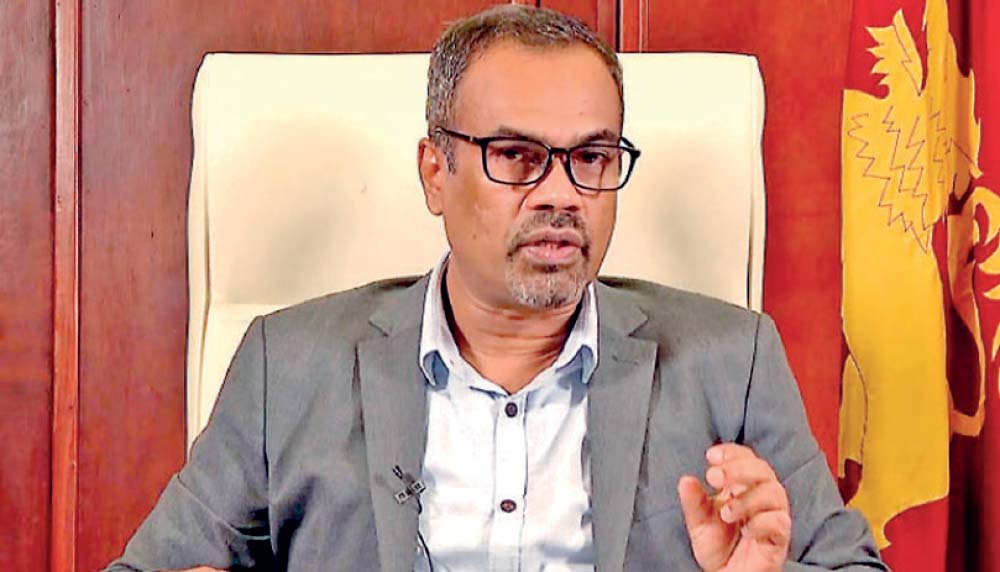
Finance and Planning Deputy Minister Dr. Anil Jayantha Fernando
The Government this week sought to draw a clear distinction between regulating virtual asset service providers and legalising cryptocurrencies, reiterating that crypto-assets remain outside Sri Lanka’s regulated financial system while outlining a phased roadmap to establish oversight in line with international anti-money laundering standards.
Responding to a series of questions raised by MP Ravi Karunanayake, Finance and Planning Deputy Minister Dr. Anil Jayantha Fernando said cryptocurrencies are neither recognised as legal tender nor regulated as an asset class or financial instrument, and that the Central Bank has not authorised any cryptocurrency exchanges, trading platforms, mining operations or related service providers to operate in Sri Lanka.
“The Sri Lankan Rupee is the legal tender in Sri Lanka,” he told Parliament, adding that cryptocurrencies and other digital or virtual currencies are therefore not accepted as a means of payment.
Dr. Fernando stressed that cryptocurrency trading has not been formally legalised or supported, with transactions taking place outside the regulated financial system and without investor protection or legal safeguards. Participation, he said, is undertaken entirely at an individual’s own risk.
At the same time, the Minister indicated that policymakers are moving towards a regulatory architecture for virtual asset service providers rather than an outright prohibition.
He disclosed that the Government has adopted a phased implementation plan aligned with Financial Action Task Force (FATF) recommendations. As part of that process, amendments to the Financial Transactions Reporting Act have been prepared to bring virtual asset service providers within Sri Lanka’s anti-money laundering and countering the financing of terrorism (AML/CFT) framework under the supervision of the Financial Intelligence Unit (FIU).
According to Dr. Fernando, the roadmap includes identifying existing virtual asset service providers, integrating them into AML/CFT supervision, and subsequently developing a prudential regulatory regime. Four meetings of a ministerial subcommittee have already been held to advance the implementation plan.
He further revealed that a Cabinet memorandum has proposed designating the Securities and Exchange Commission of Sri Lanka as the prudential regulator for virtual asset service providers through amendments to the SEC Act, subject to Cabinet approval, with additional legislative amendments also likely to be required.
Dr. Fernando also clarified that existing foreign exchange regulations do not permit residents to remit foreign exchange overseas for investments in crypto-assets issued by non-residents. In addition, Direction No. 3 of 2021 continues to prohibit resident cardholders from using debit or credit cards for virtual currency transactions, effectively preventing the formal banking system from facilitating cryptocurrency purchases.
However, he acknowledged that peer-to-peer transactions outside regulated financial intermediaries have been observed and remain difficult for banks to identify.
Addressing taxation, the Deputy Minister said profits arising from cryptocurrency-related activities would generally be recognised as “other income”, although detailed guidance on the applicable tax treatment would have to come from the Inland Revenue Department. He later added that gains arising from appreciation in crypto-asset values would be subject to tax where applicable.
On enforcement, Dr. Fernando said the FIU has supported investigations into cryptocurrency-related fraud by tracing wallets connected to suspected scams, coordinating with global cryptocurrency exchanges to obtain transaction data, facilitating the freezing of crypto-assets under court orders, and providing technical assistance where law enforcement agencies have seized digital wallets. He said several investigations involve online investment scams, cyber-enabled fraud and cross-border financial crimes in which proceeds were converted into virtual assets.
Dr. Fernando also said there are no regulatory restrictions preventing international payment platforms from operating in Sri Lanka, provided they comply with the existing regulatory framework.
He said discussions are under way to operationalise PayPal for inward export receipts, while some banks are already offering cross-border payment facilities through Wise. Several licensed commercial banks have also partnered with providers such as Wise and Payoneer to facilitate inward remittances for freelancers, startups and SMEs engaged in international trade and services.
The Minister also noted that India’s UPI system, together with China’s WeChat Pay, Alipay and UnionPay platforms, are already linked to Sri Lanka’s payments ecosystem, enabling Indian and Chinese visitors to make local payments through their domestic payment applications.
In a clarification during supplementary questions raised by MP Ravi Karunanayake, Dr. Fernando rejected suggestions that cryptocurrency trading was “illegal”, instead stating that it is “not recognised” under the current legal framework while remaining outside Sri Lanka’s regulated financial system.




