Thursday Oct 22, 2026
Thursday Oct 22, 2026
Saturday, 5 September 2026 00:31 - - {{hitsCtrl.values.hits}}
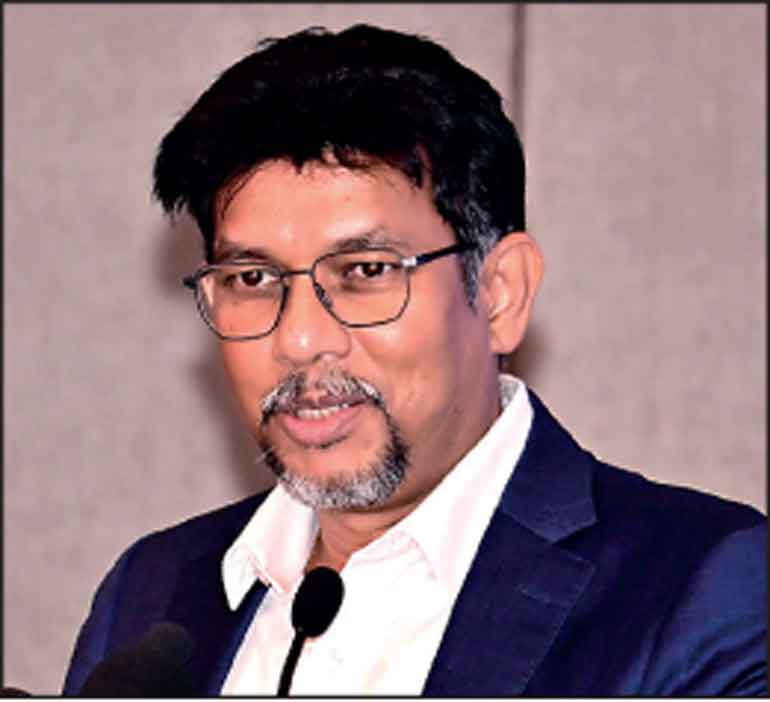
Digital Economy Deputy Minister Eng. Eranga Weeraratne - Pic by Sameera Wijesinghe
By Charumini de Silva
The Government has reaffirmed its decision to retain Sri Lanka Telecom (SLT-Mobitel) as a strategic State asset, with Digital Economy Deputy Minister Eng. Eranga Weeraratne noting the telecommunications group’s turnaround has demonstrated the potential of State enterprises when placed under the right strategy and management.
Addressing SLT-Mobitel’s latest financial update and strategic outlook recently, Weeraratne said the previous administration had placed the company on a divestment program, but the Government, after assuming office in late 2024, made a policy decision not to sell the strategic national institution.
Instead, he said the Government wanted to strengthen SLT-Mobitel and harness its capabilities to support Sri Lanka’s digital transformation.
The remarks came as the group reported a sharp improvement in financial performance, with profit after tax (PAT) rising 54.4% to Rs. 6.6 billion during the period under review. Group profit before tax (PBT) in the second quarter alone increased 55.8% to Rs. 3.1 billion.
Weeraratne noted that the turnaround was particularly significant given that SLT-Mobitel had recorded a Rs. 3.9 billion loss after tax in 2023 and subsequently returned to profitability, registering Rs. 1 billion in
PAT in 2025.
“This is not just temporary. The recovery is being sustained,” he said, noting the performance as a showcase of how a State enterprise could be transformed through the right strategy, leadership and organisational culture.
Weeraratne said the company’s improved financial position also strengthened its capacity to invest in Sri Lanka’s digital infrastructure.
He highlighted SLT-Mobitel’s acquisition last December of 5G spectrum in the 3.5 GHz band, saying the investment would enable higher broadband speeds, lower latency and greater capacity for residential and enterprise users, including emerging AI-enabled services.
The Deputy Minister said connectivity would be fundamental to the Government’s broader digitalisation agenda, which includes the development of digital identity, a national data exchange, a single Government services portal and expansion of digital payments.
He said the Government was also pursuing digital transformation across sectors including education, agriculture, healthcare, transport and tourism.
Weeraratne disclosed that steps are being taken to issue the first digital ID within the coming months.
“The Government is giving priority to the development of the digital economy and expects to move towards a fully digital identity system by August next year,” he added.
He said the aim is to transition the 17 million people currently holding existing identity cards to the new digital system within a period of around two years thereafter.
The country currently has mobile network coverage of around 94% of its geographical area, but the Government aims to raise this to 98%.
Achieving the target would require an additional 600 to 800 telecom towers, which Weeraratne said the Government intends to fast-track with the support of development partners.
The Government also aims to provide minimum broadband speeds of around 2 Mbps across the country within the next two to three years as part of efforts to bridge the digital divide.
Weeraratne said SLT-Mobitel would be a key partner in achieving these connectivity targets.
He also highlighted the growing importance of artificial intelligence, saying the Government was focused not only on deploying AI in public services but also on ensuring that citizens develop the skills needed to adapt to the technology.
The second edition of AI School, an initiative launched last year with SLT-Mobitel, is scheduled to be held around September-October, with the Deputy Minister saying the program had generated strong public interest.
Weeraratne said the Government’s broader digital transformation drive, supported by stronger connectivity and private and State-sector capabilities, would be critical to putting Sri Lanka on a faster development trajectory and achieving its $ 15 billion digital economy target.




