Tuesday Sep 15, 2026
Tuesday Sep 15, 2026
Friday, 6 February 2026 01:28 - - {{hitsCtrl.values.hits}}
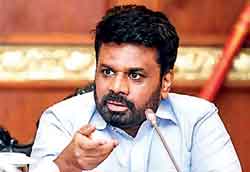 |
| President and Finance Minister Anura Kumara Dissanayake |
The Advocata Institute yesterday said that any move by the Government to revive or accommodate vehicle permit concessions for a select group of retired senior public officials would undermine governance credibility, weaken public trust, and dilute Sri Lanka’s economic reform effort.
In a statement, the economic policy think tank said that according to remarks made in Parliament, 1,900 permits have already been issued under this concessional scheme for senior officials, with 563 permits issued in 2025 alone. “Meanwhile, ordinary citizens endure an extended vehicle import ban and some of the highest effective taxes on personal transport vehicles in the world,” Advocata said.
Its statement is as follows:
During the presentation of the 2026 Budget Proposal, President Anura Kumara Dissanayake declared: “There will be no permits. The permit culture must end in Sri Lanka.”
Advocata welcomed this commitment, recognising permit culture as a relic of a feudal system, not a feature of a modern economy. It is a system that has, for decades, rewarded privilege over performance, entrenched inequality, and undermined the credibility of the State. The President’s affirmation offered renewed hope that Sri Lanka was finally moving towards transparent and equitable reform.
To now entertain exemptions for a select group sends a dangerous signal about reform credibility. Even policies publicly acknowledged as corrosive have the potential to quietly return.
Normalising State-sanctioned privilege
Vehicle permits are not compensation. They are discretionary privileges, operating as hidden transfers of public wealth to a privileged few, while the broader population absorbs higher taxes and reduced services. Worse still, they place retirement benefits at the mercy of political discretion, turning professional civil servants into political dependents rather than accountable public servants.
Therefore, it is precisely the high-ranking officials that must lead by example.
In December 2010, Transparency International Sri Lanka revealed that the majority of 65 newly elected Parliamentarians, including 2 Cabinet Ministers, sold their duty-free vehicle permits for as much as Rs. 17 million each, when adjusted for inflation. Using Department of Census and Statistics figures, that windfall is equivalent to which, adjusted for inflation, sits at approximately Rs. 48 million today.
In December 2012, in an event the media classified as a ‘Christmas Bonanza for MPs,’ the Government granted permission for MPs to openly sell their duty-free permits. At the time, they sold for Rs. 20 million each, which, adjusted for inflation, sits at approximately Rs. 50 million today.
In October 2016, Nagananda Kodituwakku, an Attorney-at-Law and rights activist, wrote to the Commissioner General of Motor Traffic, naming 75 MPs who imported luxury vehicles, including BMWs, Mercedes-Benz, Land Cruisers, and even a Hummer. The total tax waived per MP ranged from Rs. 30 million to Rs. 44.7 million. In today’s terms, this range approximately translates to between a staggering Rs. 66 million and Rs. 98.5 million.
History demonstrates the scale of abuse enabled by this system.
Towards integrity
As Advocata has previously highlighted, Sri Lanka’s cascading tax structure drives effective import duties on most passenger vehicles into the 125-250% range. Every duty-free permit therefore represents a direct fiscal loss; revenue that must be recovered through higher taxes elsewhere or reduced public services for everyone else. Since 2020 alone, more than 25,000 duty-free permits have been issued to Government employees, including during the height of the economic crisis.
Making exceptions now would set a dangerous precedent. It signals to every remaining permit holder that persistence will be rewarded, inevitably triggering lobbying pressure and further demands for carve-outs. This is how temporary “concessions” become permanent entitlements. Once reopened, the system cannot be credibly contained.
From an economic and governance perspective, reintroducing selective exemptions would undermine public confidence in fiscal consolidation, weaken the credibility of reform commitments, and damage investor perceptions of Sri Lankan regulatory stability and policy consistency.
The appropriate solution lies in transparent, on-budget salary structures, subject to Parliamentary oversight. Crucially, they must compensate public servants fairly without undermining fiscal discipline or institutional integrity, avoiding the distortions created by discretionary privilege schemes.
Advocata calls on the Government to take the following actions: Abandon plans to allow vehicle imports under existing duty-free permits; commit to permanently ending vehicle permit schemes, replacing them with clear and transparent salary frameworks subject to Parliamentary oversight; and legislate a prohibition on duty-free vehicle permits for public sector officials, safeguarding against future reversals and ensuring consistent policy application.
Sri Lanka cannot rebuild trust while preserving elite carve-outs. Reform commitments retain credibility only when they are applied consistently — without selective exemptions.




