Sunday Oct 04, 2026
Sunday Oct 04, 2026
Saturday, 23 May 2026 05:33 - - {{hitsCtrl.values.hits}}
|
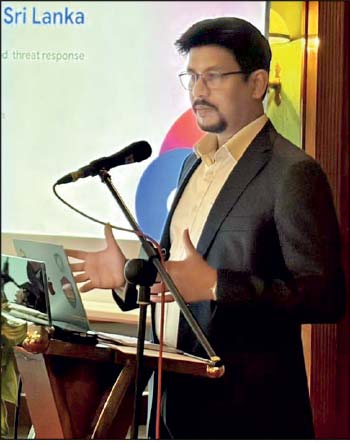
Digital Economy Deputy Minister Eranga Weeraratne
|
Digital Economy Deputy Minister Eranga Weeraratne said Sri Lanka is moving to establish a unified national cybersecurity architecture powered by artificial intelligence to combat rising digital financial fraud, cybercrime, and identity-based scams as the country accelerates its digital economy transformation.
Speaking at the ‘SL Scam Shield’ Executive Breakfast Forum held at Cinnamon Grand Colombo on 18 May, the Deputy Minister stressed that cybersecurity must now be treated as a national security priority rather than merely a technical or institutional issue.
The forum, jointly organised by Google Cloud and NCINGA, focused on strengthening protections against digital financial fraud and cyber threats amid Sri Lanka’s ongoing digitalisation drive.
Delivering the keynote address, Weeraratne said the Government’s broader vision is to build a trusted digital ecosystem where citizens across the country can safely participate in the digital economy.
“The Government’s main vision is to create a secure environment and a Unified National Shield, where all citizens, from the farmer in Anuradhapura to the grandmother in Matara and the young entrepreneur in Jaffna, can use the digital economy with full confidence,” he said.
The discussion focused heavily on the increasing sophistication of cyber threats driven by artificial intelligence (AI), including voice cloning, fake digital identities, and advanced online financial scams.
Weeraratne warned that traditional cybersecurity systems are no longer sufficient to address rapidly evolving AI-powered threats.
He said financial frauds operating at international scale using AI cannot be effectively countered through passive or outdated security approaches.
Instead, Sri Lanka requires an AI-powered “Autonomic Security” framework capable of detecting fraud and cyber threats in real time.
“The importance of a national cyber security system powered by AI technology that can detect fraud in real-time is now critical,” he noted.
The Deputy Minister also identified fragmentation within existing cybersecurity systems as a major national vulnerability.
Currently, banks, telecommunications providers, government institutions, and other sectors largely operate independent security frameworks with limited coordination.
According to Weeraratne, the Digital Economy Ministry is now prioritising the development of a “National Cybersecurity Framework” aimed at integrating these isolated systems into a unified national protection architecture.
“Cyber security is not just a technical office task, but an essential factor related to national security,” he stressed.
The Deputy Minister also commended the collaboration between Google Cloud and NCINGA in locally engineering the “Scam Shield” initiative, describing it as an important example of public-private technological cooperation.
NCINGA, which was recognised as Google’s 2026 Social Impact Partner, is working alongside Google Cloud to support the development of AI-enabled cybersecurity capabilities tailored for Sri Lanka.
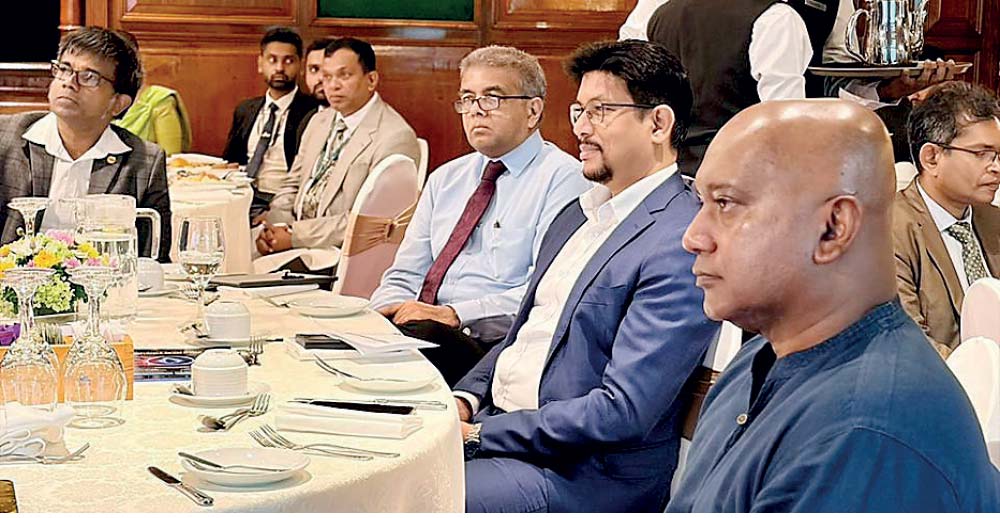
The event brought together senior policymakers, cybersecurity specialists, and technology sector leaders involved in Sri Lanka’s digital transformation agenda.
Among those attending were Presidential Senior Adviser on Digital Economy Dr. Hans Wijeyasuriya, officials from multiple Ministries and Departments, representatives from Sri Lanka Computer Emergency Response Team (SL CERT) and several international cybersecurity experts. Representing Google Cloud were Head of Security for India and SAARC Sujith Patnaik and Head of Security Engineering Sijesh Sridhar. NCINGA Founder and Chairman Imal Kalu Thotage and NCINGA GovTech CEO Asanka Bimal Rajasinghe also participated alongside technical experts and industry stakeholders.
The forum reflected growing concerns globally over the rise of AI-driven cybercrime as governments and financial systems increasingly digitise public services and economic activity.