Tuesday Sep 15, 2026
Tuesday Sep 15, 2026
Saturday, 1 August 2026 01:25 - - {{hitsCtrl.values.hits}}

Digital Economy Deputy Minister Eng. Eranga Weeraratne
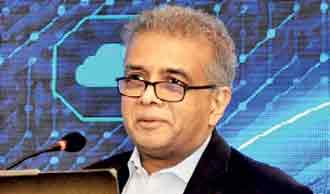
Chief Adviser to the President on Digital Economy Dr. Hans Wijayasuriya
 Cabinet paper on ‘Fund of Funds’ due within weeks to expand venture capital financing
Capital mobility, venture capital tax changes and virtual SEZ among planned reforms
Procurement overhaul to widen Government contracts for local technology firms
AI, research and IP initiatives to support digital industry growth
The Government is preparing tax, regulatory and procurement reforms, including changes to venture capital taxation, capital mobility and public procurement, as it seeks to support a target of generating $ 5 billion in digital exports by 2030.
Speaking at the national validation workshop on Sri Lanka’s proposed digital export roadmap yesterday, Digital Economy Deputy Minister Eng. Eranga Weeraratne and GovTech Sri Lanka Chairman and Chief Adviser to the President on Digital Economy Dr. Hans Wijayasuriya outlined a series of policy measures aimed at improving access to finance, reducing regulatory barriers and encouraging technology companies to establish and expand their operations from Sri Lanka.
The Deputy Minister said the Government expects to submit a Cabinet paper within weeks to establish a Fund of Funds under a national fund-of-funds policy to strengthen venture capital financing for startups.
Dr. Wijayasuriya said the Government is also finalising reforms to address tax pass-through issues affecting venture capital funds, while capital mobility rules will be revised to allow startups receiving foreign investment to use those funds for overseas expansion.
He said the measures are intended to address one of the industry’s long-standing challenges by making Sri Lanka a more attractive location for technology companies to retain their headquarters.
“We are looking at some of the root causes and creating an environment which encourages headquartering in Sri Lanka,” Dr. Wijayasuriya said.
The Government is also developing a virtual Special Economic Zone that would allow technology companies to incorporate and operate virtually with fewer administrative barriers. Dr. Wijayasuriya said the initiative draws on models adopted in the UAE and several Eastern European countries to attract investment from smaller, high-growth technology firms.
Another priority is procurement reform aimed at enabling Government institutions to purchase technology solutions from smaller domestic companies through more agile procurement processes.
Dr. Wijayasuriya said the Government should become a platform for the private sector by creating opportunities for local firms to develop digital solutions for public institutions while supporting the growth of the domestic technology industry.
The Government also plans to introduce incentive programs for research and intellectual property, alongside an Applied AI Institution and an AI Centre of Excellence as part of its digital economy agenda, Deputy Minister Weeraratne said.
He said Government could establish the policy framework, but achieving the export target would depend on commitments from industry, investors and academia.
“Government alone cannot bring the full roadmap to fruition. We can bring out the right policies. But it is the industry who can actually make this happen,” he said.
The proposals were presented during the validation workshop yesterday organised by the Digital Economy Ministry, GovTech Sri Lanka and the World Bank Group, where industry representatives, investors, academia and policymakers reviewed the draft roadmap before it is finalised.
Pix by Lasantha Kumara




