Wednesday Oct 07, 2026
Wednesday Oct 07, 2026
Wednesday, 7 October 2026 05:37 - - {{hitsCtrl.values.hits}}
|
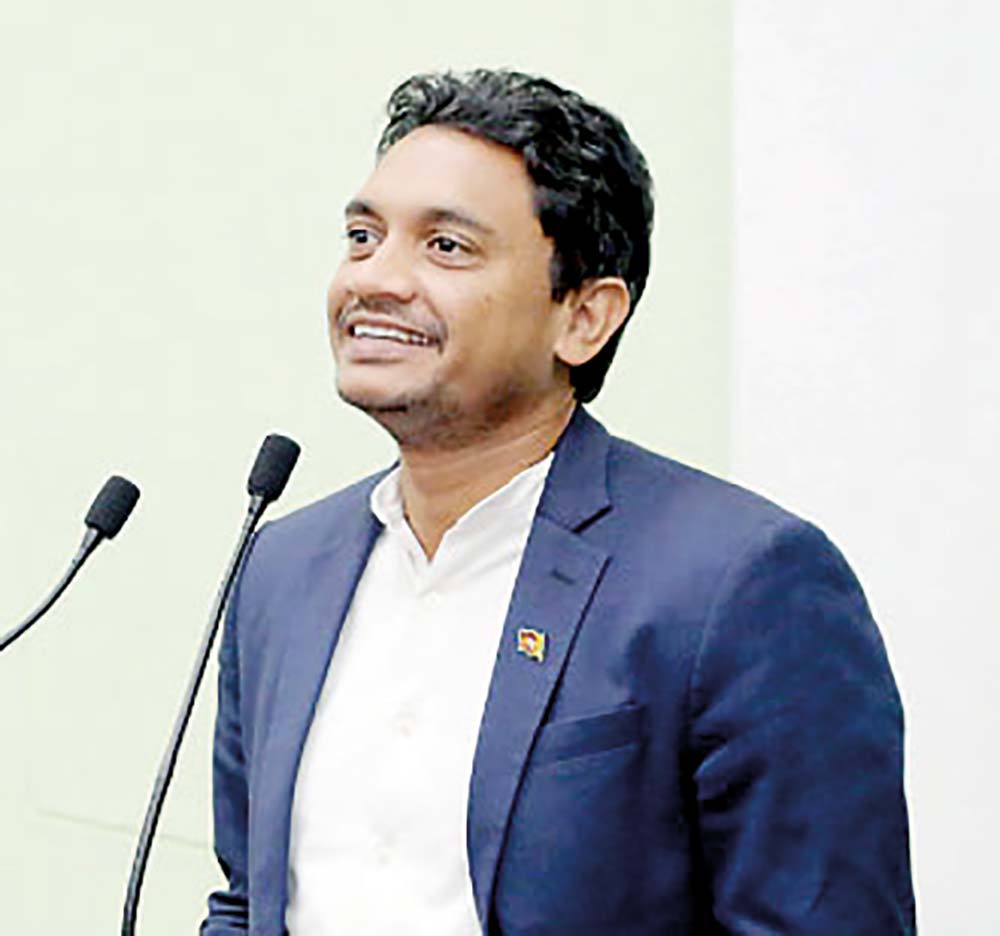
Industry and Entrepreneurship Development Deputy Minister Chathuranga Abeysinghe
|
The Government yesterday defended its gradual opening of the capital account and refused to disclose its plans for Sri Lanka’s international Bonds, arguing that any such signal would be market-sensitive.
Responding in Parliament during the debate on new regulations governing foreign exchange outflows, Industry and Entrepreneurship Development Deputy Minister Chathuranga Abeysinghe said the measures would boost investor confidence by easing restrictions on capital leaving the country.
Under the changes, local companies can invest abroad up to $ 750,000 without prior approval from the Central Bank. Abeysinghe said the allowance for Sri Lankans who emigrate had also been revised, while larger transfers would remain subject to approval.
“We have gradually opened up over the last two years. We have opened the entire import market and now we are opening the capital market,” he said, adding that returning to pre-crisis levels of openness would take time.
He contrasted the approach with that of former President Ranil Wickremesinghe, arguing that the previous administration built reserves by contracting the economy through higher taxes and curbs on imports and the capital account. “If you do that, any country can save foreign exchange. We are not doing that,” he said.
Abeysinghe rejected Opposition calls for the Government to state whether it would buy back or issue Bonds, saying decisions on International Sovereign Bonds (ISBs) would be made by the Finance Ministry and the Public Debt Management Office (PDMO). “Asking the Government to say whether it is going to buy or issue Bonds is asking it to disclose market-sensitive information,” he said, adding that bondholders need not be informed of the Government’s plans in advance.
“We have a strong plan to manage our debt, and we are confident in the officials in the Ministry,” he said.
Turning to the fiscal position, Abeysinghe dismissed claims that revenue gains were driven mainly by vehicle imports. He said Government revenue had risen from 13.5% to 16.7% of GDP, with vehicle imports contributing about 1.2 percentage points, and that such revenue would continue this year.
He said Sri Lanka had accumulated more than $ 1.5 billion in reserves for the fourth consecutive year and was on track to close 2026 with about $ 8 billion. Citing the IMF’s seventh review, the last before the program concludes, he said the Fund had acknowledged the economy’s remarkable resilience in withstanding successive shocks, including the global downturn and US tariff changes.
Abeysinghe also accused the 2015–2019 administration of raising costly ISBs at around 7% interest in 2015 and 2016, and said its Foreign Exchange Act had created loopholes that enabled capital flight.
He added that Parliament was also approving an ADB loan to be disbursed to the SME sector.