Sunday Oct 04, 2026
Sunday Oct 04, 2026
Saturday, 23 May 2026 05:37 - - {{hitsCtrl.values.hits}}
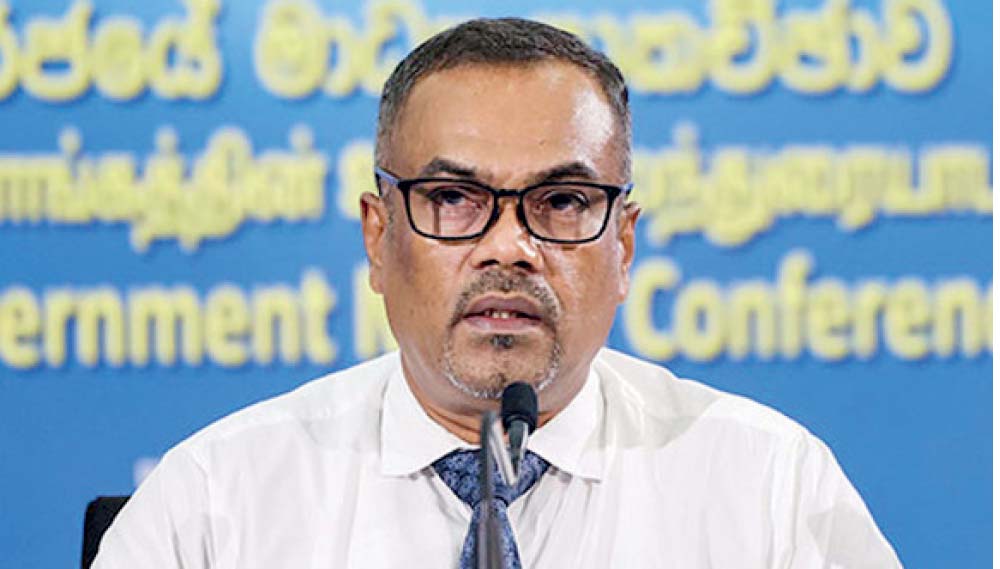
Deputy Finance and Planning Minister Dr. Anil Jayantha Fernando
By Charumini de Silva
Deputy Finance and Planning Minister Dr. Anil Jayantha Fernando yesterday defended Sri Lanka’s flexible exchange rate regime and independent monetary policy framework amid mounting pressure on the rupee, rejecting comparisons with the 2022 economic crisis and dismissing speculation over vehicle import restrictions, IMF-directed currency moves and broader economic instability.
Addressing a special media briefing, Dr. Fernando said the economy continues to function normally with growth, inflation management, reserve accumulation and private sector lending all progressing steadily despite temporary external shocks stemming from tensions in the Middle East.
Govt. defends...
“There is definitely no economic crisis in Sri Lanka and not only that the country is moving forward with its economic growth, managing inflation, building reserves, lending to the private sector and continuing all the economic activities necessary to make life comfortable for the public,” he said.
The Deputy Minister acknowledged that the rupee had experienced a slight depreciation against the US dollar, but stressed that the movement did not indicate a broader economic breakdown.
“Increased global demand for dollars and rising oil prices had exerted pressure on foreign exchange markets not only in Sri Lanka but also across regional economies including India and Indonesia,” he explained.
He revealed that as of 12:15 p.m. yesterday, the interbank exchange rate averaged Rs. 330 to the dollar, with bidding prices at Rs. 327 and selling prices at Rs. 332.
Dr. Fernando also claimed that certain groups were attempting to fuel panic and manipulate public sentiment for political or business gain.
“Certain smaller groups with ulterior political and business motives wished that the rupee would depreciate beyond Rs. 370 against the dollar,” he alleged, adding that such expectations had not materialised.
The Deputy Minister stressed that Sri Lanka now operates under a flexible exchange rate regime where the currency is determined by market forces rather than administrative controls used in the past. He also rejected speculation that the International Monetary Fund (IMF) had directed Sri Lanka to either depreciate or appreciate the rupee.
“There is no such demand by the IMF beyond the agreement. Sri Lanka has met all performance criteria and their latest statement on economy is based on the technical aspects,” he said.
He also expressed confidence that the IMF Executive Board would approve the release of the next tranche later this month under Sri Lanka’s Extended Fund Facility (EFF) program. According to Dr. Fernando, Sri Lanka expects to secure up to $ 1 b in 2026, including $ 700 m from the IMF, $ 480 m from the Asian Development Bank, $ 150 m from the World Bank and a further $ 50 m from an affiliated institution.
Responding to questions regarding the Central Bank’s decision to maintain policy interest rates at 7.75%, Dr. Fernando said monetary policy decisions fall under the authority of the Central Bank of Sri Lanka and should remain free from Government intervention.
“I cannot give a clear-cut answer to that because the Central Bank is empowered to make a decision on it without Government intervention,” he said.
Addressing concerns over vehicle imports, the Deputy Minister denied reports that 4,000 vehicles had arrived in the country on 15 May and dismissed speculation that imports would soon be suspended.
According to figures presented by him, only 1,782 Letters of Credit (LCs) valued at $ 23 m were opened for vehicle imports on 15 May. However, following public speculation surrounding the newly introduced 50% surcharge, LC openings surged to 9,429 on 18 May before dropping sharply over the next two days.
“15 May was a Friday and by driving the fear factor and through speculation into the masses on 18 May (Monday) after the surcharge 9,429 LCs were opened. But after two days it dropped to $ 3.73 million and $ 5.1 million respectively,” he said.
Dr. Fernando said the Government had opted for a cautious approach rather than imposing abrupt import restrictions.
“The Government imposed the 50% surcharge from 15 May to moderate foreign exchange demand over the next three months. We monitored the average of vehicle imports and took the decision by looking at the medium term,” he said.
He also disclosed that since the Government reopened the market in December 2024, around 624,000 LCs had been opened for vehicle imports by the end of April 2026.
Against the backdrop of rising consumption demand, Dr. Fernando warned that higher global oil prices had significantly increased the country’s fuel import bill.
“The monthly fuel bill of the Ceylon Petroleum Corporation (CPC) is expected to rise to $ 521 million in May,” he said.
The fuel bill stood at $ 152 m in December, $ 186 m in January, $ 98 m in February, $ 195 m in March and $ 316 m in April, making the projected May figure the highest recorded so far in 2026.
However, the Deputy Minister expressed confidence that global oil prices and import expenditure would moderate in the coming months, forecasting fuel costs to ease to $ 332 m in June and $ 241 m in July.
He also rejected claims that fuel procurements had violated regulations, saying imports were necessary to maintain uninterrupted supplies of fuel and other essentials such as medicine and fertiliser.
Dr. Fernando projected that foreign workers’ remittances would exceed $ 9 b this year and urged expatriate workers to remit funds through official banking channels. He also expressed optimism that export earnings and tourism receipts would strengthen during the second half of the year, helping support external sector stability.
On private sector lending, Dr. Fernando said rising credit growth reflects expanding economic activity rather than financial distress. He noted that private sector credit expansion grew to around Rs. 2 t during 2025, with approximately Rs. 250 m being added monthly in recent months.
“This enables the entrepreneurs to obtain loans and expand their business, import vehicles and build houses. It creates a higher purchasing power,” he said.



