Tuesday Sep 22, 2026
Tuesday Sep 22, 2026
Tuesday, 22 September 2026 06:20 - - {{hitsCtrl.values.hits}}
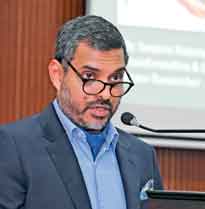 |
| Disinformation and Civic Space Researcher Dr. Sanjana Hattotuwa – Pic by Daminda Harsha Perera |
Disinformation and Civic Space Researcher Dr. Sanjana Hattotuwa warned that Sri Lanka is building a wide-reaching surveillance apparatus through a series of laws passed with little consultation and no meaningful safeguards, each reviewed in isolation rather than as part of a whole.
Speaking at the launch of the Sri Lanka Civil Society Organisations (CSO) shadow report to the Financial Action Task Force’s (FATF) Mutual Evaluation of Sri Lanka, held on 17 September at the Bandaranaike Memorial International Conference Hall (BMICH) and organised by the Sri Lanka CSO FATF Network, he said since 2023, Sri Lanka has passed or proposed a run of laws touching speech, funding, and the right to organise. These include the Online Safety Act, the Anti-Corruption Act, the Proceeds of Crime Act, a draft Protection of the State from Terrorism Act, a draft NGO Registration and Supervision Bill, and a Cybersecurity Bill from 2023.
Alongside these laws, he said the Government is building a national digital identity system, a central population register, a national data exchange, upgraded Government cloud infrastructure, digital payment systems, a single application for public services, and a national artificial intelligence (AI) strategy.
He said each law arrives under a reasonable-sounding name, such as online safety, anti-corruption, or efficient public services, making it hard to oppose on its own terms. That, he argued, is the gap. Each gets its own consultation and its own narrow debate, while no institution is required to weigh what happens once they are stacked together.
“Civil society is tired, and its attention shifts to whichever clause, Bill, or draft is loudest at a given point of time, while the scaffolding keeps going up,” he said. “Taken together, these laws or draft Bills threaten rights, remedy, and representation far more gravely than any one of them read alone.”
On safeguards, he pointed to the Anti-Corruption Act and Proceeds of Crime Act, which he said allow authorities to access a person’s financial and device records without that person knowing or being given a chance to object.
He also raised the Government’s 2024 AI white paper, released by the Technology Ministry with UN Development Program (UNDP) support on 19 April 2024. Public comment closed just five working days later, on 26 April, and the process ran in English only.
“The draft itself said nothing about AI-enabled surveillance and repression, nothing about discrimination and the algorithmic bias that would deepen it, and nothing about accountability or redress when these systems fail,” he said. “I called it a performative consultation, and see no reason to revise the judgement.”
As an example of how thin legal grounding can already be used against critics, he cited MP Shanakiyan Rasamanickam, questioned by Police for four hours in August 2026 over comments on federalism and land, after a member of the public filed a complaint. Lawyer Ambika Satkunanathan later asked publicly what law had allowed Police to act on it.
Dr. Hattotuwa said the risk of building such systems without safeguards is not hypothetical. He pointed to July 1983, when mobs moved through Colombo armed with voter registration lists, using them to identify Tamil homes, shops, and factories street by street.
“A paper-based register compiled for an unrelated purpose, held by the State, turned to targeting within days,” he said. “Digital identities held in a central repository resolve the same query in milliseconds, from anywhere in Sri Lanka. Digitalisation does not necessarily manufacture hostile intent, but it removes the friction that once limited somewhat what racism and malevolence could accomplish quickly.”
On financing, he referred to the World Bank’s $ 50 million Digital Transformation Project, which the Bank rated as low risk on environmental and social grounds, despite Sri Lanka’s history of violence against minorities and its weak record on governance. He said the Bank’s own project documents make no mention of rights and describe the Bank’s role only as financing, advising, and overseeing, a practice he called ‘deniability by design.’
He said the risks involved are not hidden. “Nobody in this room will be able to say the danger was invisible,” he said. “The warnings are present in public, through budgets, Gazettes, laws, draft Bills, official pronouncements, Presidential statements, Ministerial updates, and procurement notices.”
He said history would judge institutions not on whether they caused the harm but on what they did once the risk was clear, and whether they kept funding, advising, and endorsing the system regardless. If so, he said, they would be remembered not as bystanders but as builders.




