Thursday Oct 15, 2026
Thursday Oct 15, 2026
Thursday, 18 June 2026 00:30 - - {{hitsCtrl.values.hits}}
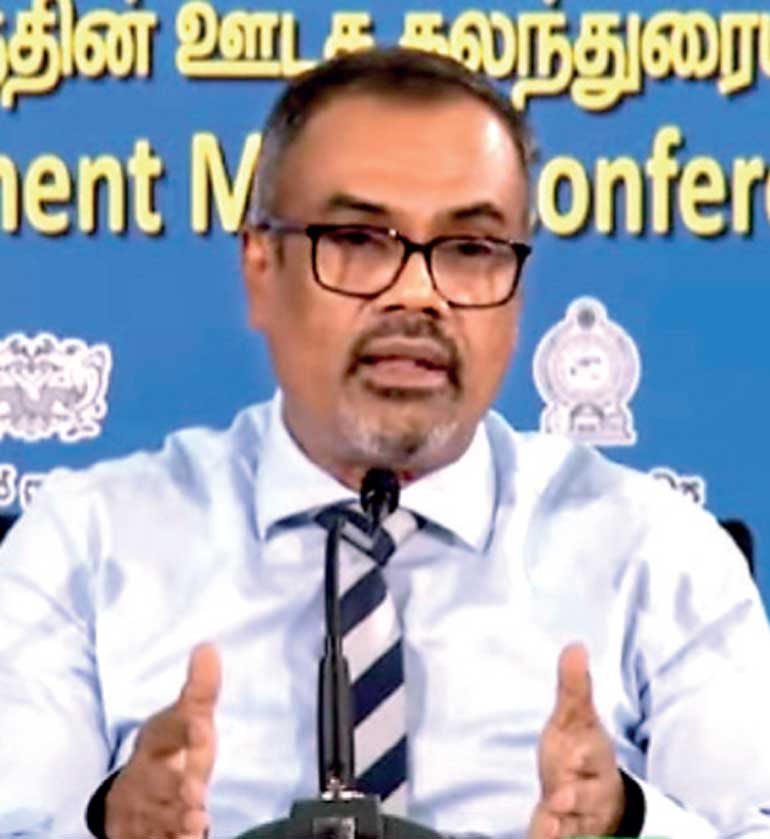
Finance and Planning Deputy Minister Dr. Anil Jayantha Fernando
The Government remains confident of achieving its 5% economic growth target this year and is working towards a medium-term objective of 7% inclusive and sustainable growth, despite concerns over rising interest rates and the pace of capital expenditure, Deputy Finance and Planning Minister Dr. Anil Jayantha Fernando said yesterday.
Addressing a special media briefing, he said the first-quarter economic growth of 5.1% was a positive indicator that the country remained on its planned economic
trajectory.
“We remain highly positive and optimistic that Sri Lanka will continue along its planned economic trajectory."
Our medium-term objective is to achieve inclusive and sustainable economic growth of around 7%. That does not mean we expect to reach 7% in 2026 itself; rather, it is a medium-term target,” he said.
Dr. Fernando noted that the Government was continuing discussions with development partners, donor agencies, line Ministries, and private sector stakeholders on strategies to sustain and accelerate economic growth.
“We are continuing discussions with development partners and other stakeholders on how best to achieve our medium-term growth objective of 7%,” Dr. Fernando explained.
Acknowledging that higher interest rates could temporarily affect economic activity, the Deputy Minister stressed that the Government did not expect a significant slowdown in demand.
“I acknowledge that higher interest rates can temporarily dampen demand. However, we will take appropriate measures to support economic activity once conditions normalise,” he said.
“From the Government’s side, capital expenditure programs will continue as planned. At the same time, we encourage the private sector to remain confident and proceed with its investment plans. We do not expect the recent increase in interest rates to cause a significant contraction in demand. Any impact should be temporary. Therefore, we continue to maintain our growth target,” Dr. Fernando added.
He argued that sustained economic growth was essential to addressing poverty, reducing income inequality, and improving living standards, describing growth as the only durable solution to Sri Lanka’s longstanding socioeconomic challenges.
Addressing concerns raised at the recent Committee on Public Finance (CoPF) meeting regarding capital expenditure performance, Dr. Fernando said figures cited during the discussions required proper context.
“The Rs. 243 billion expenditure figure referred specifically to supplementary allocations, including funding related to post-disaster recovery, rather than the entirety of the capital budget,” he explained.
He also rejected suggestions that capital spending was lagging behind target levels, pointing to last year’s performance.
“A similar criticism was made early last year. However, by year-end, we were able to achieve around 75% utilisation of the capital expenditure allocation,” he said.
According to Dr. Fernando, the Government is holding regular meetings with line Ministries and implementing agencies to accelerate project implementation and improve Budget utilisation.
“While some delays have arisen due to procurement processes, we are working to expedite these projects and meet our targets by the end of the year,” he said.
The Deputy Minister stressed that capital expenditure should not be assessed on a simple month-to-month basis, particularly in the case of large-scale infrastructure projects.
“It is important to recognise that capital expenditure does not follow a simple monthly pattern. Large infrastructure projects often require extensive preparatory work, procurement procedures, and documentation before significant financial disbursements occur,” he said.
Citing the expansion of Bandaranaike International Airport (BIA) as an example, Dr. Fernando noted that major projects often involve lengthy preparatory stages before spending becomes visible in official data.
“Financial progress may only become visible several months after the initial work begins. Therefore, it is not appropriate to assess capital expenditure solely through a proportional arithmetic approach,” he said.
Nevertheless, he reiterated the Government’s commitment to accelerating implementation and achieving strong capital expenditure growth this year, similar to the progress recorded in 2025.
Responding to allegations that public officials were reluctant to approve procurement documents due to fears of future investigations or legal repercussions, Dr. Fernando said he was not aware of any such instances.
“I am not aware of any specific cases where public officials have refused to sign procurement documents due to concerns about future repercussions,” he said.
“If there are particular cases, they should be identified specifically. From our perspective, delays are more often attributable to technical and procedural requirements rather than reluctance on the part of officials,” he added.




