Thursday Oct 15, 2026
Thursday Oct 15, 2026
Monday, 23 March 2026 04:02 - - {{hitsCtrl.values.hits}}
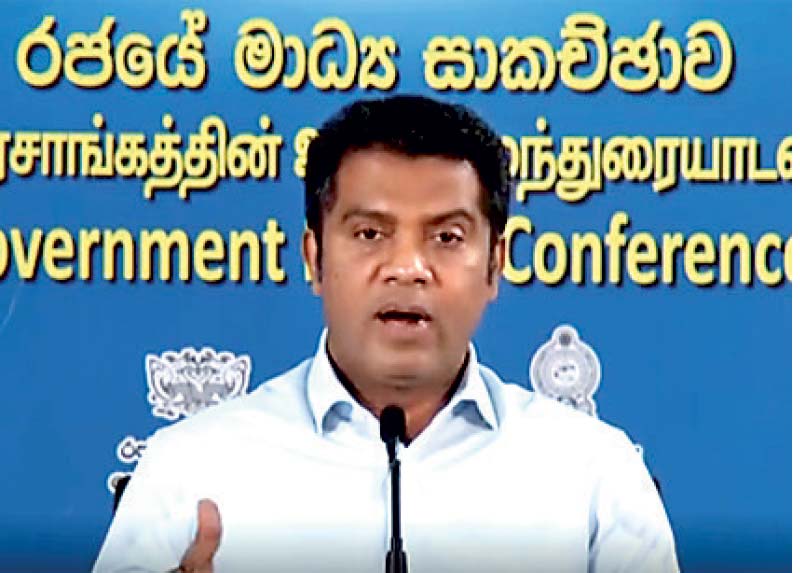
Cabinet Spokesman and Minister Dr. Nalinda Jayatissa
Cabinet Spokesman and Minister Dr. Nalinda Jayatissa yesterday said the Government is absorbing Rs. 20 billion a month to cushion the impact of sharply higher fuel prices, even after raising pump rates to levels last seen during the 2022 economic crisis, to shield consumers while preventing renewed pressure on currency and foreign reserves.
Addressing a special media briefing, he said the State continues to subsidise Rs. 100 per litre of diesel and Rs. 20 per litre of petrol despite this week’s cost-reflective revision by the Ceylon Petroleum Corporation (CPC).
The increase followed a hint in Parliament by President Anura Kumara Dissanayake last Friday that the Government would move swiftly to revise pricing, review fuel taxation, and adjust procurement strategies to manage the fallout from escalating tensions in the Middle East.
However, Opposition parties have urged the Government to reduce fuel taxes instead, arguing that households and businesses remain vulnerable after years of austerity and inflation.
The Government argues that raising retail prices, while continuing partial subsidies, is the least disruptive option available.
“Increasing fuel prices is a measure adopted globally to manage such crises,” Dr. Jayatissa said, noting that even if hostilities in the Middle East were to cease immediately, damage to infrastructure and oil production capacity would delay any price normalisation.
He defended the move, warning that failure to adjust prices would have imposed an additional burden of around $ 1.5 billion on the economy, exacerbating demand for US dollars and risking destabilisation of the exchange rate.
“This would have pushed the dollar to uncontrollable levels, even posing a risk to the country’s reserves,” he said.
He noted that between 28 February and 20 March, petrol prices had risen by $ 70.98 or 89%, diesel by $ 129.76 or 141%, and crude oil by $ 66.35 or 92% in global markets.
In addition, he said import premiums have spiked sharply. “While crude premiums were below $ 3 and refined oil near $ 4 over the past 14 months, current premiums have surged by 45-50%, with diesel recording peaks of 45%, 48%, and even 57%,” he added.
The Government’s calculus reflects a familiar dilemma for import-dependent emerging markets, whether to protect consumers from global commodity shocks or preserve hard-won external stability. Sri Lanka, still recovering from its sovereign default and a severe balance of payments crisis, has limited fiscal space to do both.
He said these increases make it inevitable for the Government to take corrective action, adding that the duration of the conflict involving major powers such as the US, Israel, and Iran remains unpredictable. “Even if the war ends immediately, the global supply chain and oil production infrastructure would take time to stabilise,” he pointed out.
Noting that the global price movements have been abrupt, he said the volatility has complicated procurement planning. “Sri Lanka’s refinery currently meets about 70% of jet fuel requirements, 30% of diesel, and between 20%-25% of petrol demand, helping to reduce import dependency,” he added.
He outlined the upcoming fuel shipment schedule, noting that a 37,000-ton petrol consignment was received on 7 March, while a similar volume of diesel is due to arrive on 25 March. Two additional diesel shipments of 37,000 tons are expected between 6 or 8 April, followed by 35,000 tons of Jet A-1 fuel on 10 or 11 April. A 30,000-ton fuel oil shipment is scheduled for 12 or 13 April, while 30,000 tons of petrol are expected on 16 or 17 April.
Dr. Jayatissa acknowledged that a crude oil shipment originally planned for April has been cancelled, with a 30,000-ton consignment now scheduled for June.
The Minister said fuel price adjustments are being adopted globally to manage crisis conditions, stressing that Sri Lanka, as a recovering economy, must balance stability with fiscal responsibility.
“The Treasury is considering more targeted welfare support for vulnerable groups, while attempting to avoid a return to universal subsidies that proved unsustainable during the previous crisis,” he said.
He described the current approach as a “supportive mechanism” calibrated for an economy still emerging from contraction and natural disaster-related damage to production infrastructure.
Dr. Jayatissa framed energy conservation as a civic responsibility, calling for “mindful usage.”
Responding to a question on whether the Government plans to restrict travel ahead of the festive season, he said: “Sinhala and Tamil New Year is a significant cultural celebration and the authorities are instead pursuing proactive measures to minimise disruptions to people’s daily lives.”
He described the approach as a strategy looking ahead of the coming month, centred on mindful consumption and prudent household management. “We can close the economy very easily like it has been done in the past, but that is not what we intend to do. We believe 6 million households can help manage both their own budgets and the broader economy by being more mindful about the global and local scenario,” he said.
He urged the public to use electricity and fuel responsibly and keep energy consumption to a minimum, while assuring that there are no plans to curtail electricity or fuel supplies.




