Tuesday Sep 15, 2026
Tuesday Sep 15, 2026
Tuesday, 15 September 2026 05:59 - - {{hitsCtrl.values.hits}}
The second round of the Industry Index survey conducted by IFH KÖLN and Messe Frankfurt shows that, whilst the global business climate has remained largely unchanged overall compared with the first round and remains at a subdued level, the factors causing pressure have shifted significantly.
In particular, global uncertainties, rising production and procurement costs, as well as tariffs and trade restrictions, are putting companies under increasing pressure.
The global industry index compiled by IFH KÖLN and Messe Frankfurt serves as an international sentiment barometer, highlighting developments in trade fair-related sectors at an early stage.
A total of 667 representatives from Industry and Trade and Service around the world took part in the second survey wave in June and July 2026. With an index score of 100.4, compared with 100.1 in the first survey wave, the global business climate remains virtually unchanged and subdued overall. The industry is slightly more confident than Trade and Service. There are also regional differences: Asia is 4.2 index points above the overall index and America 2.3 points above it, while Europe is 1.2 points below.
IFH KÖLN Head of Strategic Insights and Analytics Dr. Ralf Deckers said: “The economy is currently less in recovery mode than under pressure to reposition itself. Sentiment is stabilising in some areas, but at the same time the pressures are shifting away from weak demand towards geopolitical uncertainty, rising costs, and trade barriers.”
Costs and geopolitical crises move to centre stage
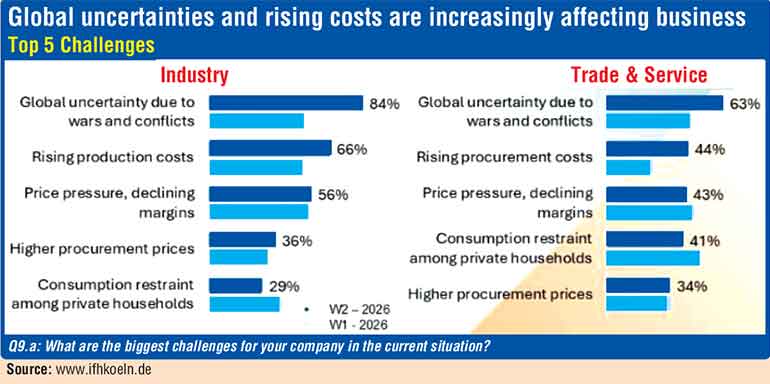
A comparison of the two survey rounds illustrates particularly clearly how the challenges facing businesses are shifting. In the manufacturing sector, 84% now cite global uncertainty caused by wars and conflicts as a key challenge – compared with 52% in the first survey round. At the same time, rising production costs are becoming significantly more important: the proportion citing this has risen from 51 to 66%. Global uncertainty is also rising significantly in the trade and services sector – from 46% to 63%.
The second survey round coincided with a period of growing geopolitical tensions. The military conflicts in the Gulf region and the associated risks to key international trade and energy routes highlight just how closely intertwined geopolitical stability, global supply chains, and economic planning certainty are. At the same time, rising procurement costs are becoming a more significant factor, whilst consumer reluctance amongst private households is becoming less of a concern compared with the first survey wave.
The second survey wave thus shows that companies are increasingly under pressure from both external factors that are difficult to influence and from rising costs.
Political pressures continue to increase
Tariffs and trade restrictions are continuing to put pressure on businesses. Regionally, businesses in America remain the hardest hit: 74% say they are severely or very severely affected. In Asia, the figure now stands at 66%, and in Europe at 42%. By way of comparison: in the first wave of the survey, the corresponding figures were 75% in America, 58% in Asia, and 33% in Europe. This means that the pressure is mounting, particularly in Asia and Europe. Despite this trend, companies do not feel significantly better prepared for changes to tariffs and import restrictions. A large proportion still consider themselves only partially prepared.
AI adoption faces structural hurdles
Another challenge is the use of artificial intelligence (AI). AI is currently used primarily for content creation and media-related applications. Its use is already somewhat more advanced in industry than in trade and services.
According to the second wave of the survey, the biggest challenges in introducing AI lie primarily in a lack of expertise and in integration into existing systems. Budgetary issues, a lack of resources, as well as data protection and security risks also play a significant role.
Moderate outlook despite challenging conditions
Despite increased geopolitical and economic pressures, companies are not entirely pessimistic about the coming months. The industry sector, in particular, appears more confident about future developments than the trade and services sectors. The slight improvement in turnover also points to the first signs of recovery. Overall, however, expectations remain cautious.
“Companies are increasingly adapting to the volatile environment, but there is still no sign of a broad-based upturn,” added Dr. Deckers.
Messe Frankfurt Vice President – Consumer Goods Fairs Julia Uherek said: “Against this backdrop, businesses need clear direction, reliable networks, and new business contacts more than ever. International platforms such as the Frankfurt consumer goods fairs bring the right partners together for this purpose. We cannot eliminate volatility – but we can support companies in dealing with it more effectively.”
The industry index can be downloaded from https://login.mailingwork.de/-lp/mfG4s2454/b4yp61361