Sunday Oct 25, 2026
Sunday Oct 25, 2026
Thursday, 10 September 2026 05:21 - - {{hitsCtrl.values.hits}}
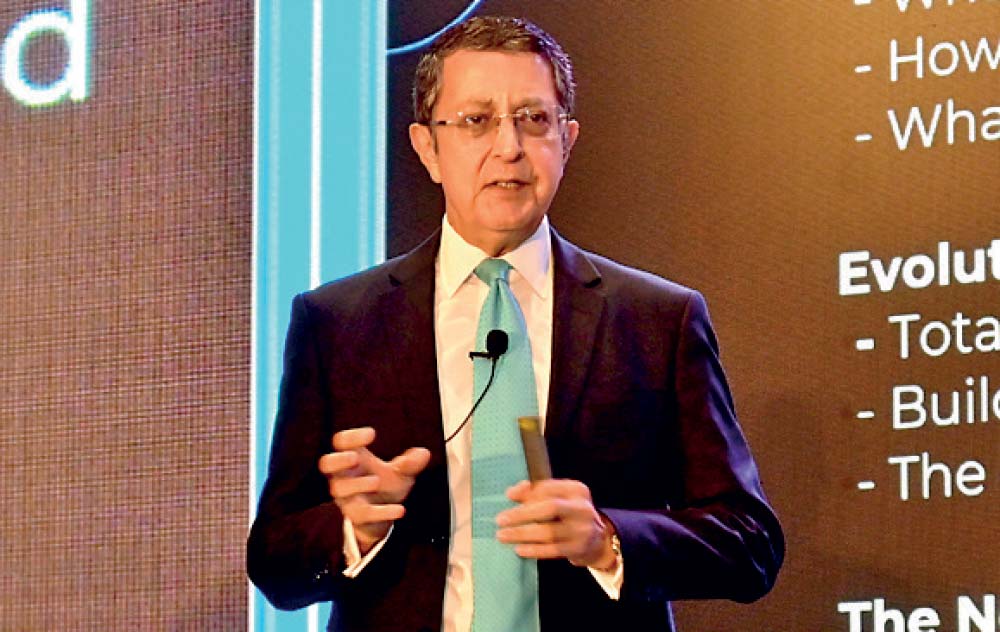
3A Ventures International Partner and Director – Asia Cyrus Daruwala – Pic by Lasantha Kumara
Sri Lanka is overbanked relative to regional peers and should brace for consolidation, 3A Ventures International Partner and Director – Asia Cyrus Daruwala told delegates at ‘The CIO Confluence 2026: Beyond Digital – The Intelligent Banking Era,’ organised by the Banks’ CIO Forum. Daruwala is a senior financial services leader with more than 25 years’ experience across banking, insurance, and capital markets, including in the Middle East.
“Sri Lanka is overbanked,” he said, comparing the country’s ratio of banks to banked population unfavourably against Malaysia, a market of similar population size with fewer institutions.
Consolidation had already reshaped banking in Hong Kong, Singapore, and Malaysia, he said, and could follow the same path locally.
He urged Chief Information Officers (CIOs) and Chief Technology Officers (CTOs) in the room to consider their own relevance in the event of a merger wave.
Three areas needed fixing first, according to Daruwala, whose firm advises close to 200 banks globally: legacy core banking systems, the payments ecosystem, and data monetisation. Net interest margin had become a commodity, he said; meaningful profit now sat in loan origination and payments instead.
The case for aggressive Artificial Intelligence (AI) investment in Sri Lanka was weaker than commonly assumed, he argued.
The sector had barely changed in a decade, the customer base remained static at roughly 21 million people, the product range was unchanged, and competitive intensity among the country’s 15 to 20 banks had not shifted. On that basis, he said, AI spending locally could only really be justified on process efficiency grounds, not transformative growth.
DBS Bank’s experience made the same point at regional scale. The Singapore-based lender, one of Asia’s largest by assets, spent $ 20 m across various AI use cases without producing any measurable gain in revenue, customer numbers, or headcount reduction. When its Chief Executive asked the CTO to show a return on that outlay, none could be shown. “Zero,” Daruwala said of the result.
At Banco Bilbao Vizcaya Argentaria (BBVA), close to 6,000 developer roles disappeared as AI took over bug-fixing and loan-processing work previously outsourced to firms such as Wipro and Infosys. Accenture cut roughly 10% of its workforce, about 10,000 people, on similar grounds. “This is the reality because it’s a tool,” Daruwala said. He likened the shift to WhatsApp’s effect on telecom revenue: AI was not eliminating banking functions so much as diverting revenue towards whichever institutions moved first.
Two staff at State Bank of India monitor some 26,000 to 27,000 automated teller machines around the clock, he noted, through an agentic system run by outsourcing partner FSS, an illustration, he said, of the scale of efficiency gains now available.
Uncoordinated AI purchases were, in his assessment, the primary cause of poor returns across the region, and he recommended banks form an AI steering committee spanning infrastructure, data, and applications.
A legal dimension was also emerging: a customer denied a loan by United Overseas Bank (UOB) successfully challenged the decision, and regulators would increasingly demand explainable justification for AI-assisted credit decisions rather than accept “AI did it” as an answer.
Sri Lanka’s absence of institutions comparable to the Massachusetts Institute of Technology or the Indian Institutes of Technology limited the domestic technology talent pool, Daruwala said, and banks should look to regional best practice instead, the same approach the United Arab Emirates (UAE) took in studying Singapore and Hong Kong to build its financial sector.
Banks should buy and customise AI solutions rather than attempt to build them in-house, he advised, warning that the pace of change would leave internally developed systems obsolete before completion. Every AI initiative, he suggested, should be weighed on a two-axis framework balancing implementation speed against enterprise risk, a lesson from First Abu Dhabi Bank’s operational standstill after a data centre was struck during the recent regional conflict.
A criminal enclave near the Thailand-Cambodia border possessed quantum computing capacity capable of decrypting encrypted financial communications and transaction data previously assumed secure, Daruwala warned. “We think we are secure, but we are not,” he told delegates.
He closed with a direct challenge, framing AI adoption as a career decision rather than a corporate one.
“Not doing agentic tech or AI is a choice, but let that be your decision, because that’s how you’re going to either make it or break it for your own personal career,” he said. “But if you do, you’ll be remembered for creating something new to help people build careers. Build a bit of a legacy yourself within your division.”




