Friday Sep 25, 2026
Friday Sep 25, 2026
Saturday, 13 December 2025 00:48 - - {{hitsCtrl.values.hits}}
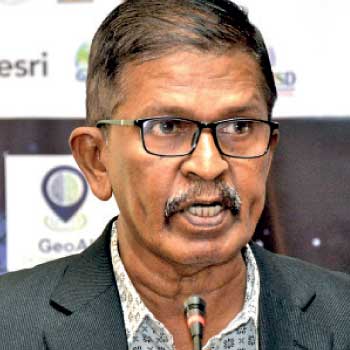 |
| ADRiMP President Sarath Premalal |
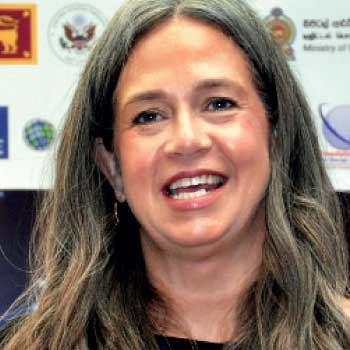 |
| Sri Lanka US Embassy Deputy Chief of Mission Jayne A. Howell |
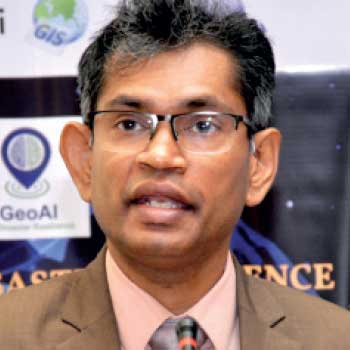 |
| Digital Economy Ministry Actg. Secretary Waruna Sri Dhanapala |
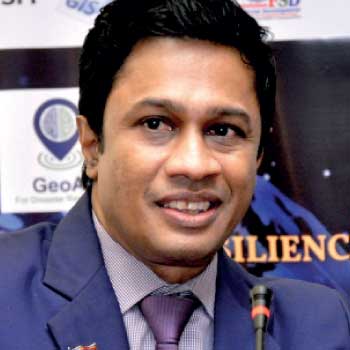 |
| Colombo University Vice Chancellor Prof. Indika Mahesh Karunathilaka |
By Amira Cader
Sri Lanka yesterday marked a major step toward modernising its disaster management capabilities with the launch of the GeoAI for Disaster Resilience initiative at the Taj Samudra Hotel, Colombo.
The program brings together Artificial Intelligence and Geographic Information Systems (GIS) to strengthen early warning systems, improve emergency response and enhance long-term planning.
The event commenced with a one-minute silence in memory of the victims of Cyclone Ditwah, last month’s devastating storm that caused widespread flooding.
The disaster affected over one million people, claimed hundreds of lives and has been described as the worst catastrophe to hit Sri Lanka since the 2004 tsunami. The destruction has also slowed the country’s economic recovery, with major rebuilding efforts still underway across affected districts.
Delivering the welcome address, ADRIMP President Sarath Premalal emphasised the urgency for innovation: “Sri Lanka’s climate risks are increasing every year. GeoAI gives us the opportunity to think ahead to forecast hazards more accurately and ensure our responders have the knowledge and technology needed to save lives.”
More than 20 Government officials and 125 university students have joined the yearlong program, supported by the US Embassy in Sri Lanka, which aims to train a new generation of disaster-tech specialists through advanced GeoAI learning.
GeoAI Project Lead Dr. Novil Wijesekara highlighted the program’s transformative potential: “Our goal is not only to introduce new tools but to strengthen the entire ecosystem, from real-time data to predictive models, so Sri Lanka can shift from reactive disaster response to proactive, intelligence-driven preparedness.”
Dr. Wijesekara urges Sri Lanka to pair innovation with human commitment, highlighting that technology can guide recovery but people drive it.
Digital Economy Ministry Acting Secretary Waruna Sri Dhanapala underscored the importance of digital readiness: “Digital transformation is central to Sri Lanka’s future. GeoAI will unify fragmented data, strengthen inter-agency coordination and enable rapid decision-making during national emergencies.”
Disaster Management Centre Director General Major General Sampath Kotuwegoda stressed operational impact: “Every minute matters during a disaster. Tools like GeoAI can give our teams the critical lead time needed during floods, landslides and cyclones. This initiative will directly support our frontline responders.”
US Embassy Deputy Chief of Mission Jayne A. Howell, who also served as the chief guest reaffirmed the United States’ continued support: “Investing in these young minds is investing in Sri Lanka’s safer future. The United States is proud to support this initiative, which strengthens early warning systems, enhances emergency response and builds long-term national resilience.”
University of Colombo Vice Chancellor Prof. Indika Mahesh Karunathilaka, who was the guest of honour, spoke on the role of youth in national recovery: “This program will empower our youth with greater vigilance and advanced skills. It is the young people of Sri Lanka who are now rebuilding, both financially and physically after the devastation of Cyclone Ditwah. Their contribution is vital and GeoAI will further strengthen their ability to support the country in times of crisis.”
The launch brought together technical agencies and development partners. Over the coming year, students will receive training in hazard mapping, drone data analysis, predictive modelling and real-time emergency response applications.
As climate-driven disasters intensify globally and locally, the GeoAI initiative is expected to play a critical role in strengthening Sri Lanka’s preparedness, enhancing inter-agency coordination and positioning the nation as a regional leader in AI-powered disaster resilience.
Pix by Lasantha Kumara




