Thursday Oct 22, 2026
Thursday Oct 22, 2026
Monday, 4 May 2026 04:57 - - {{hitsCtrl.values.hits}}
The Ceylon Petroleum Corporation (CPC) has come under scrutiny from fuel dealers, who have raised concerns over the reported Rs. 36.4 billion profit for 2025, as disclosed in the latest report of the Central Bank of Sri Lanka (CBSL).
The Petroleum Dealers’ Association has alleged that the profit figure includes revenue generated through what it describes as “unlawful deductions” from dealer margins implemented during 2025. According to the Association, since the establishment of the CPC in 1961, fuel dealers, who serve as key stakeholders in the retail supply chain, have been entitled to a defined share of dealer margins. However, from 1 March 2025, the CPC is alleged to have unilaterally reduced this share by more than half.
The Association said the move has significantly impacted the financial viability of dealers, making it increasingly difficult to sustain operations. It warned that nearly 200 cooperative fuel stations operating as CPC dealers, along with a considerable number of rural filling stations, are now at risk of closure.
The matter has reportedly been brought to the attention of President Anura Kumara Dissanayake.
Fuel dealers also pointed to the Cabinet-approved pricing formula introduced on 29 November 2022 under reference No. 22/1876/604/706, which was designed to facilitate the entry and stabilisation of international oil companies in Sri Lanka’s fuel market.
Under this framework, oil companies were allocated a 4% (V6) profit margin and a 2% (V5) operational margin, while distributors were entitled to an operational margin of approximately 2.96% (around 3%) under the V2h component. Subsequently, the CPC Board of Directors, through Board Paper No. 27/1281 dated 16 August 2023, had reaffirmed the dealer margin at 3%. The Association noted that international oil companies continue to adhere to this structure, providing their dealers with a 3% margin based on the Maximum Retail Price (MRP), in line with contractual agreements.
However, the Association alleged that the CPC’s current management reduced the dealer margin under the pricing formula from 3% to 1.5% with effect from 1 March 2025. It claimed that this reduction was implemented unilaterally, with the deducted portion effectively absorbed into the CPC’s profit.
According to audited financial statements for 2024, the Association pointed out that the CPC’s profit was Rs. 34.2 billion. In this context, it questioned how the 2025 profit of Rs. 36.4 billion could be presented as a significant increase, suggesting that the figure may have been inflated through the inclusion of margins deducted from dealers.
At the time of introducing the pricing formula, the Cabinet of Ministers had ensured that, for every price revision, the relevant line ministry published the applicable formula together with prevailing prices and the associated cost components. This practice was consistently followed up to September 2024. However, since October 2024, the pricing formula and its underlying cost details have not been published by the Power and Energy Ministry or by any other Government authority at the time of price revisions.
The Association said this lack of disclosure raises serious concerns regarding transparency, accountability, and the integrity of the decision-making process. In the absence of publicly available information, stakeholders are unable to verify whether pricing adjustments are being carried out in accordance with the originally approved formula.
Given the importance of transparency in maintaining public trust, the Association has urged authorities to resume the regular publication of the pricing formula and its key components for each revision, while also calling for a review of the current pricing structure to ensure fairness and sustainability across the fuel distribution network.
Fuel prices increase again
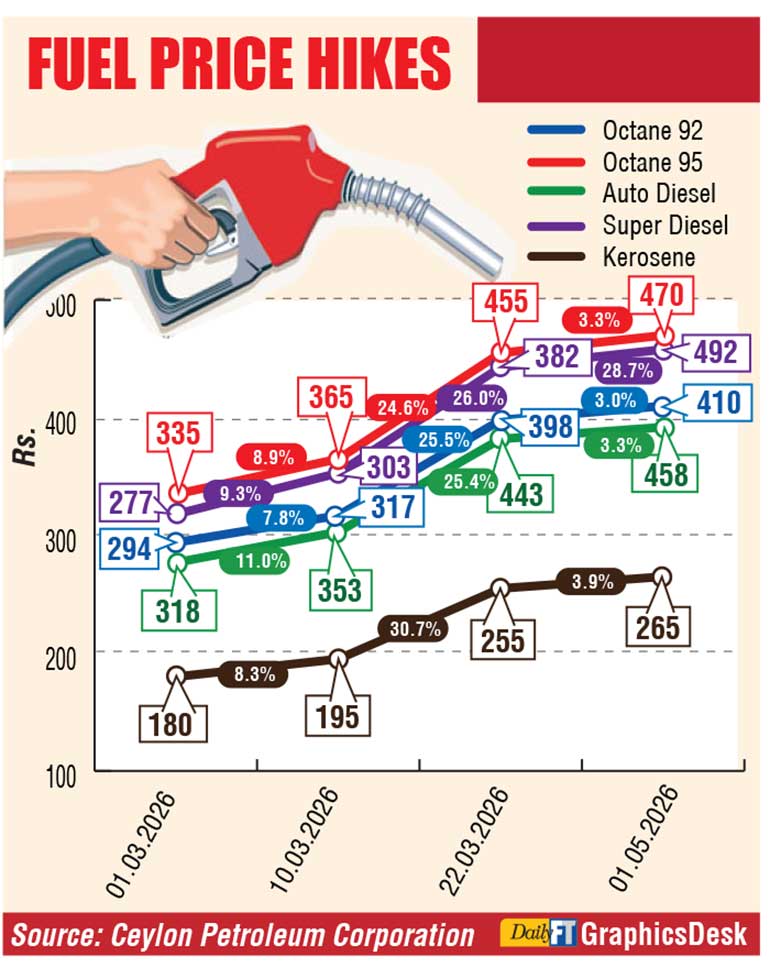
Fuel prices were increased with effect from midnight on 1 May, with the Ceylon Petroleum Corporation (CPC) revising retail prices across key fuel categories.
According to the CPC, auto diesel was increased by Rs. 10 to Rs. 392 per litre, while super diesel rose by Rs. 15 to Rs. 458. Petrol octane 92 was raised by Rs. 12 to Rs. 410, and petrol octane 95 by Rs. 15 to Rs. 470. The price of kerosene was also increased by Rs. 10 to Rs. 265 per litre.
Lanka Indian Oil Company (LIOC) said it had revised its prices in line with the CPC, with effect from midnight yesterday. Accordingly, LIOC increased the price of Lanka Auto Diesel to Rs. 392 and Petrol 92 to Rs. 410. The company said prices of other fuel categories remain unchanged.
Since the Government revised fuel prices on 9 March to deal with the Mideast war supply shock, fuel prices have increased cumulatively by Rs. 89 for auto diesel, Rs. 105 for super diesel, Rs. 93 for petrol 92, Rs. 105 for petrol 95, and Rs. 70 for kerosene.




