Sunday Oct 11, 2026
Sunday Oct 11, 2026
Monday, 16 March 2026 05:30 - - {{hitsCtrl.values.hits}}
 In a better-later-than-never move, the Government yesterday reintroduced the fuel QR code system to manage limited fuel stocks and prevent panic buying as the ongoing Mideast crisis disrupts global oil supplies and pressures prices.
In a public notice issued yesterday, the Energy Ministry said the petroleum product supply chain has been adversely affected by the prevailing geopolitical developments in the Middle East, while demand for fuel in Sri Lanka has increased abnormally in recent days.
The Central Bank of Sri Lanka (CBSL) on Friday said that during the period from 9 March to 13 March, crude oil prices rose to their highest level since July 2022, driven by tighter Middle Eastern oil supplies amid the escalating US-Israel war with Iran.
Prices eased mid-week on expectations of easing tensions in the region and a possible release of oil reserves to support global supply. However, prices rose again towards the end of the period as Iran intensified attacks on oil facilities and supply chains across the Middle East, disrupting global oil supplies further.
Overall, by end of the week, Brent and WTI crude oil prices increased by $ 16 per barrel and $ 16.04 per barrel, respectively, compared to a week ago.
Authorities said the situation has led to a depletion of the country’s existing fuel reserves, making it necessary to carefully manage available stocks in order to sustain national economic activities.
“The petroleum product supply chain has been adversely affected. At the same time, the demand for fuel has increased abnormally, resulting in a depletion of the country’s existing fuel stock,” the Ministry said.
The notice also said certain groups have been illegally purchasing fuel in excessive quantities, which the Government intends to prevent through the QR-based system to ensure uninterrupted fuel supply for the public and the economy.
Accordingly, fuel will not be issued by any operating filling station in the country without a valid QR code from 6 a.m. yesterday (15).
Users who had already registered for the fuel QR system and whose vehicle ownership and registered mobile number remain unchanged since their initial registration were able to download their QR code from the official portal https://fuelpass.gov.lk from midnight on 14 March using the “Vehicle Login” option.
Those whose vehicle ownership or registered mobile number had changed since their previous registration were required to re-register their details through the same portal from 6 a.m. yesterday using the “Vehicle Registration” option.
Vehicle owners who had not previously registered for the QR system, as well as users with newly registered vehicles at the Department of Motor Traffic, were also able to complete registration through the same portal from 6 a.m. yesterday.
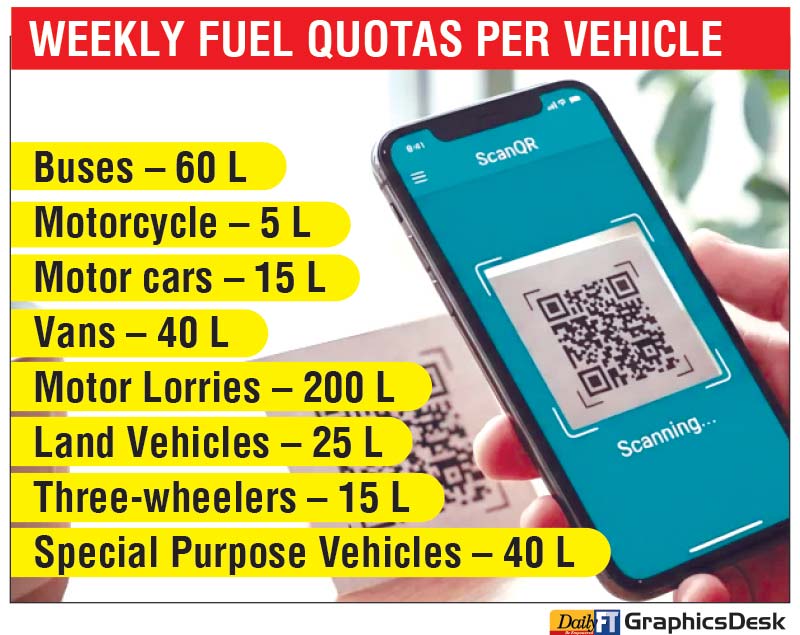
The Ministry said the quantity of fuel allocated for each category of vehicle is specified in an accompanying schedule.
It also said a special fuel issuance system will be implemented for vehicles required to support national production and essential services.
The Ministry has also specified weekly fuel quotas under the QR system for different categories of vehicles. Buses will be allocated 60 litres per week, motorcycles 5 litres, motor cars 15 litres, vans 40 litres, motor lorries 200 litres, land vehicles 25 litres, three-wheelers 15 litres, and Special Purpose Vehicles 40 litres. These allocations will be enforced through the QR-based system at filling stations across the country.
The QR-based quota system was first introduced in August 2022 at the height of the debt crisis to manage severe fuel shortages. At that time, the weekly allocations were set at 5 litres for three-wheelers, 4 litres for motorcycles, 40 litres for buses, 20 litres for motor cars, 15 litres for land vehicles, 50 litres for lorries, 4 litres for quadricycles, and 20 litres for Special Purpose Vehicles.
Last week, President Anura Kumara Dissanayake said: “Continuous energy supply can now be assured. However, it is only possible to forecast and guarantee this reliably for a maximum period of two months,” in remarks released by the President’s Media Division. “If the conflict persists beyond this two-month window, predictions based on current assessments will no longer hold.”
The President said maintaining uninterrupted energy supply is critical to protecting the economic stabilisation achieved since the crisis. The President also urged the public to moderate consumption and avoid panic buying.
The Government has announced that it has secured oil supplies from India and has discussions ongoing with Russia.
Certain users meanwhile encountered glitches yesterday following the reintroduction of the fuel QR code system. The Department of Government Information said steps were taken to address issues that have arisen since the system was brought back into operation.
In a statement, Director General of Government Information Harsha Bandara said motorists who had previously obtained a QR code and continue to use the same vehicle and registered mobile number should be able to update and obtain the new QR code without difficulty.
Authorities are also working to identify and resolve issues faced by individuals whose vehicle ownership or registered phone numbers have changed, as well as those who have recently purchased new vehicles.
He added that decisions would be taken yesterday evening regarding specific issues, including fuel supplies for essential services and agricultural activities, with solutions expected to be implemented from today (16).




