Saturday Oct 10, 2026
Saturday Oct 10, 2026
Tuesday, 30 June 2026 06:34 - - {{hitsCtrl.values.hits}}
At the crossroads of the world’s digital highways
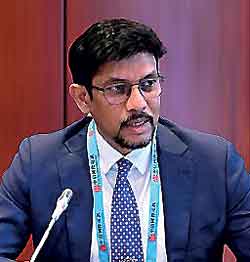 |
| Deputy Digital Economy Minister Eng. Eranga Weeraratne |
At MWC Shanghai 2026, Sri Lanka presented a bold vision to become a trusted regional hub for AI, digital infrastructure and cross-border collaboration.
As artificial intelligence reshapes economies across the world, a fundamental question confronts every emerging nation: Will they simply consume AI developed elsewhere, or will they actively participate in creating it?
That question formed the centrepiece of Sri Lanka’s message at MWC Shanghai 2026, where Deputy Digital Economy Minister Eng. Eranga Weeraratne addressed the GSMA Roundtable on “Powering the AI Economy: Computing–Network Synergy.”
Rather than positioning Sri Lanka as another technology adopter, he outlined an ambitious vision for the country to become a trusted partner in building the region’s AI future, leveraging its strategic geography, digital infrastructure, renewable energy ambitions and skilled workforce.
The message was simple yet significant: “Sri Lanka intends to be a producer, not only a consumer.” It was a statement of intent that reflects Sri Lanka’s broader digital transformation strategy and its aspiration to play a meaningful role in the evolving global AI economy.
The new race isn’t about AI alone. Artificial intelligence has become one of the defining technologies of this century. Nations are investing billions of dollars in computing infrastructure, semiconductor technologies, cloud platforms, large language models and high-capacity data centres.
Yet AI is about much more than algorithms. Behind every AI application lies an enormous physical infrastructure comprising global fibre optic networks, subsea cables, data centres, cloud platforms, cybersecurity systems and reliable energy supplies.
Countries that own, or strategically position themselves within this digital infrastructure will increasingly shape the future global economy. For many smaller nations, the challenge is significant. Limited computing resources, high infrastructure costs, language diversity, cybersecurity risks and data sovereignty concerns often force countries to become dependent consumers of technologies developed elsewhere.
Sri Lanka believes there is another path. Rather than attempting to compete with global technology giants, the country seeks to become an enabling platform where international collaboration, trusted infrastructure and sovereign digital capabilities can flourish together.
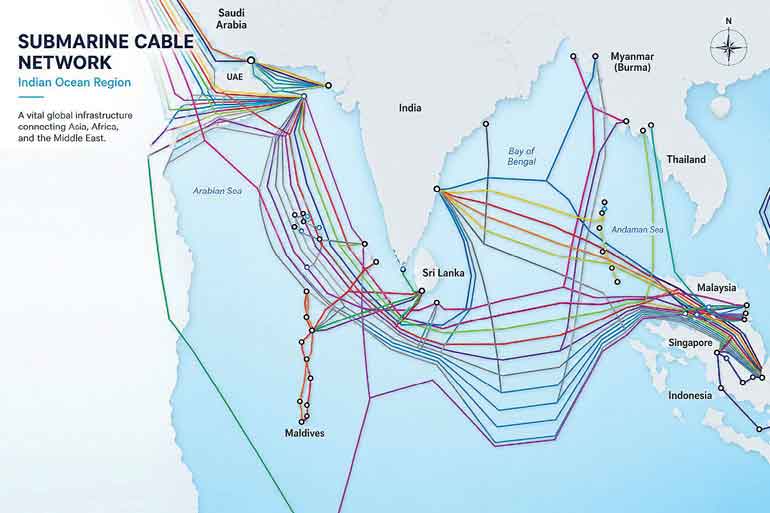
One of Sri Lanka’s greatest strategic advantages is something invisible to most people. Beneath the Indian Ocean lies one of the world’s busiest digital highways. Multiple international submarine fibre optic cable systems including SEA-ME-WE 3, SEA-ME-WE 4, SEA-ME-WE 5, SEA-ME-WE 6, and the India Asia Xpress (IAX) pass through Sri Lanka, carrying enormous volumes of international internet traffic between Europe, Middle East and Asia.
These cables are the backbone of today’s digital economy. Every international financial transaction, cloud service, AI model, streaming platform and enterprise application depends on these global networks.
Sri Lanka is no longer simply a landing point along these routes. The country is also home to South Asia’s first submarine cable depot, strengthening its role in maintaining and supporting critical regional digital infrastructure.
Combined with the country’s location at the centre of the Indian Ocean, these assets position Sri Lanka as a natural digital bridge connecting East and West.
Connectivity alone is no longer enough. The next generation of digital economies will depend equally on where computing happens. Around the world, AI is driving unprecedented demand for hyperscale data centres capable of supporting advanced computing, cloud services and AI model training.
Sri Lanka believes it can become part of this new infrastructure landscape. The country’s vision extends beyond hosting data. It seeks to create an integrated ecosystem where connectivity, computing, cybersecurity, trusted governance and renewable energy come together to support AI innovation for the region.
Such an ecosystem would enable businesses, governments and researchers to develop AI solutions closer to where data is generated while maintaining greater resilience, lower latency and stronger digital sovereignty.
One of the defining themes of Sri Lanka’s presentation was sovereign AI. However, sovereignty was not presented as technological isolation. Instead, it was defined as the ability to retain control over sensitive national data, develop AI systems that understand local languages and cultures, and ensure that critical digital infrastructure remains trusted and resilient.
At the same time, Sri Lanka recognised that no country can build the AI future alone. The Deputy Minister therefore proposed regional cooperation across seven key areas: Sovereign AI, Affordable and inclusive AI, Green computing, Local-language AI models, AI literacy, Cyber resilience and Computing-network synergy Rather than advocating exclusive alliances, Sri Lanka called for shared principles, interoperable infrastructure and trusted partnerships that benefit all participating nations. The vision is one of collaboration, not competition.
Several factors strengthen Sri Lanka’s proposition as an emerging regional AI hub. Located at the centre of major international maritime and digital routes, Sri Lanka naturally connects Europe, the Middle East and Asia. Multiple international submarine cable systems provide resilient, high-capacity international connectivity essential for cloud computing and AI.
Sri Lanka has set an ambitious target of generating 70 percent of its electricity from renewable sources by 2030, while working towards carbon-neutral electricity generation by 2050. As global technology companies increasingly prioritise sustainable infrastructure, access to renewable energy will become a significant competitive advantage.
Sri Lanka continues to position itself as a trusted, non-aligned destination for international investment and digital partnerships, offering stability and openness in an increasingly complex geopolitical landscape. With a growing ICT sector, English-speaking professionals and expanding digital talent, Sri Lanka possesses the skills required to support next-generation digital services and AI innovation.
Rather than presenting a list of ambitions, Sri Lanka also presented a practical partnership proposition.
The country offers: A strategically located, green-powered data centre destination, a regional interconnection hub on the East-West digital corridor, a testbed for sovereign and local-language AI, and skilled English-speaking digital talent.
In return, Sri Lanka seeks: Investment in advanced computing and digital infrastructure, collaborative AI research, and partnerships in cybersecurity and AI governance.
It is a model built on shared value rather than dependence, one that recognises that regional AI development requires collective effort.
The conversations held in Shanghai were not intended to end there. Sri Lanka extended an invitation to governments, technology companies, investors, research institutions and development partners to continue this dialogue through future AI forums and digital economy initiatives hosted in Sri Lanka.
As AI transforms industries and societies worldwide, countries that successfully combine trusted governance, resilient infrastructure, renewable energy and international collaboration will become the foundations of tomorrow’s digital economy. Sri Lanka believes it can be one of those foundations. Its ambition is not to compete with the world’s largest technology powers, but to become a trusted regional platform where innovation, infrastructure and international cooperation converge.
As Deputy Minister Eranga Weeraratne concluded: “We wish to be an active platform for regional cooperation in AI.”




