Thursday Oct 15, 2026
Thursday Oct 15, 2026
Thursday, 15 October 2026 06:14 - - {{hitsCtrl.values.hits}}
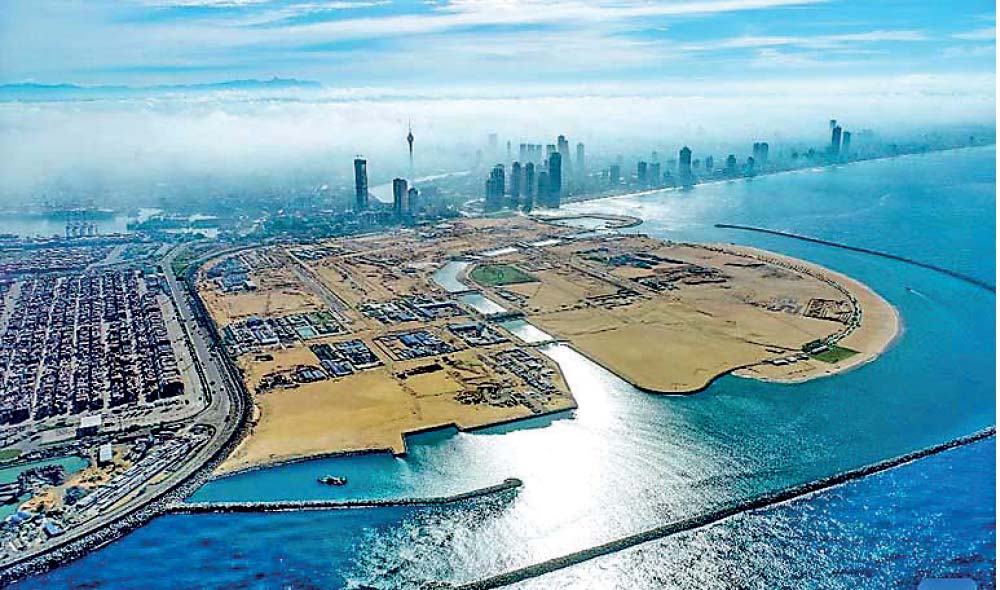
Parliament’s Committee on Public Finance (CoPF) is seeking the Attorney General’s opinion on whether Colombo Port City apartments can lawfully be sold on a freehold basis when the underlying land is held on 99-year leases. The committee is also pressing for tighter controls over how developers raise presale proceeds and fund construction.
Colombo Port City Economic Commission (CPCEC) Chairman Harsha Amarasekera, PC, told the committee that Section 38 of the Colombo Port City Economic Commission Act, enacted in 2021, empowers the Commission to lease or transfer, on a freehold basis, condominium parcels on land leased to the project company. Because the Commission must join in each conveyance to the end purchaser, he said, the provision was designed to close a gap in the law, and the Commission did not consider it a legal impediment.
Opposition MP Ravi Karunanayake disputed this. He argued that Sri Lanka had told the world the Port City was available only on 99-year leases, so converting this to freehold created a risk for the country, and called for a comprehensive response on the provision’s validity and the country’s obligations. COPF Chairman MP Dr. Harsha de Silva said that if the problem lay in the Act, it was for Parliament, not the Commission, to amend it. A Government member noted that the Attorney General’s Department had vetted the Bill before Parliament approved it.
The funding rules drew equal scrutiny. Amarasekera said the entire construction cost of a primary project must be met in foreign currency raised outside Sri Lanka, and cannot be financed through foreign currency deposits or foreign currency loans from local banks. Apartments, however, may be sold in rupees, even entirely to local buyers. Foreign purchases must be routed through an Inward Investment Account (IIA), a designated account for channelling foreign investment into Sri Lanka. Developers that fail to bring in the full construction cost in foreign currency lose their exemptions under the Act.
Dr. de Silva cited one developer’s public claims that 50% of its units had been sold before the official launch and that its project was valued at $ 300 million. The project is gazetted at $ 152 million, of which Amarasekera said the $ 110 million construction component must come in as foreign currency. He said the Commission would audit actual construction costs rather than rely on disclosed figures.
Dr. de Silva said the regime fell short of global best practice in several respects. Presales face no restriction ahead of construction milestones, developers need not publicly disclose balance sheets, and beneficial ownership is not always clear. He urged the Commission to consider escrow accounts, which hold buyers’ money until set conditions are met, so that presale funds are used for their intended purpose. The Commission said escrow accounts had been discussed and that it was reviewing its condominium management regulations, in consultation with the Legal Draftsman, with a view to adopting such practices in the next revision.
On reporting, the Act requires annual returns, which are due at the end of October under an expanded schedule. Amarasekera said the Commission nonetheless obtains sales and inflow updates from developers almost monthly. Dr. de Silva questioned whether annual reporting was adequate.
The committee’s concerns extended to smaller investors. Its own review of the 68 secondary businesses of strategic importance (BSIs) Gazetted in April found that most listed no parent company and many were incorporated in the British Virgin Islands. Dr. de Silva noted some had invested as little as $ 2,500, yet qualified for BSI status and a 7.5% tax rate.
Amarasekera could not say what one business Gazetted with a $ 10,000 investment does, but said the Commission examined each application before approval. Where no parent company is listed, the Commission said, the applicant is owned by individuals, who are screened as the beneficial owners. It added that beneficial ownership information is collected at application, and that beneficial ownership provisions from this year’s Companies Act amendments have been made mandatory in annual returns.
Earlier approvals have also faltered. Of 10 approvals the committee reviewed, Dr. de Silva counted five as withdrawn, though the Commission said some of those he named had never been Gazetted. One withdrawn project had promised a seven-star hotel and a vertical art gallery aimed at a Guinness World Record. Its investor had paid only a $ 10,000 application fee and is believed to have forfeited a token deposit to the project company.
Dr. de Silva also urged the Commission to reconsider appointing a full-time legal head. Amarasekera said the Commission relies on the Attorney General for substantive legal advice. Its Director-Commercial, who has a legal background, also covers legal affairs and was recently authorised to sign off as Director-Legal; no Director-Legal salary is being paid. Members also raised an unresolved question over where Port City residents would vote in local government elections, and the Commission said it would seek advice.




