Sunday Oct 04, 2026
Sunday Oct 04, 2026
Tuesday, 26 May 2026 05:23 - - {{hitsCtrl.values.hits}}
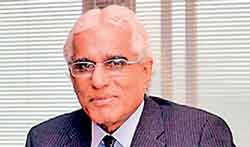 |
| Former CBSL Governor Dr. Indrajit Coomaraswamy |
Former Central Bank of Sri Lanka (CBSL) Governor Dr. Indrajit Coomaraswamy has said the recent depreciation pressure on the rupee was driven primarily by external shocks stemming from the Middle East conflict, while arguing that market participants had overreacted despite major improvements in Sri Lanka’s macroeconomic policy framework.
Speaking to Insight News, Dr. Coomaraswamy said the current situation was “qualitatively different” from the 2022 economic crisis, noting that the domestic policy environment had strengthened significantly through reforms introduced under the Public Finance Management Act, the Central Bank Act, and cost-reflective pricing mechanisms.
“This is much more an externally induced set of developments,” he said, contrasting current pressures with the domestic policy failures that contributed to the 2022 collapse, including large tax cuts, monetary financing, and unsustainable fiscal deficits.
Dr. Coomaraswamy said the legal and institutional reforms introduced since the crisis had fundamentally altered the country’s macroeconomic management framework, arguing that the policy excesses seen before 2022 were no longer possible under the current regime.
He said Sri Lanka’s reserve position was substantially stronger than during the sovereign default period, noting that usable reserves had risen from around $ 20 million at the time of the April 2022 debt standstill to approximately $ 5.3 billion currently, after excluding the People’s Bank of China swap arrangement.
Dr. Coomaraswamy acknowledged that rising oil prices had intensified pressure on the external sector, citing estimates that the Ceylon Petroleum Corporation’s (CPC) monthly import bill had increased to around $ 521 million in May from about $ 152 million in December 2025 amid the Middle East conflict.
However, he argued that market behaviour had amplified the pressure beyond what underlying conditions warranted.
“I think importers have front-loaded imports. Exporters, I suspect, are delaying their conversions. And that has caused a liquidity problem in the foreign exchange market,” he said.
He added that many market participants appeared to be reacting based on memories of the 2022 crisis rather than recognising the structural changes made to macroeconomic management since then.
On inflation, Dr. Coomaraswamy said the recent acceleration from 2.2% to 5.4% reflected external price pressures, and warned that inflation could move towards the upper end of the CBSL’s 3%-7% target range if energy prices remained elevated.
He said the Monetary Policy Board would likely assess whether interest rate adjustments were necessary to ensure inflation remained within target under the flexible inflation targeting framework.
Dr. Coomaraswamy also defended targeted and time-bound fuel support measures, arguing that temporary assistance during externally driven shocks was broadly acceptable within International Monetary Fund (IMF) program parameters, provided overall cost-reflective pricing was maintained.
He cautioned against introducing broad import restrictions or administrative controls, saying such measures could undermine investor confidence at a time when Sri Lanka was attempting to restore credibility with both domestic and foreign investors.
On the longer-term outlook, Dr. Coomaraswamy said Sri Lanka could no longer rely on unsustainable fiscal expansion and monetary stimulus to generate growth, arguing that future growth would depend on structural reforms, productivity improvements, and maintaining macroeconomic discipline.



