Tuesday Sep 15, 2026
Tuesday Sep 15, 2026
Saturday, 7 March 2026 00:35 - - {{hitsCtrl.values.hits}}
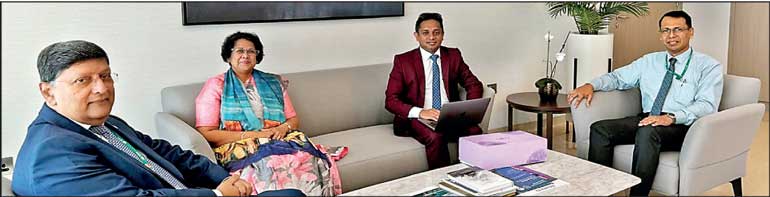
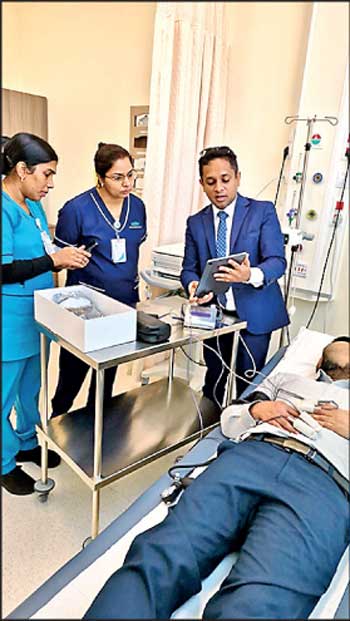 A Sri Lankan-invented medical device designed for the non-invasive early detection of cardiovascular conditions using Artificial Intelligence was successfully piloted at the King Hamad American Mission Hospital in the Kingdom of Bahrain.
The initiative was facilitated by the Embassy of Sri Lanka in Bahrain, in collaboration with the Information and Communication Technology Agency (ICTA) under the Ministry of Digital Economy of Sri Lanka.
The device, marketed under the trademark JENDO, is a novel screening system developed by a team of Sri Lankan scientists led by Engineer and biomedical innovator Keerthi Kodithuwakku. The technology enables early identification of vascular abnormalities and cardiovascular risk through non-invasive physiological signal analysis, supporting preventive healthcare and population-level screening.
Following an initial technical demonstration to the hospital’s medical team, the system was subsequently deployed for patient testing during the pilot program from 23 to 25 February. The trial evaluated the usability and clinical integration of the device within a hospital environment.
The King Hamad American Mission Hospital is the fifth and largest branch of the American Mission Hospital network in Bahrain, whose origins date back to 1903 with the establishment of the Mason Memorial Hospital.
Sri Lanka’s Ambassador to Bahrain Shanika Dissanayake, expressed appreciation to King Hamad American Mission Hospital CEO Dr. George Cheriyanfor enabling the pilot programme on the request of the Embassy.
She noted that the collaboration not only supported the advancement of the inventor’s research and commercialisation efforts but also highlighted the growing capacity of Sri Lanka in the field of digital health and medical innovation.
The JENDO device has previously received national recognition in Sri Lanka, including the Presidential Gold Award in 2025, and represents part of a broader effort to introduce scalable preventive healthcare technologies developed in Sri Lanka to international healthcare systems.




