Monday Sep 21, 2026
Monday Sep 21, 2026
Monday, 21 September 2026 03:55 - - {{hitsCtrl.values.hits}}
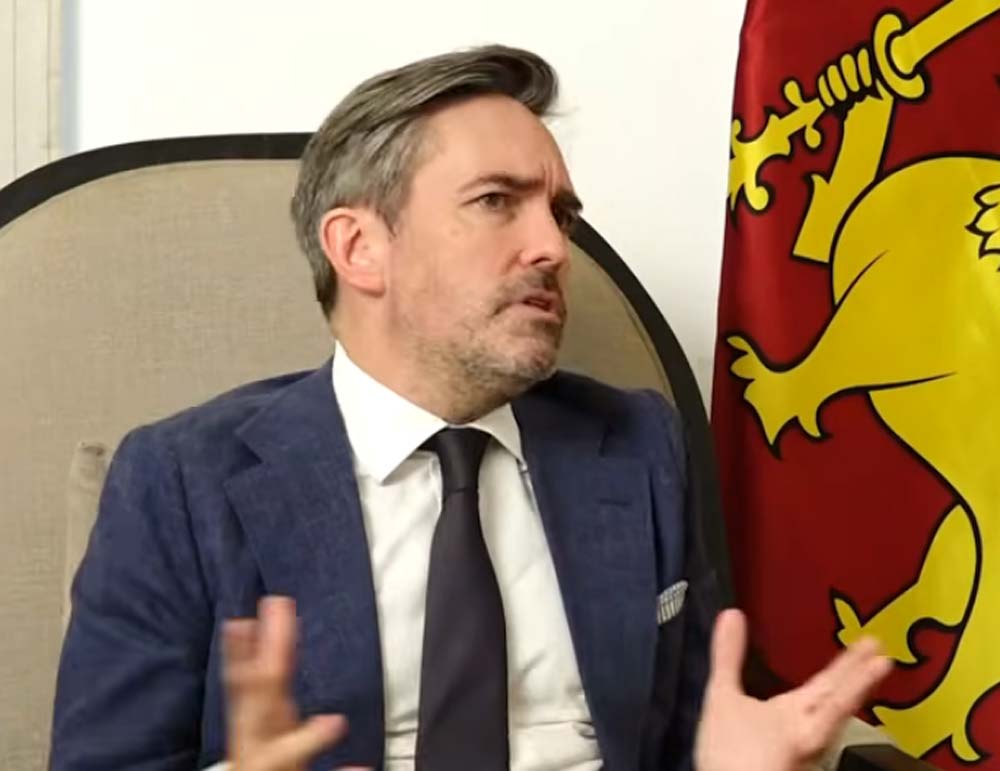
UN Resident Coordinator in Sri Lanka Marc-André Franche
UN Resident Coordinator in Sri Lanka Marc-André Franche said the combined impact of El Niño and the Indian Ocean Dipole on Sri Lanka remains highly uncertain, warning that the country needs to prepare for multiple possible scenarios, in a discussion with Opposition Leader Sajith Premadasa, a video of which Premadasa has released.
Franche said Sri Lanka is looking at two climate phenomena working simultaneously, and because they can work against each other, the net effect on the country is difficult to forecast.
He said the most likely scenario at present is a combination of drought and heat followed by heavy rainfall, but said the reverse, a mix of both, or neither materialising, were all possible outcomes.
He said the UN and the Food and Agriculture Organisation (FAO) have prepared a detailed paper modelling scenarios specific to Sri Lanka, which could be shared with Parliament or other forums.
Franche said the uncertainty meant Sri Lanka needed a localised, district-by-district approach rather than a single national response. He cited Anuradhapura as needing flood prevention measures and Monaragala needing drought prevention, with some districts requiring both. He said around 15 to 16 of the country’s 25 districts should be prioritised over the coming months.
Franche said addressing this was less a question of additional funding than of using existing funding, people, and capacities differently, though he acknowledged more resources would still be needed. He stressed that District Secretaries, Land Commissioners, Divisional Secretaries, farmer associations, and herders needed clear information to make decisions on planting timelines, since planting too early or too late could result in failed harvests and the need to replant in some areas.
Franche said the UN has been advocating for district-level plans and investment, and offered technical assistance, monitoring support, and modelling capacity to the Government.
He added that climate risk should not be viewed in isolation from other pressures facing the country, citing the economic crisis, Middle East tensions, and global disruptions including restrictions in the Strait of Hormuz and China’s export restrictions on fertiliser, alongside oil prices he noted were at $ 95 a barrel on the day of the discussion. He said this required a whole-of-Government approach, including diversifying fertiliser supply agreements through Sri Lanka’s diplomatic missions and accelerating renewable energy adoption to reduce dependence on costly fuel imports.
Franche said the UN was ready to support a Parliamentary Climate Committee discussion or a roundtable on the issue, offering to bring in UN experts to assist.




