Thursday Oct 22, 2026
Thursday Oct 22, 2026
Monday, 18 May 2026 00:00 - - {{hitsCtrl.values.hits}}
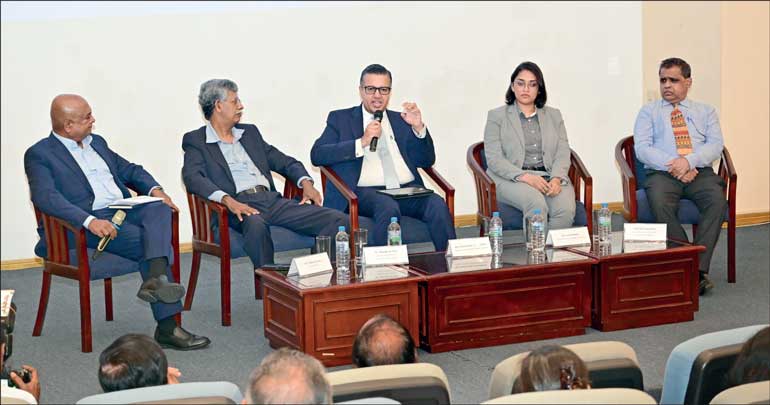
The panel discussion in session. From left: Daily FT Editor/CEO Nisthar Cassim (Moderator), Gamani Corea Foundation Board Director Manjula de Silva, CBSL Deputy Governor Dr. Chandranath Amarasekara, Ceylon Chamber of Commerce Economist Arani Rodrigo and Peradeniya University Senior Professor of Economics Prof. O.G. Dayaratna-Banda
-Pix by Sameera Wijesingha

Sri Lanka’s post-crisis recovery is entering a more difficult phase as policymakers, economists and businesses attempt to preserve stability amid rising geopolitical tensions, volatile energy markets and growing uncertainty in the global economy.
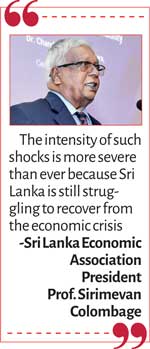
 Setting the tone and dining the scope of a recent seminar co-hosted by the Gamani Corea Foundation and the Sri Lanka Economic Association on “Sri Lanka’s Current Macroeconomic Policy Directions in the Current Global Volatility,” Sri Lanka Economic Association President Prof. Sirimevan Colombage said Sri Lanka, as a small open economy, remained highly vulnerable to external shocks, particularly while still recovering from the 2022 economic crisis and the aftereffects of Cyclone Ditwah.
He said recent developments, including US tariff actions and the conflict in the Middle East, had intensified risks facing the economy at a time when Sri Lanka was still rebuilding macroeconomic stability.
At the forum, speakers warned that the country’s next challenge would be sustaining reform momentum while rebuilding reserves, strengthening fiscal discipline and accelerating export-led growth in an increasingly unstable external environment.
Participants argued that Sri Lanka could no longer return to the cycle of stimulus-led growth, untargeted subsidies and heavy borrowing that culminated in the 2022 economic crisis, while also cautioning that repeated global shocks continue to expose structural weaknesses in the economy.
The context
Keynote speaker Central Bank Deputy Governor Dr. Chandranath Amarasekara warned that Sri Lanka cannot afford a return to the “stop-and-go” economic model driven by fiscal stimulus, money printing and untargeted subsidies, arguing that the country’s post-crisis recovery will only be sustained through deep structural reforms, fiscal discipline and productivity-led growth.
Delivering a presentation on Sri Lanka’s economic conditions and macroeconomic policy direction amid rising global volatility, Amarasekara said the economy had staged a significant recovery since the 2022 crisis, but cautioned that the gains remained vulnerable to external shocks, particularly the ongoing conflict in the Middle East and associated energy price pressures.
He said Sri Lanka’s economy expanded beyond $ 100 billion for the first time in 2025, with per capita GDP also exceeding $ 5,000, but stressed that the country had historically failed to sustain high growth momentum due to repeated policy reversals and dependence on short-term stimulus.
“At the time of independence, the size of the Sri Lankan economy was less than $ 1 billion. By 2025, the economy exceeded $ 100 billion for the first time and per capita GDP exceeded $ 5,000,” he said.
The growth question
However, Dr. Amarasekara said Sri Lanka’s economic history since independence reflected repeated cycles of expansion and contraction rather than sustained transformation.
“We have never been able to sustain our growth momentum. This is a stop-and-go cycle,” he said.
According to Dr. Amarasekara, Sri Lanka would take 102 years to reach Singapore’s current per capita income level if it grows at 3%, 62 years at 5% growth and 39 years even at 8% annual growth.
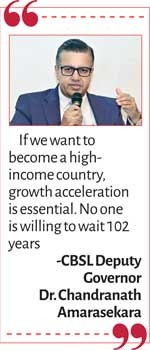
 “If we want to become a high-income country, growth acceleration is essential. No one is willing to wait 102 years,” he said.
He pointed to countries such as China, Vietnam, Korea, Singapore, Thailand and Malaysia as examples of economies that sustained high growth over decades through export-oriented industrialisation, trade openness, institutional strengthening and productivity gains.
Dr. Amarasekara said Sri Lanka’s 2022 economic collapse represented the culmination of long-standing vulnerabilities worsened by external shocks and policy mistakes.
The economy contracted 7.3% in 2022, followed by another 2% contraction in 2023, while inflation peaked at 70% in September 2022. The rupee depreciated from around Rs. 200 per dollar to above Rs. 360 in the formal market, reserves fell to negligible usable levels and fiscal deficits widened sharply.
He noted that Sri Lanka’s revenue-to-GDP ratio had fallen to among the lowest in the world during the build-up to the crisis.
“We have been living beyond our means for many decades,” he said, noting that revenue-to-GDP had dropped to 8.5% during 2020-2022.
Dr. Amarasekara said only nine countries globally recorded revenue ratios below 10% of GDP during that period.
“We cannot artificially keep revenue-to-GDP ratios low. We have already experienced the repercussions,” he said.
He said the IMF program approved in March 2023 differed significantly from Sri Lanka’s previous 16 IMF arrangements because the country’s debt had become unsustainable and restructuring was unavoidable.
Defending reforms
“Sri Lanka has borrowed 16 times from the IMF previously. If you take the past 65 years, we have been under IMF programmes for about 45 years,” he said.
Unlike previous programs aimed at balance of payments support through the Central Bank, Dr. Amarasekara said the current four-year IMF Extended Fund Facility was structured as budget support due to the severity of the crisis.
The $ 3 billion program has so far disbursed $ 1.7 billion, while Sri Lanka is awaiting approval for the fifth and sixth tranches.
Dr. Amarasekara argued that the IMF programme restored credibility rather than merely providing financing.
“Once the country loses trust, this is what brings us credibility,” he said.
He defended key IMF-backed reforms, arguing they reflected measures Sri Lanka needed irrespective of IMF involvement.
These included formula-based fuel pricing, cost-reflective electricity tariffs, the new Central Bank Act, anti-corruption legislation, public financial management reforms and restrictions on monetary financing.
“When you really think about the reforms we agreed to do with the IMF, those are the reforms we needed as a country,” he said.
Dr. Amarasekara strongly defended cost-reflective utility pricing, warning against politically driven subsidies.
He noted that electricity tariffs had not been revised between 2014 and August 2022 despite global energy price fluctuations, resulting in mounting losses.
“Petroleum prices, electricity prices and overall utility pricing cannot be government decisions. They have to be cost-reflective,” he said.
“If any government starts subsidising electricity or petroleum, remember that you have to pay for that in future.”
He argued that subsidies, where necessary, must be narrowly targeted at vulnerable groups rather than applied universally.
Dr. Amarasekara also defended the Central Bank’s post-crisis monetary tightening, arguing that rapid disinflation prevented Sri Lanka from entering prolonged hyperinflation episodes experienced by countries such as Venezuela and Zimbabwe.
 He said inflation was brought down from 70% to single digits within 10 months, before stabilising near the Central Bank’s 5% target. “If inflation had continued rising, Sri Lanka could have become like some of those countries that experienced prolonged hyperinflation,” he said.
Dr. Amarasekara said the new Central Bank Act established a more independent, transparent and evidence-based monetary policy framework under flexible inflation targeting, with a market-determined exchange rate regime.
He stressed that exchange rate flexibility was necessary despite recent depreciation pressures.
The rupee depreciated 3.6% against the US dollar so far in 2026, compared with a 44.8% depreciation in 2022. He noted several regional currencies had also weakened this year, including the Indian rupee, Indonesian rupiah and Nepalese rupee.
Dr. Amarasekara said the Central Bank had rebuilt reserves entirely through market purchases rather than sovereign borrowing.
The Central Bank purchased $ 1.7 billion from the market in 2023, $ 2.8 billion in 2024 and another $ 2 billion in 2025, contributing to gross official reserves of $ 6.8 billion by end-2025.
He also highlighted improvements in the fiscal sector, with the primary balance shifting from a deficit of 5.7% of GDP in 2021 to a surplus of 5.4% by 2025.
Meanwhile, the central Government debt-to-GDP ratio had declined to around 92%.
Dr. Amarasekara said private sector credit growth accelerated sharply in 2025, reaching around Rs. 2 trillion, supported partly by reduced borrowing by the Government and State-owned enterprises from the banking system.
He said this allowed banks to redirect lending towards the private sector without creating excessive macroeconomic imbalances.
On the external front, Dr. Amarasekara said Sri Lanka recorded current account surpluses for three consecutive years, an unprecedented development for the country.
Tourism and workers’ remittances played a significant role in offsetting a widening trade deficit.
However, he warned that the Middle East conflict posed significant downside risks through higher oil prices, fertiliser costs, shipping disruptions and weaker global demand.
“The funny thing is that no one knows what will happen,” he said.
“You prepare slides at night and by the next morning the story is completely different.”
Dr. Amarasekara said global growth was expected to slow in 2026 under the IMF’s baseline scenario as higher prices and geopolitical uncertainty dampened demand.
A panel discussion following Dr. Amarasekara’s presentation focused on Sri Lanka’s long-term resilience, the risks posed by global fragmentation and the importance of preserving post-crisis reforms.
Creative destruction
 Moderating the discussion, Daily FT Editor/CEO Nisthar Cassim said Sri Lanka had faced multiple crises in recent years, from the Easter Sunday attacks and the pandemic to the sovereign default and current geopolitical tensions, raising questions about how the country could strengthen long-term resilience.
Peradeniya University Senior Professor of Economics Prof. O. G. Dayaratna-Banda argued that the global economy was undergoing a deeper structural shift rather than a temporary disruption, describing the current period as a “creative destruction crisis”.
He said the post-Second World War global order and multilateral institutional framework were increasingly under pressure, while protectionism and retaliatory trade policies were re-emerging globally.
“There is an intense global trade war,” he said, adding that the world order appeared to be gradually changing.
However, Prof.Dayaratna-Banda argued that the shifting global landscape also created opportunities for Sri Lanka, particularly given its strategic location along East-West shipping routes.
Referring to disruptions caused by the Middle East conflict, he said Sri Lanka could potentially benefit as a maritime and logistics hub if the country was prepared to exploit emerging opportunities.
The economist also supported post-crisis institutional reforms, including the new Central Bank Act, fiscal discipline measures and anti-corruption initiatives, arguing that the 2022 crisis had forced the country to confront long-standing structural weaknesses.
He warned that Sri Lanka’s past growth model, driven by short-term stimulus and subsidies, had repeatedly resulted in economic shocks and reversals.
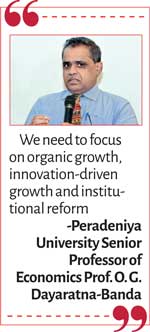
“We need to focus on organic growth, innovation-driven growth and institutional reform,” he said.
Gamani Corea Foundation Board Director Manjula de Silva said policymakers and businesses were operating in an environment where conditions were changing rapidly due to global developments.
He pointed to the volatility in oil prices resulting from developments in the Middle East conflict and said both Government and private sector decision-making now required continuous reassessment.
“Almost on a weekly basis, you have to see what is changing and how to adapt,” he said.
De Silva noted that inflation had risen from 2.2% to 5.4% within a month, complicating the Central Bank’s policy choices.
“If these shocks did not happen, the Central Bank may have looked at a more relaxed monetary policy stance,” he said.
He argued that Sri Lanka’s ability to manage the latest external shocks demonstrated the importance of preserving the fiscal and monetary reforms implemented after the crisis.
“We should protect the fiscal discipline that has been built,” he said.
Prolonged stress, policy response
 Responding to a question on the Government’s capacity to provide support measures under prolonged global stress, Dr. Amarasekara said authorities were already working on multiple economic scenarios and had shared assessments with a Government-appointed surveillance committee monitoring the crisis.
“We are all working on scenarios because no one knows exactly what will happen,” he said.
Dr. Amarasekara stressed the need for maintaining policy buffers and fiscal space to absorb future shocks, noting that crises would continue to emerge periodically.
“That is not the end of shocks,” he said.
He said the Government had accumulated cash buffers after the crisis, including deposits exceeding Rs. 1 trillion in State banks by end-2025, which helped authorities support the economy during periods of stress without additional borrowing.
However, Dr. Amarasekara cautioned that no country could sustain prolonged stimulus measures indefinitely.
“For brief periods of time, governments can support the economy. But whether any country can continue doing that over longer periods is another matter,” he said.
He also reiterated the importance of increasing non-debt creating inflows such as exports and foreign direct investment.
“We have been given a grace period, and it is a very short period of time,” he said.
“Enhancing exports and attracting FDI is where the focus should be.”
Businesses on survival mode
Ceylon Chamber of Commerce Economist Arani Rodrigo said businesses were already facing rising operational costs linked to fuel, logistics, transport and insurance.
She said exporters were particularly vulnerable due to imported input costs, exchange rate volatility and higher insurance premiums linked to shipping disruptions.
Rodrigo also said businesses were facing workforce-related pressures as rising living and commuting costs intensified demands for wage increases.
“At this point, businesses are focused more on survival than growth,” she said.
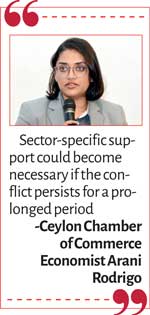
However, Rodrigo noted that businesses were not yet seeking broad-based assistance, although sector-specific support could become necessary if the conflict persists for a prolonged period.
The panel also highlighted the need for stronger evidence-based policymaking and independent economic analysis.
Prof. Dayaratne criticised what he described as “populist gossip” dominating policy discussions and argued that economists and professional bodies needed to challenge ideology-driven policymaking through technical and data-driven analysis.
“We need good economics to challenge ideology-driven policy,” he said.
Engaging Q&A
During the audience Q&A session conducted by Gamani Corea Foundation Chairperson Dr. Harsha Aturupane that followed, Dr. Amarasekara elaborated further on the Central Bank’s policy stance, reserve management strategy and concerns surrounding future economic shocks.
Responding to concerns raised by participants regarding Sri Lanka’s lack of strategic reserves and vulnerability to external disruptions, Amarasekara acknowledged that the country remained exposed to repeated shocks and said rebuilding buffers would take time.
“What we have to understand is that we are recovering from a very deep economic crisis,” he said.
“At that stage, it is very difficult to build huge buffers. It has to be done gradually.”
He said official reserves were critical both as a confidence signal and as a policy tool during crises.
However, Dr. Amarasekara noted that rebuilding reserves remained difficult because new global disruptions continued to emerge before targets could be reached.
“We build reserves and before we even get to the target, there is another shock, another shock and another shock,” he said.
Responding to questions on inflation targeting amid rising oil prices and supply chain disruptions, Amarasekara defended the Central Bank’s decision not to loosen monetary policy aggressively during the recent low inflation period.
He said the Central Bank had faced pressure to inject additional stimulus when inflation was below target, but policymakers resisted because economic activity and private sector credit growth were already recovering strongly.
“We were under pressure when inflation was below target to relax monetary policy so that we hit that inflation target of 5%,” he said.
“But we did not do that because we saw the economy was doing well.”
Dr. Amarasekara said policymakers understood that favourable oil prices and weather conditions represented temporary supply-side developments that could reverse quickly.
“If by any chance we were already at the 5% inflation target, where would inflation be today?” he asked.
He added that the Central Bank was currently in the middle of a monetary policy cycle and would announce its latest stance together with a detailed policy assessment at the end of the month.
On the widening trade deficit and depreciation of the rupee, Dr. Amarasekara said Sri Lanka had removed most import controls by 2025 as the economy recovered.
“If we have the money, should the Government tell you what to import and what not to import?” he asked.
He reiterated that Sri Lanka now operated under a flexible exchange rate regime and said the Central Bank intervened only to address excessive volatility rather than defend a specific exchange rate.
“We do not intervene to hit a certain rate,” he said.
Dr. Amarasekara also said authorities were not overly concerned about the trade deficit because Sri Lanka had recorded strong current account performances over the previous three years.
“We have seen three very good years,” he said.
Renewables, inclusive growth
Addressing a question related to solar energy approvals and renewable energy expansion, Manjula de Silva said inadequate storage capacity remained one of the key constraints.
He said solar generation was concentrated during daytime hours when electricity demand was relatively low, creating pressure on grid stability.
“The answer to that is developing storage capacity,” he said.
Questions were also raised regarding unpaid care work performed by women and the absence of broader social security protections.
Dr. Amarasekara acknowledged criticisms surrounding GDP as a measure of economic activity and noted that unpaid labour was not fully reflected within standard national accounting frameworks.
“GDP is just one way to think about how a country’s economy is evolving,” he said.
He noted that GDP estimates were compiled by the Department of Census and Statistics using internationally accepted methodologies under the System of National Accounts.
However, Dr. Amarasekara agreed that unpaid care work contributed significantly to the economy.
On social security, he said Sri Lanka needed a nationwide contributory pension and social protection system that would allow workers to retain retirement benefits across different jobs and sectors.
“The country needs it,” he said.
Excessing lending rates
Responding to another question on the expansion of pawning and gold-backed lending, Dr. Amarasekara said growth in credit extended by non-bank financial institutions in 2025 had been driven significantly by leasing and pawning-related lending.
He said the increase in gold prices had raised the value of gold-backed assets, benefiting those holding such assets, although questions remained regarding the broader implications for poorer households relying on pawning.
Amarasekara also addressed concerns over profitability in the financial sector following a question on lending institutions recording double-digit margins.
He said average net interest margins in the banking sector remained around 4%, compared with significantly higher margins in the non-bank financial sector.
“On average, it’s around 4% in the banking sector,” he said, adding that the Central Bank was monitoring some of these developments closely and had already initiated market conduct supervision.
“Our officers are going to financial institutions for market conduct supervision so that savers as well as borrowers get a better deal from financial institutions,” he said.
Dr. Amarasekara also highlighted reforms introduced under the IMF-supported program to address corruption vulnerabilities, which he described as macro-critical issues for Sri Lanka.
He said measures such as the Anti-Corruption Act, operationalisation of the Anti-Corruption Commission and establishment of a beneficial ownership register were already underway.
In response to another question, Amarasekara revealed that the Central Bank had begun collecting gender-disaggregated data from banks.
“Good news, we have started collecting it,” he said, adding that the information would eventually be published after validation.
He also defended increased scrutiny of welfare targeting, arguing that taxpayers were now more conscious about how subsidies were distributed following the crisis.
“In the past, no one really cared who got the subsidies because no one was paying for it,” he said.
“But now taxpayers are paying the price.”
The seminar ultimately reflected a growing consensus among economists, policymakers and businesses that Sri Lanka’s recovery remains fragile, and that preserving reform momentum, rebuilding buffers and accelerating export- and investment-led growth will determine whether the country can withstand the next global shock without relapsing into crisis.




