Sunday Oct 11, 2026
Sunday Oct 11, 2026
Saturday, 21 March 2026 00:00 - - {{hitsCtrl.values.hits}}
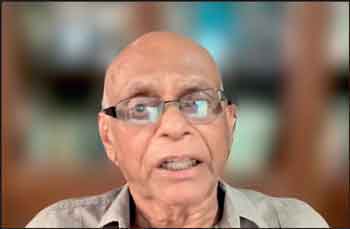 |
| Dr. W.A. Wijewardena |
Former Central Bank Deputy Governor Dr. W.A. Wijewardena has warned that Sri Lanka is entering a more vulnerable phase where Government debt sustainability, interest rate dynamics and growth prospects are increasingly exposed to external shocks, particularly from the ongoing Middle East conflict.
He said Sri Lanka’s fiscal and external financing model remains heavily dependent on continuous borrowing and refinancing, making it sensitive to shifts in interest rates, liquidity and growth.
“Sri Lanka is also operating with a very large credit card. If it cannot pay the credit balance, the family will find that it cannot use this credit card anymore,” he said, drawing a parallel between Government financing and a household dependent on revolving credit.
Dr. Wijewardena, speaking at a webinar hosted by the Institute of Certified Management Accountants of Sri Lanka (CMA), explained that the Government’s ability to service interest payments from current revenue remains intact, but the rollover of maturing debt depends on market conditions and investor appetite. If domestic liquidity tightens or external financing conditions weaken, refinancing capacity could become constrained.
He said this risk is heightened by the possibility of rising interest rates, which would increase borrowing costs and reduce the Government’s ability to issue new debt at current yields.
“If the inflation rate rises above the Central Bank’s upper bound, it will have to take restrictive monetary policies. Interest rates will have to be increased and as a result, the Government’s honeymoon of low interest rates will be over. I think this situation is the biggest challenge for the Central Bank,” he said.
Dr. Wijewardena noted that the Central Bank of Sri Lanka (CBSL), which operates under an inflation target of 5% with a band of 2% to 7%, is currently below the lower bound following a sharp disinflation from around 70% in 2023 to near zero levels.
He said the present external shock could push inflation back into the target range in the short term without policy action, but warned that the risk lies in overshooting the upper bound, which would compel the Central Bank to tighten monetary policy.
Such tightening would transmit directly into higher Government borrowing costs, altering the current low interest rate environment that has supported fiscal financing.
Dr. Wijewardena also highlighted the interaction between monetary and fiscal policy, noting that the Central Bank cannot on its own sustain higher inflation within target without complementary fiscal expansion. However, fiscal space remains constrained, limiting policy coordination.
He said the broader macroeconomic risk is the emergence of stagflation, where rising prices coincide with slowing or negative growth.
“The stagflation will lead to high unemployment… poverty levels will go up and it will also lead to social calamity as well,” he said.
Dr. Wijewardena pointed out that growth could weaken due to supply constraints affecting key imports required for production and consumption, while price pressures build from higher input costs.
He also warned of pressure on the exchange rate, driven by rising inflation, weakening foreign exchange inflows and the need to maintain balance of payments stability.
“With regard to the exchange rate… we know the direction will be downward direction,” he said, indicating a likely depreciation trend in the short to medium term.
On the external side, he said Sri Lanka faces a dual financing challenge. The country must continue to refinance maturing external debt while also funding current account pressures, both of which depend on access to foreign borrowing.
He cautioned that global conditions linked to the conflict could reduce liquidity and limit Sri Lanka’s ability to raise funds externally, particularly if global growth slows.
Dr. Wijewardena said the combined effect of tighter financing conditions, higher interest rates, exchange rate pressure and weaker growth points to a more constrained macroeconomic environment.
He identified rising energy costs as a key transmission channel, noting that higher oil prices will increase the import bill and widen external imbalances, adding further pressure on both fiscal and external accounts.
He described the situation as an externally driven shock and said policy responses will require adjustment across fiscal, monetary and external sectors, with limited room for policy error.




